New Zealand Foam Market Top 5 Importing Countries and Market Competition (HHI) Analysis
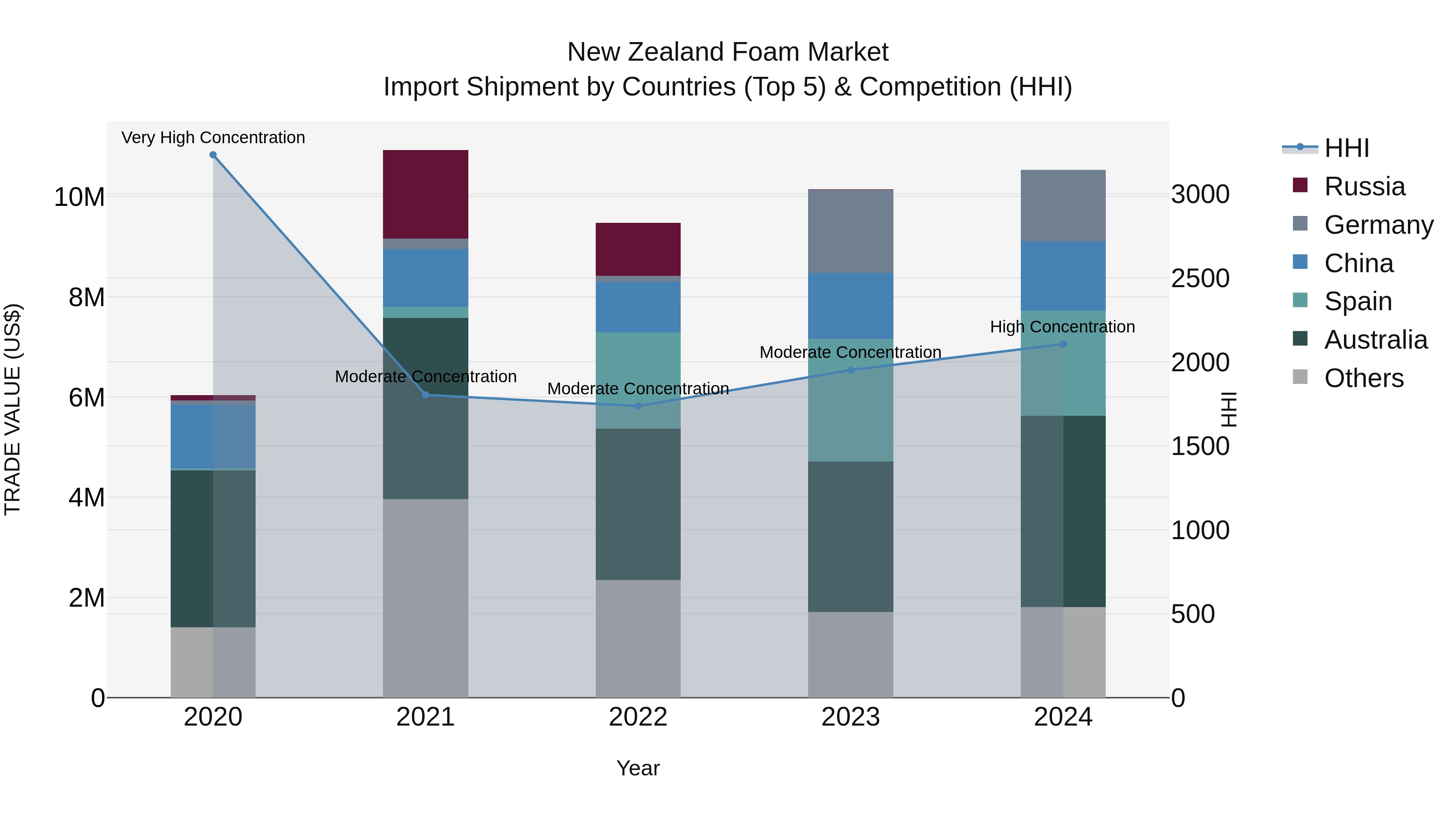
The New Zealand foam import market experienced a significant increase in concentration levels in 2024, with top exporting countries being Australia, Spain, Germany, China, and the USA. The industry`s Compound Annual Growth Rate (CAGR) from 2020 to 2024 stood at an impressive 14.94%, showcasing robust growth. Moreover, the growth rate from 2023 to 2024 was recorded at 3.86%, indicating sustained momentum in the market. This data suggests a dynamic and competitive landscape for foam imports in New Zealand, driven by a diverse range of international suppliers.
Key Highlights of the Report:
- New Zealand Foam Market Outlook
- Market Size of New Zealand Foam Market, 2025
- Forecast of New Zealand Foam Market, 2032
- Historical Data and Forecast of New Zealand Foam Revenues & Volume for the Period 2022 - 2032F
- New Zealand Foam Market Trend Evolution
- New Zealand Foam Market Drivers and Challenges
- New Zealand Foam Price Trends
- New Zealand Foam Porter`s Five Forces
- New Zealand Foam Industry Life Cycle
- Historical Data and Forecast of New Zealand Foam Market Revenues & Volume By Type for the Period 2022 - 2032F
- Historical Data and Forecast of New Zealand Foam Market Revenues & Volume By Flexible Foam for the Period 2022 - 2032F
- Historical Data and Forecast of New Zealand Foam Market Revenues & Volume By Rigid Foam for the Period 2022 - 2032F
- Historical Data and Forecast of New Zealand Foam Market Revenues & Volume By Foam Type for the Period 2022 - 2032F
- Historical Data and Forecast of New Zealand Foam Market Revenues & Volume By Polyurethane for the Period 2022 - 2032F
- Historical Data and Forecast of New Zealand Foam Market Revenues & Volume By Polystyrene for the Period 2022 - 2032F
- Historical Data and Forecast of New Zealand Foam Market Revenues & Volume By Polyolefin for the Period 2022 - 2032F
- Historical Data and Forecast of New Zealand Foam Market Revenues & Volume By Phenolic for the Period 2022 - 2032F
- Historical Data and Forecast of New Zealand Foam Market Revenues & Volume By PET for the Period 2022 - 2032F
- Historical Data and Forecast of New Zealand Foam Market Revenues & Volume By Others for the Period 2022 - 2032F
- Historical Data and Forecast of New Zealand Foam Market Revenues & Volume By End-use Industry for the Period 2022 - 2032F
- Historical Data and Forecast of New Zealand Foam Market Revenues & Volume By Building & Construction for the Period 2022 - 2032F
- Historical Data and Forecast of New Zealand Foam Market Revenues & Volume By Packaging for the Period 2022 - 2032F
- Historical Data and Forecast of New Zealand Foam Market Revenues & Volume By Automotive for the Period 2022 - 2032F
- Historical Data and Forecast of New Zealand Foam Market Revenues & Volume By Furniture & Bedding for the Period 2022 - 2032F
- Historical Data and Forecast of New Zealand Foam Market Revenues & Volume By Footwear, Sports, & Recreational for the Period 2022 - 2032F
- Historical Data and Forecast of New Zealand Foam Market Revenues & Volume By Others for the Period 2022 - 2032F
- New Zealand Foam Import Export Trade Statistics
- Market Opportunity Assessment By Type
- Market Opportunity Assessment By Foam Type
- Market Opportunity Assessment By End-use Industry
- New Zealand Foam Top Companies Market Share
- New Zealand Foam Competitive Benchmarking By Technical and Operational Parameters
- New Zealand Foam Company Profiles
- New Zealand Foam Key Strategic Recommendations






































