New Zealand Fragrance Market Year-wise Growth Rate (2021-2031F)
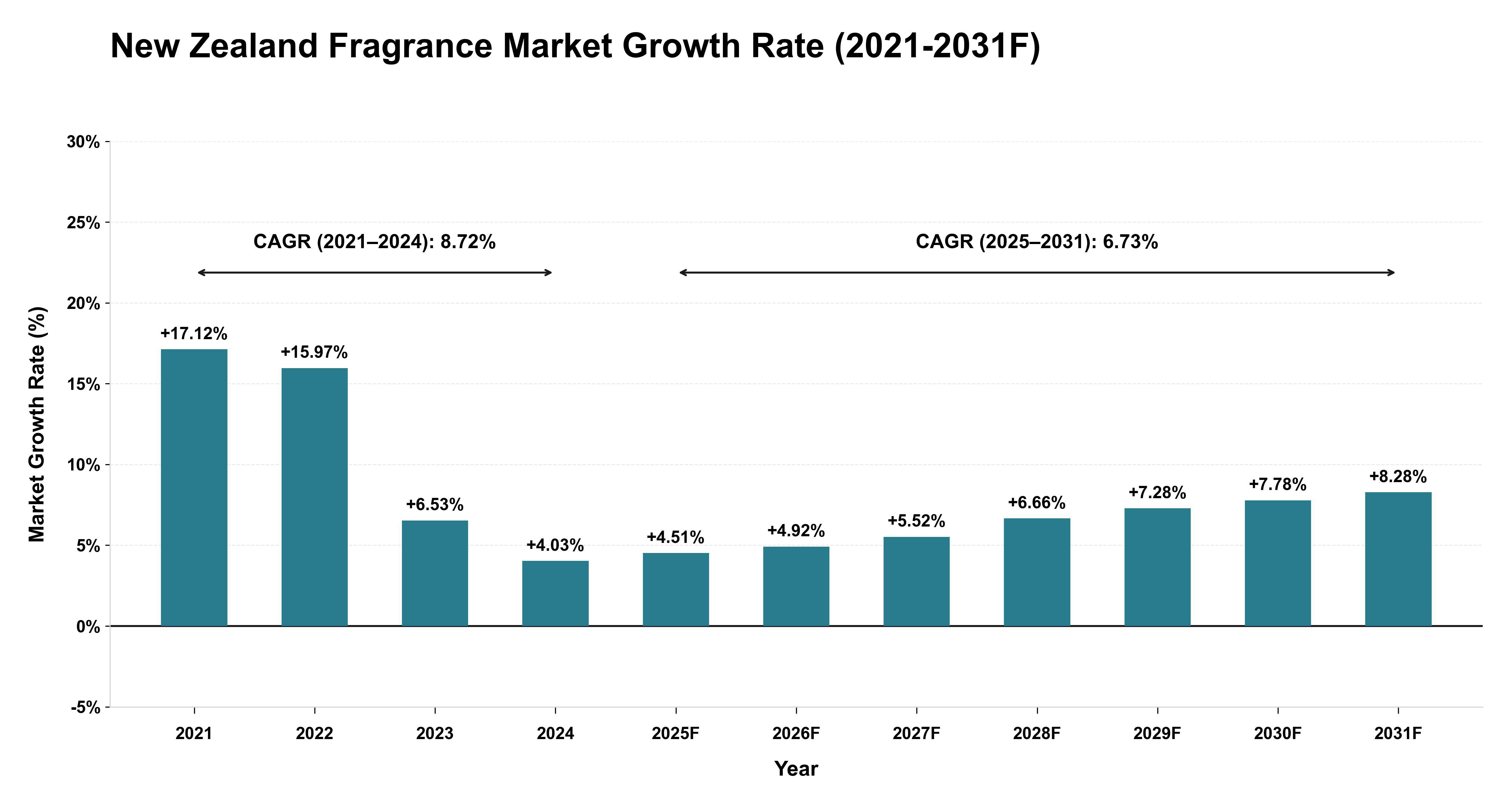
The New Zealand Fragrance Market witnessed robust growth from 2021 to 2024, with a significant CAGR of 8.72%. The period was characterized by accelerating demand driven by rising disposable incomes, shifting consumer preferences towards premium fragrances, and increased product innovation. However, in 2023 and 2024, the market experienced a slight deceleration due to supply chain disruptions and regulatory challenges. Looking ahead to 2025-2031, the market is forecasted to maintain a healthy growth trajectory with a CAGR of 6.73%. This period is expected to see a rebound in growth supported by technological advancements in fragrance production, evolving consumer trends towards sustainable and natural products, and expanding export opportunities. The gradual increase in growth rates throughout the forecast period indicates a maturing market adapting to changing dynamics while maintaining steady expansion.
Key Highlights of the Report:
- New Zealand Fragrance Market Outlook
- Market Size of New Zealand Fragrance Market, 2025
- Forecast of New Zealand Fragrance Market, 2032
- Historical Data and Forecast of New Zealand Fragrance Revenues & Volume for the Period 2022 - 2032
- New Zealand Fragrance Market Trend Evolution
- New Zealand Fragrance Market Drivers and Challenges
- New Zealand Fragrance Price Trends
- New Zealand Fragrance Porter's Five Forces
- New Zealand Fragrance Industry Life Cycle
- Historical Data and Forecast of New Zealand Fragrance Market Revenues & Volume By Product Type for the Period 2022 - 2032
- Historical Data and Forecast of New Zealand Fragrance Market Revenues & Volume By Deodorants for the Period 2022 - 2032
- Historical Data and Forecast of New Zealand Fragrance Market Revenues & Volume By Perfumes for the Period 2022 - 2032
- Historical Data and Forecast of New Zealand Fragrance Market Revenues & Volume By Others for the Period 2022 - 2032
- Historical Data and Forecast of New Zealand Fragrance Market Revenues & Volume By Application for the Period 2022 - 2032
- Historical Data and Forecast of New Zealand Fragrance Market Revenues & Volume By Personal Care for the Period 2022 - 2032
- Historical Data and Forecast of New Zealand Fragrance Market Revenues & Volume By Household Care for the Period 2022 - 2032
- Historical Data and Forecast of New Zealand Fragrance Market Revenues & Volume By Others for the Period 2022 - 2032
- Historical Data and Forecast of New Zealand Fragrance Market Revenues & Volume By Distribution Channel for the Period 2022 - 2032
- Historical Data and Forecast of New Zealand Fragrance Market Revenues & Volume By Offline for the Period 2022 - 2032
- Historical Data and Forecast of New Zealand Fragrance Market Revenues & Volume By Online for the Period 2022 - 2032
- New Zealand Fragrance Import Export Trade Statistics
- Market Opportunity Assessment By Product Type
- Market Opportunity Assessment By Application
- Market Opportunity Assessment By Distribution Channel
- New Zealand Fragrance Top Companies Market Share
- New Zealand Fragrance Competitive Benchmarking By Technical and Operational Parameters
- New Zealand Fragrance Company Profiles
- New Zealand Fragrance Key Strategic Recommendations






































