New Zealand Greenhouse Horticulture Market Top 5 Importing Countries and Market Competition (HHI) Analysis
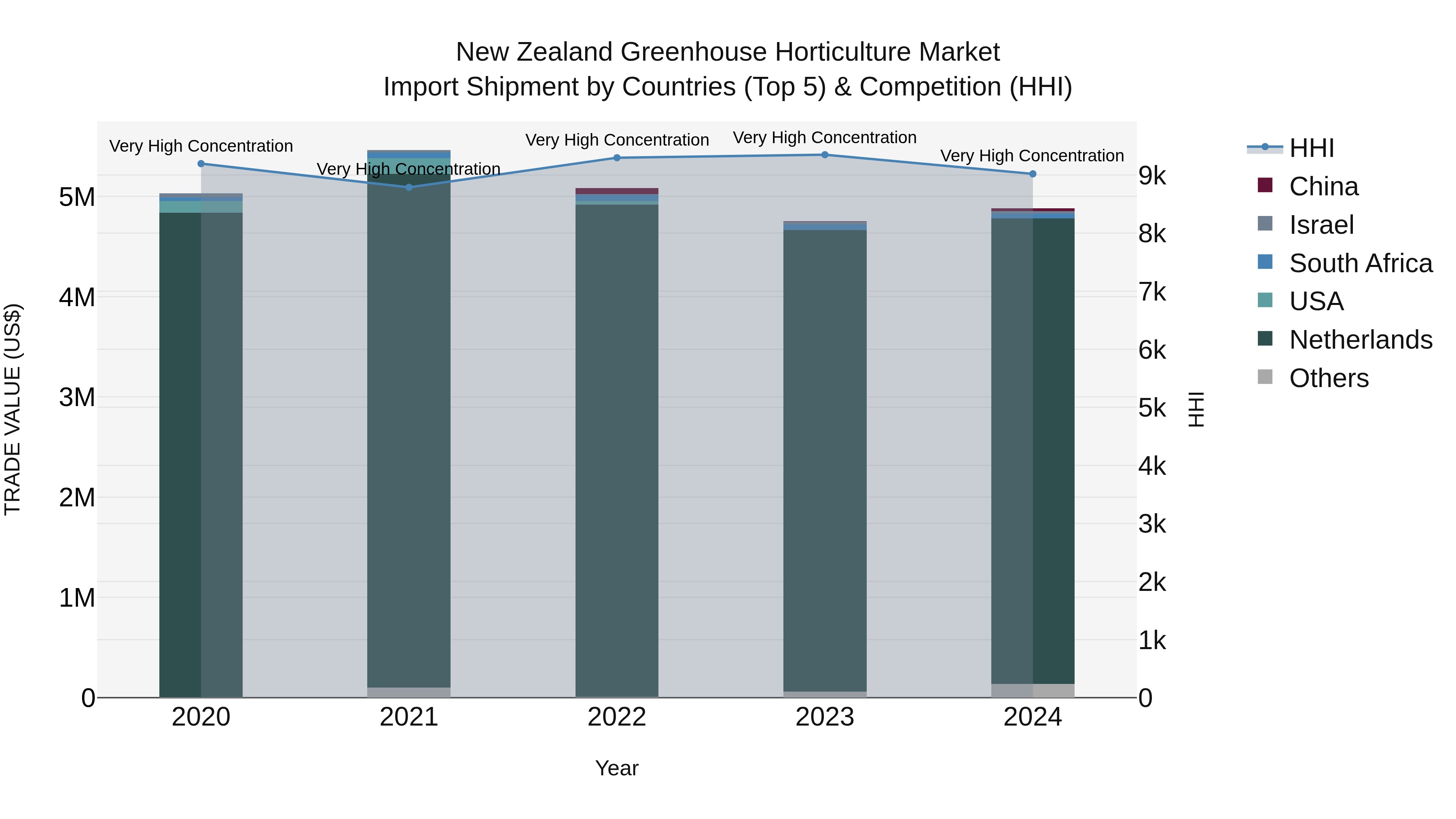
The greenhouse horticulture import shipments in New Zealand in 2024 continued to show a high level of concentration, with the top exporting countries being Netherlands, Niger, South Africa, Metropolitan France, and Israel. Despite a slight decline in the compound annual growth rate (CAGR) from 2020-2024, there was a positive growth rate of 2.72% from 2023-2024. This indicates a stable market with key players maintaining their dominance in supplying greenhouse products to New Zealand. The diverse range of exporting countries highlights the global reach of New Zealand`s greenhouse horticulture sector.
Key Highlights of the Report:
- New Zealand Greenhouse Horticulture Market Outlook
- Market Size of New Zealand Greenhouse Horticulture Market, 2025
- Forecast of New Zealand Greenhouse Horticulture Market, 2032
- Historical Data and Forecast of New Zealand Greenhouse Horticulture Revenues & Volume for the Period 2022 - 2032F
- New Zealand Greenhouse Horticulture Market Trend Evolution
- New Zealand Greenhouse Horticulture Market Drivers and Challenges
- New Zealand Greenhouse Horticulture Price Trends
- New Zealand Greenhouse Horticulture Porter`s Five Forces
- New Zealand Greenhouse Horticulture Industry Life Cycle
- Historical Data and Forecast of New Zealand Greenhouse Horticulture Market Revenues & Volume By Material Type for the Period 2022 - 2032F
- Historical Data and Forecast of New Zealand Greenhouse Horticulture Market Revenues & Volume By Glass for the Period 2022 - 2032F
- Historical Data and Forecast of New Zealand Greenhouse Horticulture Market Revenues & Volume By Plastic for the Period 2022 - 2032F
- Historical Data and Forecast of New Zealand Greenhouse Horticulture Market Revenues & Volume By Crop Type for the Period 2022 - 2032F
- Historical Data and Forecast of New Zealand Greenhouse Horticulture Market Revenues & Volume By Fruits and Vegetables for the Period 2022 - 2032F
- Historical Data and Forecast of New Zealand Greenhouse Horticulture Market Revenues & Volume By Flowers and Ornamentals for the Period 2022 - 2032F
- Historical Data and Forecast of New Zealand Greenhouse Horticulture Market Revenues & Volume By Nursery Crops for the Period 2022 - 2032F
- Historical Data and Forecast of New Zealand Greenhouse Horticulture Market Revenues & Volume By Others for the Period 2022 - 2032F
- Historical Data and Forecast of New Zealand Greenhouse Horticulture Market Revenues & Volume By Technology for the Period 2022 - 2032F
- Historical Data and Forecast of New Zealand Greenhouse Horticulture Market Revenues & Volume By Heating System for the Period 2022 - 2032F
- Historical Data and Forecast of New Zealand Greenhouse Horticulture Market Revenues & Volume By Cooling System for the Period 2022 - 2032F
- New Zealand Greenhouse Horticulture Import Export Trade Statistics
- Market Opportunity Assessment By Material Type
- Market Opportunity Assessment By Crop Type
- Market Opportunity Assessment By Technology
- New Zealand Greenhouse Horticulture Top Companies Market Share
- New Zealand Greenhouse Horticulture Competitive Benchmarking By Technical and Operational Parameters
- New Zealand Greenhouse Horticulture Company Profiles
- New Zealand Greenhouse Horticulture Key Strategic Recommendations






































