New Zealand Industrial Drums Market Top 5 Importing Countries and Market Competition (HHI) Analysis
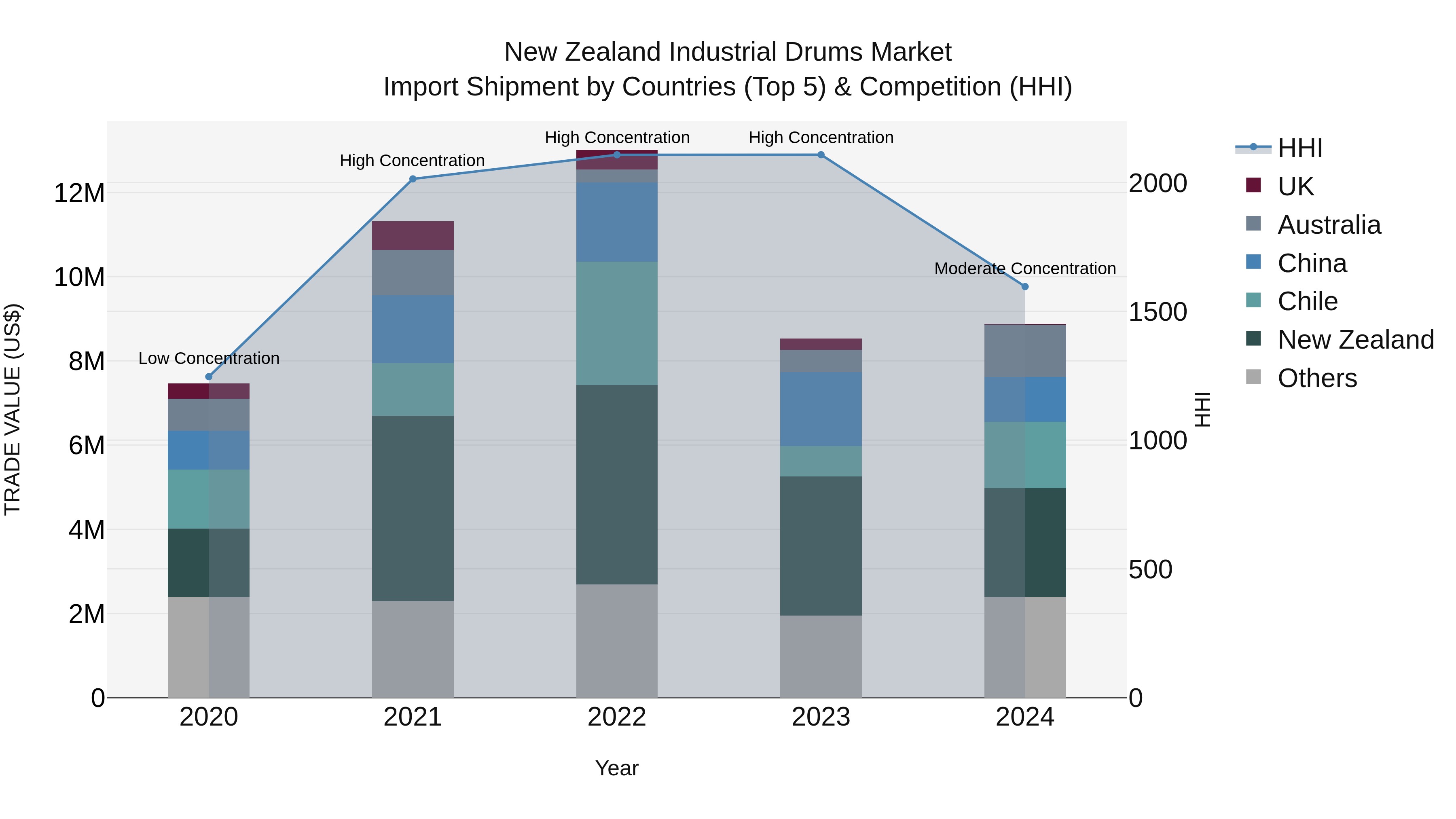
New Zealand`s industrial drums import market saw a shift in concentration levels from high to moderate in 2024, reflecting a more diverse range of exporting countries including New Zealand, Chile, Australia, China, and Taiwan. The consistent CAGR of 4.43% from 2020 to 2024 indicates steady growth, with a notable 4.07% increase in import shipments between 2023 and 2024. This suggests a positive outlook for the industry, as New Zealand continues to strengthen its trade relationships with key exporting nations in the industrial drums sector.
Key Highlights of the Report:
- New Zealand Industrial Drums Market Outlook
- Market Size of New Zealand Industrial Drums Market, 2025
- Forecast of New Zealand Industrial Drums Market, 2032
- Historical Data and Forecast of New Zealand Industrial Drums Revenues & Volume for the Period 2022 - 2032F
- New Zealand Industrial Drums Market Trend Evolution
- New Zealand Industrial Drums Market Drivers and Challenges
- New Zealand Industrial Drums Price Trends
- New Zealand Industrial Drums Porter`s Five Forces
- New Zealand Industrial Drums Industry Life Cycle
- Historical Data and Forecast of New Zealand Industrial Drums Market Revenues & Volume By Product Type for the Period 2022 - 2032F
- Historical Data and Forecast of New Zealand Industrial Drums Market Revenues & Volume By Steel Drum for the Period 2022 - 2032F
- Historical Data and Forecast of New Zealand Industrial Drums Market Revenues & Volume By Plastic Drum for the Period 2022 - 2032F
- Historical Data and Forecast of New Zealand Industrial Drums Market Revenues & Volume By Fiber Drum for the Period 2022 - 2032F
- Historical Data and Forecast of New Zealand Industrial Drums Market Revenues & Volume By Capacity for the Period 2022 - 2032F
- Historical Data and Forecast of New Zealand Industrial Drums Market Revenues & Volume By Up to 100 Liter for the Period 2022 - 2032F
- Historical Data and Forecast of New Zealand Industrial Drums Market Revenues & Volume By 100 to 250 Liter for the Period 2022 - 2032F
- Historical Data and Forecast of New Zealand Industrial Drums Market Revenues & Volume By 250 to 500 Liter for the Period 2022 - 2032F
- Historical Data and Forecast of New Zealand Industrial Drums Market Revenues & Volume By Above 500 Liter for the Period 2022 - 2032F
- Historical Data and Forecast of New Zealand Industrial Drums Market Revenues & Volume By End Use for the Period 2022 - 2032F
- Historical Data and Forecast of New Zealand Industrial Drums Market Revenues & Volume By Food & Beverages for the Period 2022 - 2032F
- Historical Data and Forecast of New Zealand Industrial Drums Market Revenues & Volume By Chemical & Fertilizers for the Period 2022 - 2032F
- Historical Data and Forecast of New Zealand Industrial Drums Market Revenues & Volume By Pharmaceuticals for the Period 2022 - 2032F
- Historical Data and Forecast of New Zealand Industrial Drums Market Revenues & Volume By Petroleum & Lubricants for the Period 2022 - 2032F
- Historical Data and Forecast of New Zealand Industrial Drums Market Revenues & Volume By Building & Construction for the Period 2022 - 2032F
- Historical Data and Forecast of New Zealand Industrial Drums Market Revenues & Volume By Paints, Inks, & Dyes for the Period 2022 - 2032F
- Historical Data and Forecast of New Zealand Industrial Drums Market Revenues & Volume By Other End Uses for the Period 2022 - 2032F
- New Zealand Industrial Drums Import Export Trade Statistics
- Market Opportunity Assessment By Product Type
- Market Opportunity Assessment By Capacity
- Market Opportunity Assessment By End Use
- New Zealand Industrial Drums Top Companies Market Share
- New Zealand Industrial Drums Competitive Benchmarking By Technical and Operational Parameters
- New Zealand Industrial Drums Company Profiles
- New Zealand Industrial Drums Key Strategic Recommendations






































