New Zealand Lead Alloy Market Growth Rate Analysis (2025 - 2031)
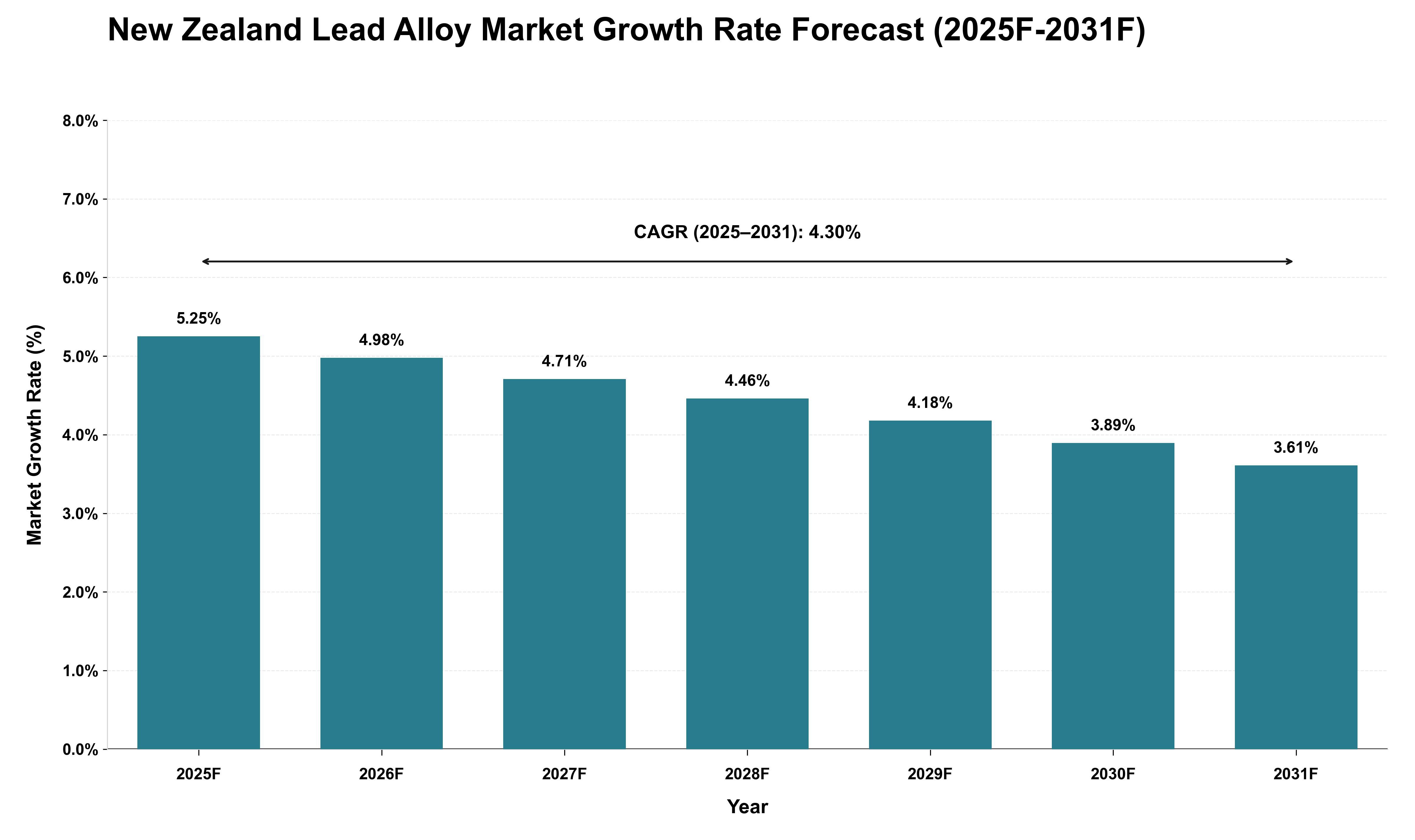
From 2025 onward, the New Zealand lead alloy market will likely experience a steady growth trajectory, driven by macroeconomic factors such as industrial demand and infrastructure investments. The projected compound annual growth rate (CAGR) of 4.30% reflects a robust underlying economic environment, where the initial surge of 5.25% in 2025 may be attributed to increased manufacturing activities and heightened demand from sectors like automotive and construction. As the forecast progresses, growth rates are expected to gradually decline, indicating a potential normalization phase influenced by cyclical trends in global commodity markets and import dependencies. The anticipated fluctuations in annual growth—from 5.25% down to 3.61%—will mirror broader economic cycles, where external factors such as trade policies and supply chain dynamics will play critical roles in shaping market conditions for lead alloys through 2031.
Key Highlights of the Report:
- New Zealand Lead Alloy Market Outlook
- Market Size of New Zealand Lead Alloy Market, 2024
- Forecast of New Zealand Lead Alloy Market, 2031
- Historical Data and Forecast of New Zealand Lead Alloy Revenues & Volume for the Period 2021-2031
- New Zealand Lead Alloy Market Trend Evolution
- New Zealand Lead Alloy Market Drivers and Challenges
- New Zealand Lead Alloy Price Trends
- New Zealand Lead Alloy Porter`s Five Forces
- New Zealand Lead Alloy Industry Life Cycle
- Historical Data and Forecast of New Zealand Lead Alloy Market Revenues & Volume By Type for the Period 2021-2031
- Historical Data and Forecast of New Zealand Lead Alloy Market Revenues & Volume By Lead Antimony Alloys for the Period 2021-2031
- Historical Data and Forecast of New Zealand Lead Alloy Market Revenues & Volume By Lead Tin Alloys for the Period 2021-2031
- Historical Data and Forecast of New Zealand Lead Alloy Market Revenues & Volume By Lead Arsenic Alloys for the Period 2021-2031
- Historical Data and Forecast of New Zealand Lead Alloy Market Revenues & Volume By Lead Calcium Alloys for the Period 2021-2031
- Historical Data and Forecast of New Zealand Lead Alloy Market Revenues & Volume By Others for the Period 2021-2031
- Historical Data and Forecast of New Zealand Lead Alloy Market Revenues & Volume By Application for the Period 2021-2031
- Historical Data and Forecast of New Zealand Lead Alloy Market Revenues & Volume By Battery Grids for the Period 2021-2031
- Historical Data and Forecast of New Zealand Lead Alloy Market Revenues & Volume By Metals for the Period 2021-2031
- Historical Data and Forecast of New Zealand Lead Alloy Market Revenues & Volume By Cable Sheathing for the Period 2021-2031
- Historical Data and Forecast of New Zealand Lead Alloy Market Revenues & Volume By Lead Sheet for the Period 2021-2031
- Historical Data and Forecast of New Zealand Lead Alloy Market Revenues & Volume By Seamless Pipe for the Period 2021-2031
- Historical Data and Forecast of New Zealand Lead Alloy Market Revenues & Volume By Others for the Period 2021-2031
- New Zealand Lead Alloy Import Export Trade Statistics
- Market Opportunity Assessment By Type
- Market Opportunity Assessment By Application
- New Zealand Lead Alloy Top Companies Market Share
- New Zealand Lead Alloy Competitive Benchmarking By Technical and Operational Parameters
- New Zealand Lead Alloy Company Profiles
- New Zealand Lead Alloy Key Strategic Recommendations






































