New Zealand Lipsticks Market Top 5 Importing Countries and Market Competition (HHI) Analysis
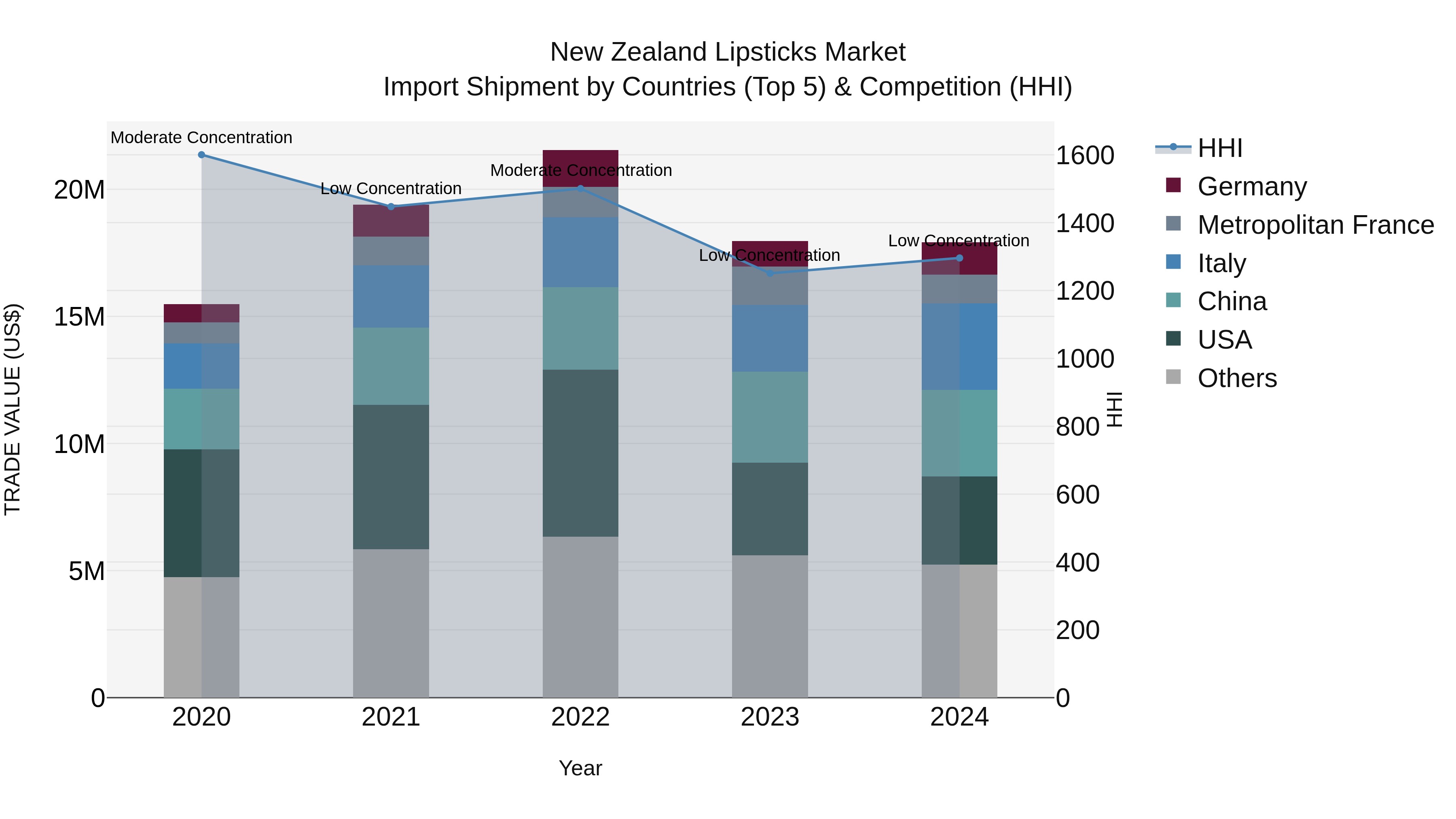
The New Zealand lipstick market continues to see steady growth with a CAGR of 3.72% from 2020 to 2024. Despite a slight decline in growth rate from 2023 to 2024 (-0.2%), the market remains resilient. The top countries exporting lipsticks to New Zealand in 2024 are the USA, China, Italy, Germany, and Australia, indicating a diverse import market. With a low concentration level measured by the Herfindahl-Hirschman Index (HHI), the market remains competitive, offering consumers a wide variety of options from different countries.
Key Highlights of the Report:
- New Zealand Lipsticks Market Outlook
- Market Size of New Zealand Lipsticks Market, 2025
- Forecast of New Zealand Lipsticks Market, 2032
- Historical Data and Forecast of New Zealand Lipsticks Revenues & Volume for the Period 2022 - 2032F
- New Zealand Lipsticks Market Trend Evolution
- New Zealand Lipsticks Market Drivers and Challenges
- New Zealand Lipsticks Price Trends
- New Zealand Lipsticks Porter`s Five Forces
- New Zealand Lipsticks Industry Life Cycle
- Historical Data and Forecast of New Zealand Lipsticks Market Revenues & Volume By Product Type for the Period 2022 - 2032F
- Historical Data and Forecast of New Zealand Lipsticks Market Revenues & Volume By Shimmer? for the Period 2022 - 2032F
- Historical Data and Forecast of New Zealand Lipsticks Market Revenues & Volume By Matte? for the Period 2022 - 2032F
- Historical Data and Forecast of New Zealand Lipsticks Market Revenues & Volume By Cream for the Period 2022 - 2032F
- Historical Data and Forecast of New Zealand Lipsticks Market Revenues & Volume By Longwearing for the Period 2022 - 2032F
- Historical Data and Forecast of New Zealand Lipsticks Market Revenues & Volume By Applicator for the Period 2022 - 2032F
- Historical Data and Forecast of New Zealand Lipsticks Market Revenues & Volume By Palette for the Period 2022 - 2032F
- Historical Data and Forecast of New Zealand Lipsticks Market Revenues & Volume By Pencil for the Period 2022 - 2032F
- Historical Data and Forecast of New Zealand Lipsticks Market Revenues & Volume By Tube/stick for the Period 2022 - 2032F
- Historical Data and Forecast of New Zealand Lipsticks Market Revenues & Volume By Liquid for the Period 2022 - 2032F
- Historical Data and Forecast of New Zealand Lipsticks Market Revenues & Volume By Age for the Period 2022 - 2032F
- Historical Data and Forecast of New Zealand Lipsticks Market Revenues & Volume By Under 20 for the Period 2022 - 2032F
- Historical Data and Forecast of New Zealand Lipsticks Market Revenues & Volume By 20 - 30 for the Period 2022 - 2032F
- Historical Data and Forecast of New Zealand Lipsticks Market Revenues & Volume By 31 - 50 for the Period 2022 - 2032F
- Historical Data and Forecast of New Zealand Lipsticks Market Revenues & Volume By Over 50 for the Period 2022 - 2032F
- Historical Data and Forecast of New Zealand Lipsticks Market Revenues & Volume By Distribution Channel for the Period 2022 - 2032F
- Historical Data and Forecast of New Zealand Lipsticks Market Revenues & Volume By Offline for the Period 2022 - 2032F
- Historical Data and Forecast of New Zealand Lipsticks Market Revenues & Volume By Online for the Period 2022 - 2032F
- New Zealand Lipsticks Import Export Trade Statistics
- Market Opportunity Assessment By Product Type
- Market Opportunity Assessment By Applicator
- Market Opportunity Assessment By Age
- Market Opportunity Assessment By Distribution Channel
- New Zealand Lipsticks Top Companies Market Share
- New Zealand Lipsticks Competitive Benchmarking By Technical and Operational Parameters
- New Zealand Lipsticks Company Profiles
- New Zealand Lipsticks Key Strategic Recommendations






































