New Zealand Lithium Compounds Market Top 5 Importing Countries and Market Competition (HHI) Analysis
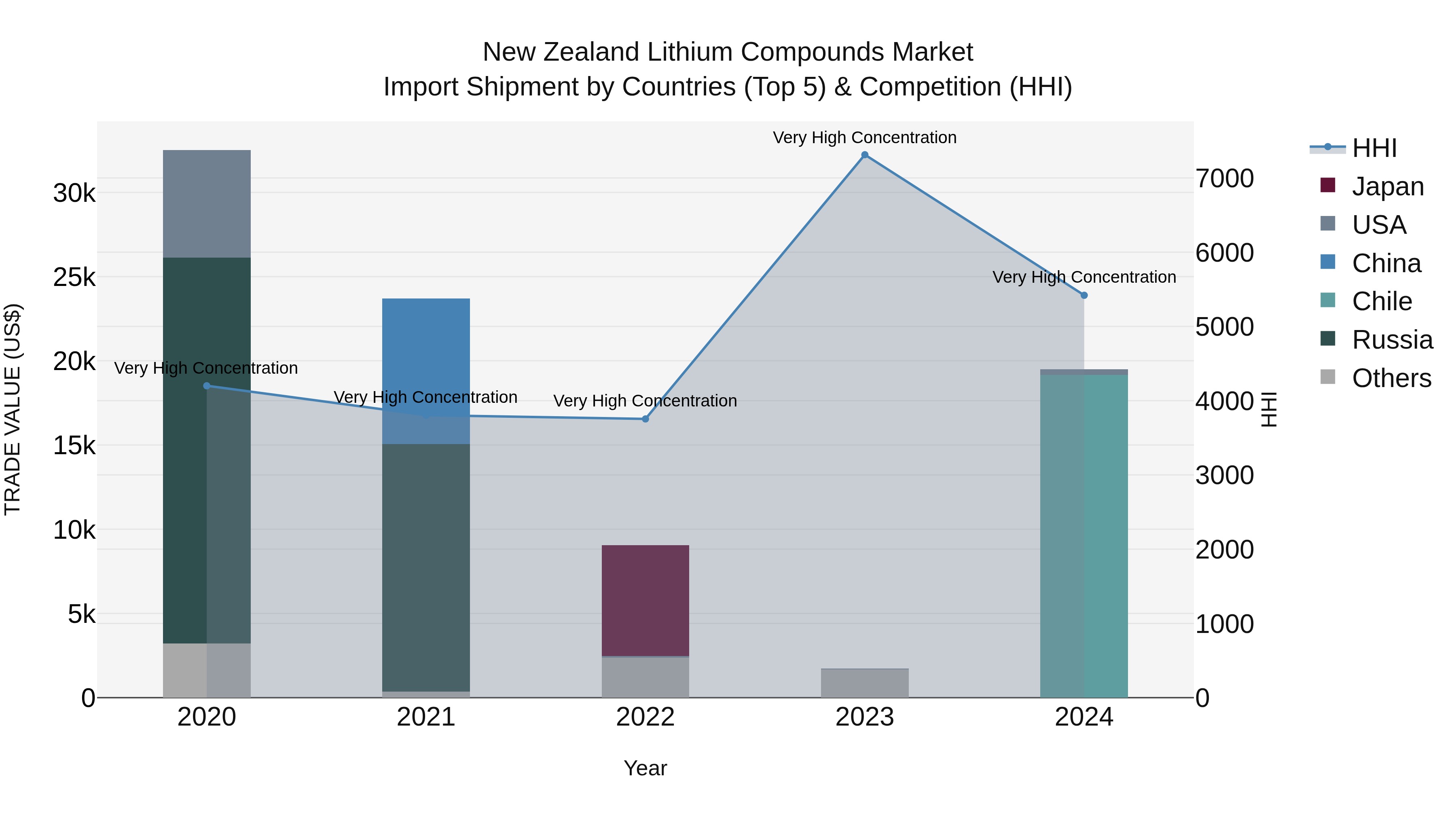
New Zealand`s lithium compounds import market in 2024 continued to be dominated by key suppliers from Chile, USA, China, Australia, and India, reflecting a high concentration level. Despite a negative CAGR of -12.0% from 2020 to 2024, the market showed a remarkable growth rate of 1020.42% from 2023 to 2024. This rapid growth highlights the evolving demand dynamics and potential opportunities for market players to capitalize on the shifting landscape in the New Zealand lithium compounds import sector.
New Zealand Lithium Compounds Market Overview
The market for lithium compounds in New Zealand includes products like lithium hydroxide, lithium chloride, and lithium fluoride. These compounds are critical for various industrial applications, particularly in battery manufacturing and electronics.
Drivers of the market
The New Zealand lithium compounds market is driven by the expanding applications of lithium in various industries, particularly in energy storage and electronics. Lithium compounds, including lithium carbonate, lithium hydroxide, and lithium chloride, are essential for manufacturing lithium-ion batteries, which power electric vehicles, portable devices, and renewable energy storage systems. The push for sustainable energy solutions and the growth of the electric vehicle market are key drivers. Furthermore, research and development efforts aimed at improving battery performance and expanding the applications of lithium compounds drive market growth.
Challenges of the market
The broader lithium compounds market faces similar challenges to the individual segments, including reliance on imports, regulatory compliance, and global market dynamics. Moreover, the lack of domestic processing facilities adds complexity to the supply chain and limits value-added opportunities for local businesses.
Government Policy of the market
Government policies on renewable energy, battery technology, and environmental sustainability influence the lithium compounds market. Support for green energy initiatives and investments in advanced battery research are crucial. Regulations ensuring the safe and sustainable extraction and processing of lithium also play a significant role.
Key Highlights of the Report:
- New Zealand Lithium Compounds Market Outlook
- Market Size of New Zealand Lithium Compounds Market, 2024
- Forecast of New Zealand Lithium Compounds Market, 2031
- Historical Data and Forecast of New Zealand Lithium Compounds Revenues & Volume for the Period 2021-2031
- New Zealand Lithium Compounds Market Trend Evolution
- New Zealand Lithium Compounds Market Drivers and Challenges
- New Zealand Lithium Compounds Price Trends
- New Zealand Lithium Compounds Porter`s Five Forces
- New Zealand Lithium Compounds Industry Life Cycle
- Historical Data and Forecast of New Zealand Lithium Compounds Market Revenues & Volume By End-Use for the Period 2021-2031
- Historical Data and Forecast of New Zealand Lithium Compounds Market Revenues & Volume By Li-ion Batteries for the Period 2021-2031
- Historical Data and Forecast of New Zealand Lithium Compounds Market Revenues & Volume By Glass & Ceramics for the Period 2021-2031
- Historical Data and Forecast of New Zealand Lithium Compounds Market Revenues & Volume By Medical for the Period 2021-2031
- Historical Data and Forecast of New Zealand Lithium Compounds Market Revenues & Volume By Lubricants for the Period 2021-2031
- Historical Data and Forecast of New Zealand Lithium Compounds Market Revenues & Volume By Metallurgy for the Period 2021-2031
- Historical Data and Forecast of New Zealand Lithium Compounds Market Revenues & Volume By Polymers for the Period 2021-2031
- Historical Data and Forecast of New Zealand Lithium Compounds Market Revenues & Volume By Others for the Period 2021-2031
- Historical Data and Forecast of New Zealand Lithium Compounds Market Revenues & Volume By Derivatives for the Period 2021-2031
- Historical Data and Forecast of New Zealand Lithium Compounds Market Revenues & Volume By Lithium Carbonate for the Period 2021-2031
- Historical Data and Forecast of New Zealand Lithium Compounds Market Revenues & Volume By Lithium Hydroxide for the Period 2021-2031
- Historical Data and Forecast of New Zealand Lithium Compounds Market Revenues & Volume By Lithium Concentrate for the Period 2021-2031
- Historical Data and Forecast of New Zealand Lithium Compounds Market Revenues & Volume By Lithium Metal for the Period 2021-2031
- Historical Data and Forecast of New Zealand Lithium Compounds Market Revenues & Volume By Butyl Lithium for the Period 2021-2031
- Historical Data and Forecast of New Zealand Lithium Compounds Market Revenues & Volume By Lithium Chloride for the Period 2021-2031
- Historical Data and Forecast of New Zealand Lithium Compounds Market Revenues & Volume By Others for the Period 2021-2031
- New Zealand Lithium Compounds Import Export Trade Statistics
- Market Opportunity Assessment By End-Use
- Market Opportunity Assessment By Derivatives
- New Zealand Lithium Compounds Top Companies Market Share
- New Zealand Lithium Compounds Competitive Benchmarking By Technical and Operational Parameters
- New Zealand Lithium Compounds Company Profiles
- New Zealand Lithium Compounds Key Strategic Recommendations






































