New Zealand Livestock Market Growth Rate Analysis (2021 - 2031)
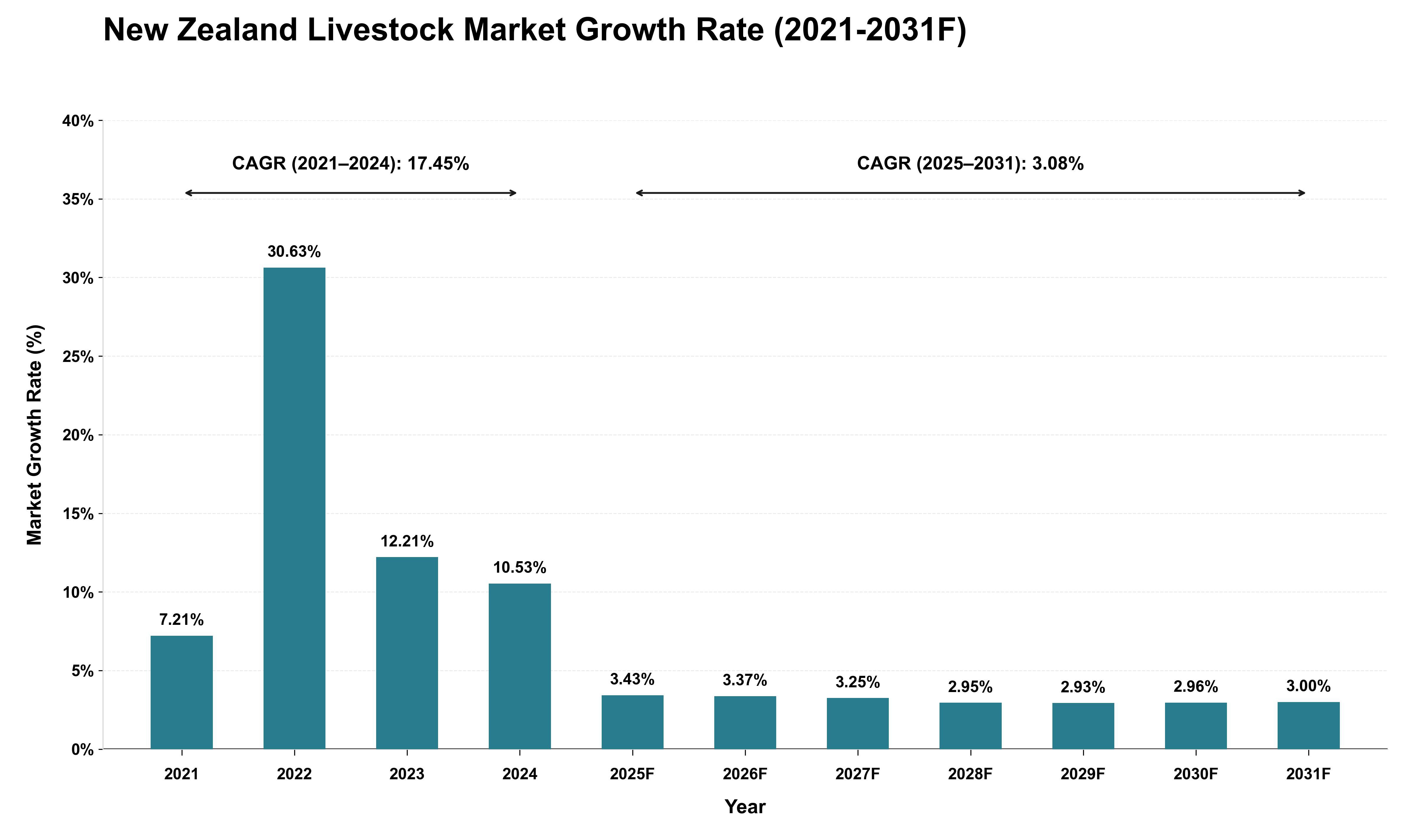
Between 2021 and 2024, the New Zealand livestock market experienced a robust compound annual growth rate (CAGR) of 17.45%, driven by heightened global demand for protein sources and supply chain disruptions that affected raw material availability and pricing. The sharp increase in growth rates, particularly in 2022 at 30.63%, can be attributed to post-pandemic recovery dynamics, where the reopening of hospitality sectors globally spurred meat consumption. However, as the market transitioned into a more stable phase from 2025 to 2031, the forecasted CAGR of 3.08% reflects a normalization process influenced by factors such as fluctuating feed costs, changing import reliance due to geopolitical tensions, and evolving consumer preferences towards sustainable practices. This anticipated deceleration underscores the need for producers to adapt to a landscape increasingly shaped by global commodity price volatility and environmental considerations impacting livestock production.
Key Highlights of the Report:
- New Zealand Livestock Market Outlook
- Market Size of New Zealand Livestock Market, 2024
- Forecast of New Zealand Livestock Market, 2031
- Historical Data and Forecast of New Zealand Livestock Revenues & Volume for the Period 2021-2031
- New Zealand Livestock Market Trend Evolution
- New Zealand Livestock Market Drivers and Challenges
- New Zealand Livestock Price Trends
- New Zealand Livestock Porter`s Five Forces
- New Zealand Livestock Industry Life Cycle
- Historical Data and Forecast of New Zealand Livestock Market Revenues & Volume By Animal Type for the Period 2021-2031
- Historical Data and Forecast of New Zealand Livestock Market Revenues & Volume By Ruminants for the Period 2021-2031
- Historical Data and Forecast of New Zealand Livestock Market Revenues & Volume By Poultry for the Period 2021-2031
- Historical Data and Forecast of New Zealand Livestock Market Revenues & Volume By Swine for the Period 2021-2031
- Historical Data and Forecast of New Zealand Livestock Market Revenues & Volume By Aquaculture for the Period 2021-2031
- New Zealand Livestock Import Export Trade Statistics
- Market Opportunity Assessment By Animal Type
- New Zealand Livestock Top Companies Market Share
- New Zealand Livestock Competitive Benchmarking By Technical and Operational Parameters
- New Zealand Livestock Company Profiles
- New Zealand Livestock Key Strategic Recommendations






































