New Zealand Loudspeakers Market Year-wise Growth Rate (2021-2031F)
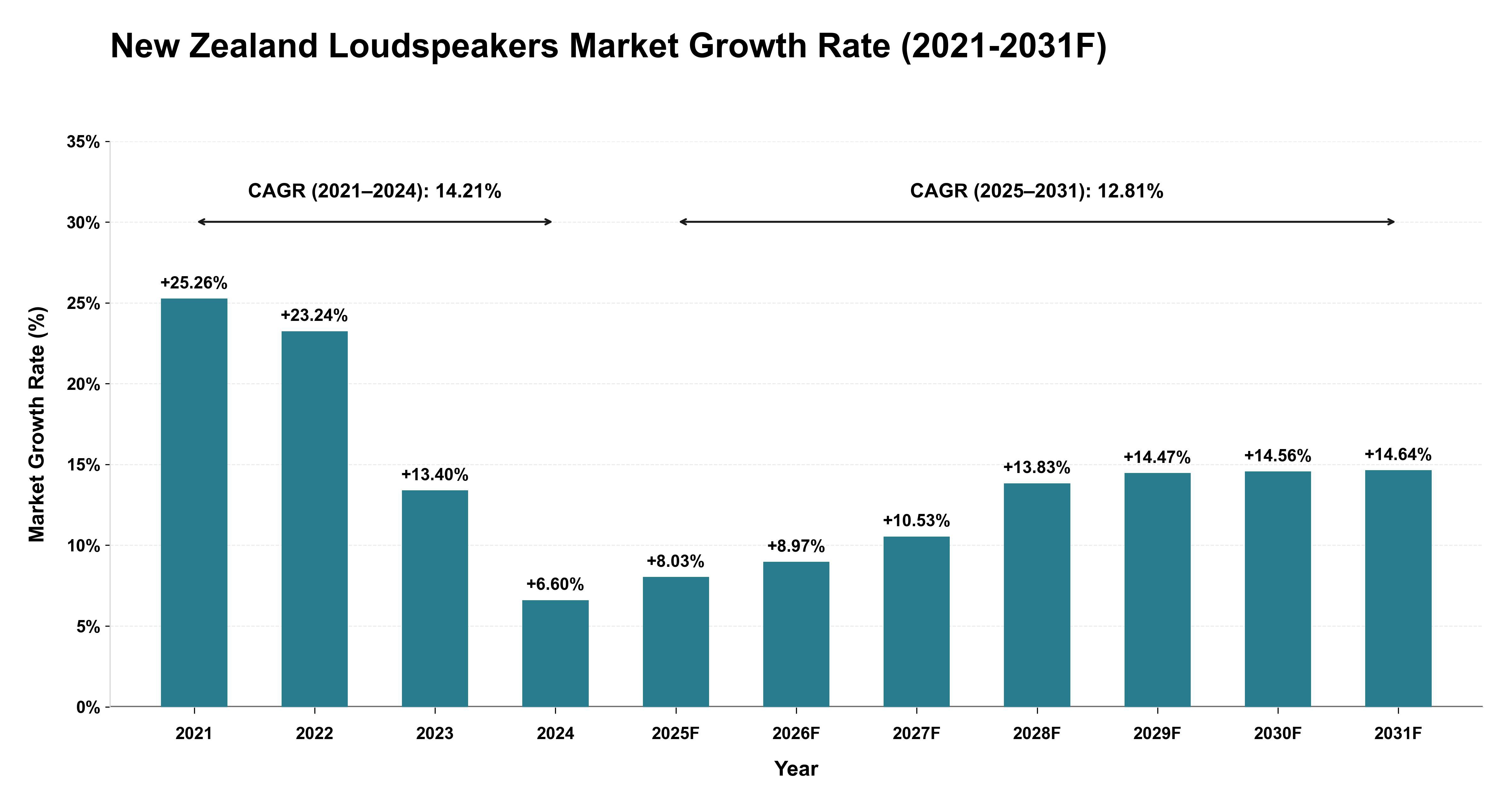
In the New Zealand Loudspeakers Market, from 2021 to 2024, the segment experienced robust growth with a CAGR of 14.21%. This period saw significant acceleration, particularly in 2021 and 2022 with growth rates of 25.26% and 23.24% respectively, driven by increasing demand for premium audio products. However, from 2023 onwards, growth decelerated due to market saturation and intense competition, leading to a lower growth rate of 6.60% in 2024. Looking ahead to 2025-2031, the market is expected to maintain a positive trajectory with a forecasted CAGR of 12.81%. Factors such as technological advancements in wireless connectivity and smart home integration are anticipated to drive steady growth rates, reflecting evolving consumer preferences and lifestyle trends towards immersive audio experiences.
Key Highlights of the Report:
- New Zealand Loudspeakers Market Outlook
- Market Size of New Zealand Loudspeakers Market, 2024
- Forecast of New Zealand Loudspeakers Market, 2031
- Historical Data and Forecast of New Zealand Loudspeakers Revenues & Volume for the Period 2021-2031
- New Zealand Loudspeakers Market Trend Evolution
- New Zealand Loudspeakers Market Drivers and Challenges
- New Zealand Loudspeakers Price Trends
- New Zealand Loudspeakers Porter`s Five Forces
- New Zealand Loudspeakers Industry Life Cycle
- Historical Data and Forecast of New Zealand Loudspeakers Market Revenues & Volume By Type for the Period 2021-2031
- Historical Data and Forecast of New Zealand Loudspeakers Market Revenues & Volume By Electric Loudspeaker for the Period 2021-2031
- Historical Data and Forecast of New Zealand Loudspeakers Market Revenues & Volume By Capacitive Loudspeaker for the Period 2021-2031
- Historical Data and Forecast of New Zealand Loudspeakers Market Revenues & Volume By Electromagnetic Loudspeaker for the Period 2021-2031
- Historical Data and Forecast of New Zealand Loudspeakers Market Revenues & Volume By Piezoelectric Loudspeaker for the Period 2021-2031
- Historical Data and Forecast of New Zealand Loudspeakers Market Revenues & Volume By Mounting for the Period 2021-2031
- Historical Data and Forecast of New Zealand Loudspeakers Market Revenues & Volume By Wall-mounted for the Period 2021-2031
- Historical Data and Forecast of New Zealand Loudspeakers Market Revenues & Volume By Portable for the Period 2021-2031
- Historical Data and Forecast of New Zealand Loudspeakers Market Revenues & Volume By Ceiling for the Period 2021-2031
- Historical Data and Forecast of New Zealand Loudspeakers Market Revenues & Volume By Bracket-mounted for the Period 2021-2031
- Historical Data and Forecast of New Zealand Loudspeakers Market Revenues & Volume By Flush-mounted for the Period 2021-2031
- Historical Data and Forecast of New Zealand Loudspeakers Market Revenues & Volume By Sound Level for the Period 2021-2031
- Historical Data and Forecast of New Zealand Loudspeakers Market Revenues & Volume By < 50dB for the Period 2021-2031
- Historical Data and Forecast of New Zealand Loudspeakers Market Revenues & Volume By 51 ??? 80dB for the Period 2021-2031
- Historical Data and Forecast of New Zealand Loudspeakers Market Revenues & Volume By >81dB for the Period 2021-2031
- Historical Data and Forecast of New Zealand Loudspeakers Market Revenues & Volume By Applications for the Period 2021-2031
- Historical Data and Forecast of New Zealand Loudspeakers Market Revenues & Volume By Commercial for the Period 2021-2031
- Historical Data and Forecast of New Zealand Loudspeakers Market Revenues & Volume By Agricultural for the Period 2021-2031
- Historical Data and Forecast of New Zealand Loudspeakers Market Revenues & Volume By Educational Institutions for the Period 2021-2031
- New Zealand Loudspeakers Import Export Trade Statistics
- Market Opportunity Assessment By Type
- Market Opportunity Assessment By Mounting
- Market Opportunity Assessment By Sound Level
- Market Opportunity Assessment By Applications
- New Zealand Loudspeakers Top Companies Market Share
- New Zealand Loudspeakers Competitive Benchmarking By Technical and Operational Parameters
- New Zealand Loudspeakers Company Profiles
- New Zealand Loudspeakers Key Strategic Recommendations






































