New Zealand Magnetic Tape Market Growth Rate Analysis (2025 - 2031)
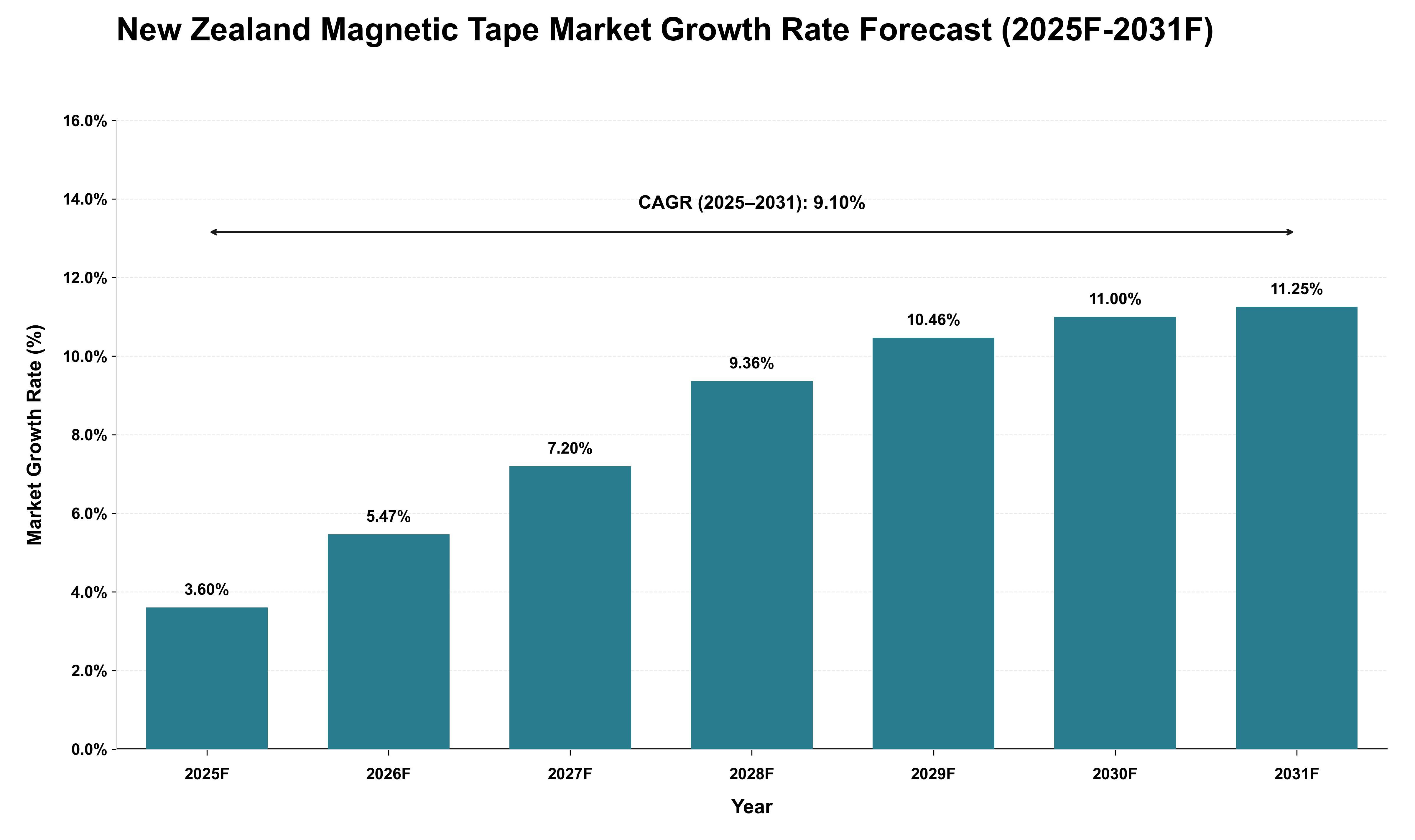
The forecasted growth trajectory for the New Zealand magnetic tape market will exhibit a notable acceleration, particularly evident as the CAGR of 9.10% reflects increasing demand driven by evolving technological applications and media storage needs. The initial growth rate of 3.60% in 2025 will transition to a robust 11.25% by 2031, indicating a significant upward shift in market dynamics. This trend will likely be influenced by supply chain efficiencies and input cost fluctuations, as manufacturers adapt to global sourcing strategies and potential tariff impacts on imported raw materials. As production scales up, economies of scale may further enhance profitability while mitigating rising costs associated with logistics and material procurement. Additionally, cyclical trends in consumer electronics and data storage solutions will contribute to sustained demand, reinforcing the market's expansion throughout this period.
Key Highlights of the Report:
- New Zealand Magnetic Tape Market Outlook
- Market Size of New Zealand Magnetic Tape Market, 2024
- Forecast of New Zealand Magnetic Tape Market, 2031
- Historical Data and Forecast of New Zealand Magnetic Tape Revenues & Volume for the Period 2021-2031
- New Zealand Magnetic Tape Market Trend Evolution
- New Zealand Magnetic Tape Market Drivers and Challenges
- New Zealand Magnetic Tape Price Trends
- New Zealand Magnetic Tape Porter`s Five Forces
- New Zealand Magnetic Tape Industry Life Cycle
- Historical Data and Forecast of New Zealand Magnetic Tape Market Revenues & Volume By Base Material for the Period 2021-2031
- Historical Data and Forecast of New Zealand Magnetic Tape Market Revenues & Volume By Synthetic Rubber for the Period 2021-2031
- Historical Data and Forecast of New Zealand Magnetic Tape Market Revenues & Volume By PVC for the Period 2021-2031
- Historical Data and Forecast of New Zealand Magnetic Tape Market Revenues & Volume By Others for the Period 2021-2031
- Historical Data and Forecast of New Zealand Magnetic Tape Market Revenues & Volume By End-users for the Period 2021-2031
- Historical Data and Forecast of New Zealand Magnetic Tape Market Revenues & Volume By Data Storage for the Period 2021-2031
- Historical Data and Forecast of New Zealand Magnetic Tape Market Revenues & Volume By Packaging & Labelling for the Period 2021-2031
- Historical Data and Forecast of New Zealand Magnetic Tape Market Revenues & Volume By Consumer Appliances for the Period 2021-2031
- Historical Data and Forecast of New Zealand Magnetic Tape Market Revenues & Volume By Others for the Period 2021-2031
- New Zealand Magnetic Tape Import Export Trade Statistics
- Market Opportunity Assessment By Base Material
- Market Opportunity Assessment By End-users
- New Zealand Magnetic Tape Top Companies Market Share
- New Zealand Magnetic Tape Competitive Benchmarking By Technical and Operational Parameters
- New Zealand Magnetic Tape Company Profiles
- New Zealand Magnetic Tape Key Strategic Recommendations






































