New Zealand Nylon Market Growth Rate Analysis (2025 - 2031)
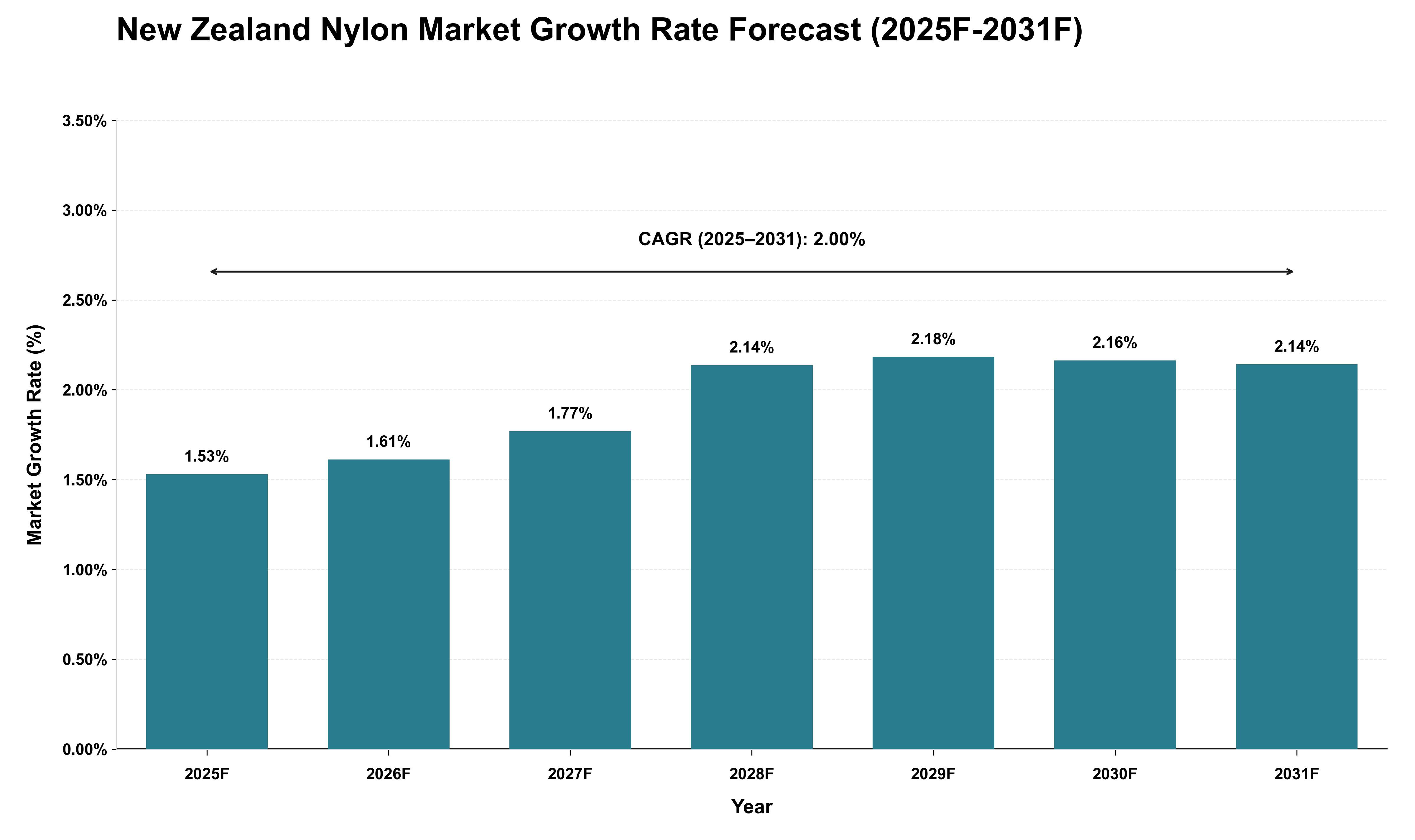
From 2025 onward, the New Zealand nylon market will likely experience a steady growth trajectory, driven by macroeconomic factors such as increasing consumer demand for sustainable materials and advancements in manufacturing technologies. The projected CAGR of 2.00% reflects a gradual acceleration in growth rates, peaking at 2.18% in 2029 before slightly tapering off. This trend suggests that while domestic production may face challenges from import dependencies, particularly in sourcing raw materials, the overall economic environment will support incremental increases in consumption across various sectors, including textiles and automotive. As global supply chains stabilize post-pandemic, New Zealand's nylon market will benefit from enhanced trade relations and potential shifts towards local sourcing strategies. Consequently, the interplay of these cyclical trends will underpin a resilient market performance through to 2031, aligning with broader economic recovery patterns observed globally.
Key Highlights of the Report:
- New Zealand Nylon Market Outlook
- Market Size of New Zealand Nylon Market, 2025
- Forecast of New Zealand Nylon Market, 2032
- Historical Data and Forecast of New Zealand Nylon Revenues & Volume for the Period 2022 - 2032F
- New Zealand Nylon Market Trend Evolution
- New Zealand Nylon Market Drivers and Challenges
- New Zealand Nylon Price Trends
- New Zealand Nylon Porter`s Five Forces
- New Zealand Nylon Industry Life Cycle
- Historical Data and Forecast of New Zealand Nylon Market Revenues & Volume By Product for the Period 2022 - 2032F
- Historical Data and Forecast of New Zealand Nylon Market Revenues & Volume By Nylon 6 for the Period 2022 - 2032F
- Historical Data and Forecast of New Zealand Nylon Market Revenues & Volume By Nylon 66 for the Period 2022 - 2032F
- Historical Data and Forecast of New Zealand Nylon Market Revenues & Volume By Application for the Period 2022 - 2032F
- Historical Data and Forecast of New Zealand Nylon Market Revenues & Volume By Automobile for the Period 2022 - 2032F
- Historical Data and Forecast of New Zealand Nylon Market Revenues & Volume By Electrical & Electronics for the Period 2022 - 2032F
- Historical Data and Forecast of New Zealand Nylon Market Revenues & Volume By Engineering Plastics for the Period 2022 - 2032F
- Historical Data and Forecast of New Zealand Nylon Market Revenues & Volume By Textiles for the Period 2022 - 2032F
- Historical Data and Forecast of New Zealand Nylon Market Revenues & Volume By Others for the Period 2022 - 2032F
- New Zealand Nylon Import Export Trade Statistics
- Market Opportunity Assessment By Product
- Market Opportunity Assessment By Application
- New Zealand Nylon Top Companies Market Share
- New Zealand Nylon Competitive Benchmarking By Technical and Operational Parameters
- New Zealand Nylon Company Profiles
- New Zealand Nylon Key Strategic Recommendations






































