New Zealand Particle Board Market Growth Rate Analysis (2025 - 2031)
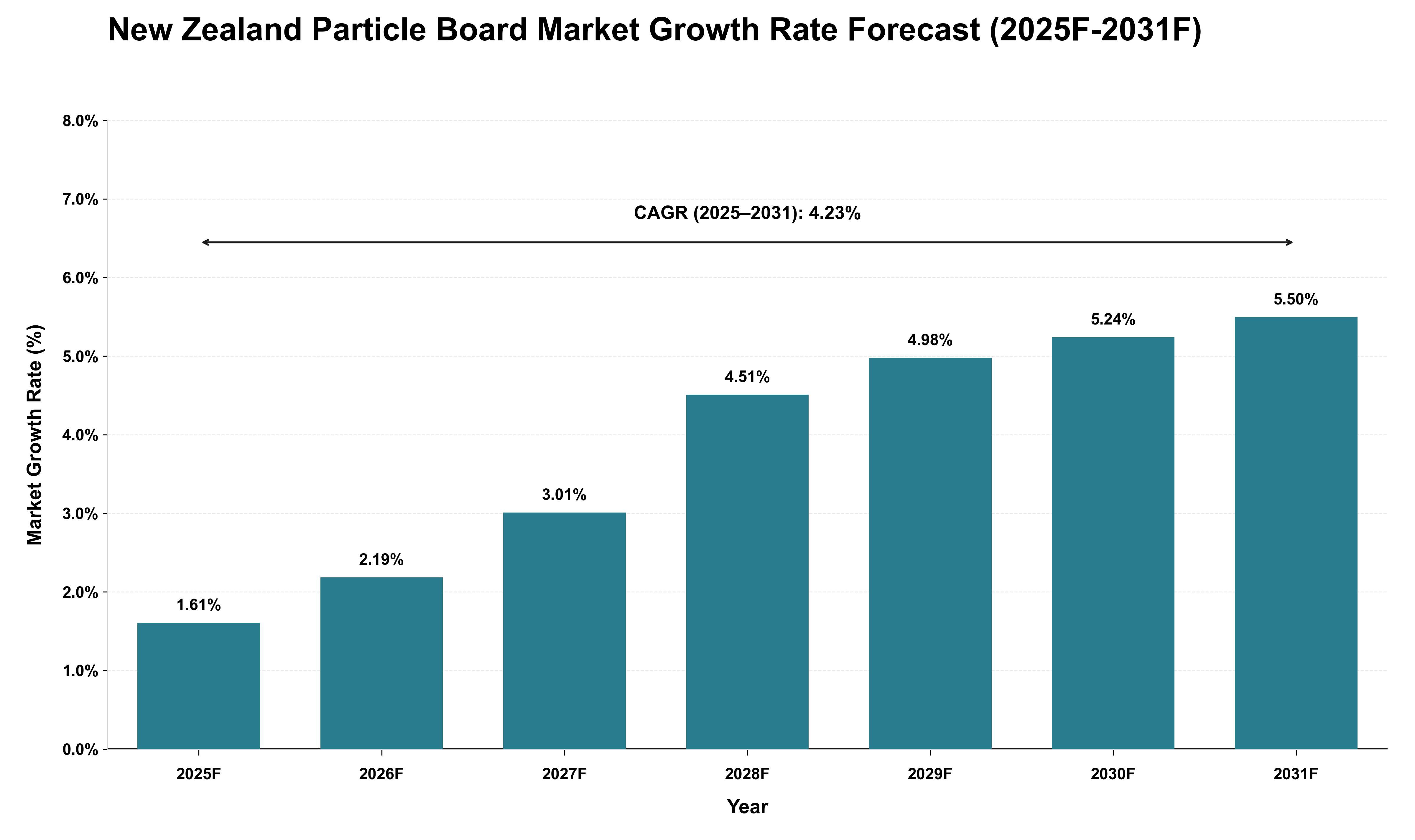
The New Zealand particle board market will experience a growth trajectory driven by evolving regulatory frameworks and trade policies that favor sustainable materials. As environmental regulations tighten, manufacturers will increasingly adopt eco-friendly practices, enhancing the appeal of particle board as a viable alternative to traditional wood products. The forecasted CAGR of 4.23% reflects an anticipated rise in demand, particularly as construction and furniture sectors expand in response to population growth and urbanization. Import dependencies may shift as local production capabilities strengthen, influenced by government incentives aimed at boosting domestic manufacturing. The annual growth rates will likely accelerate from 1.61% in 2025 to 5.50% by 2031, indicating a robust upward trend fueled by cyclical economic recovery and increased investment in green building initiatives, positioning particle board favorably within the broader context of sustainable construction materials.
Key Highlights of the Report:
- New Zealand Particle Board Market Outlook
- Market Size of New Zealand Particle Board Market, 2025
- Forecast of New Zealand Particle Board Market, 2032
- Historical Data and Forecast of New Zealand Particle Board Revenues & Volume for the Period 2022 - 2032F
- New Zealand Particle Board Market Trend Evolution
- New Zealand Particle Board Market Drivers and Challenges
- New Zealand Particle Board Price Trends
- New Zealand Particle Board Porter`s Five Forces
- New Zealand Particle Board Industry Life Cycle
- Historical Data and Forecast of New Zealand Particle Board Market Revenues & Volume By Type for the Period 2022 - 2032F
- Historical Data and Forecast of New Zealand Particle Board Market Revenues & Volume By Standard Chipboard for the Period 2022 - 2032F
- Historical Data and Forecast of New Zealand Particle Board Market Revenues & Volume By Melamine Veneered Chipboard for the Period 2022 - 2032F
- Historical Data and Forecast of New Zealand Particle Board Market Revenues & Volume By Flooring Grade Chipboard for the Period 2022 - 2032F
- Historical Data and Forecast of New Zealand Particle Board Market Revenues & Volume By Wood Veneered Chipboard for the Period 2022 - 2032F
- Historical Data and Forecast of New Zealand Particle Board Market Revenues & Volume By Plastic Veneered Chipboard for the Period 2022 - 2032F
- Historical Data and Forecast of New Zealand Particle Board Market Revenues & Volume By Other for the Period 2022 - 2032F
- Historical Data and Forecast of New Zealand Particle Board Market Revenues & Volume By Application for the Period 2022 - 2032F
- Historical Data and Forecast of New Zealand Particle Board Market Revenues & Volume By Construction for the Period 2022 - 2032F
- Historical Data and Forecast of New Zealand Particle Board Market Revenues & Volume By Furniture for the Period 2022 - 2032F
- Historical Data and Forecast of New Zealand Particle Board Market Revenues & Volume By Infrastructure for the Period 2022 - 2032F
- Historical Data and Forecast of New Zealand Particle Board Market Revenues & Volume By Other for the Period 2022 - 2032F
- New Zealand Particle Board Import Export Trade Statistics
- Market Opportunity Assessment By Type
- Market Opportunity Assessment By Application
- New Zealand Particle Board Top Companies Market Share
- New Zealand Particle Board Competitive Benchmarking By Technical and Operational Parameters
- New Zealand Particle Board Company Profiles
- New Zealand Particle Board Key Strategic Recommendations






































