New Zealand Phosphate Market Top 5 Importing Countries and Market Competition (HHI) Analysis
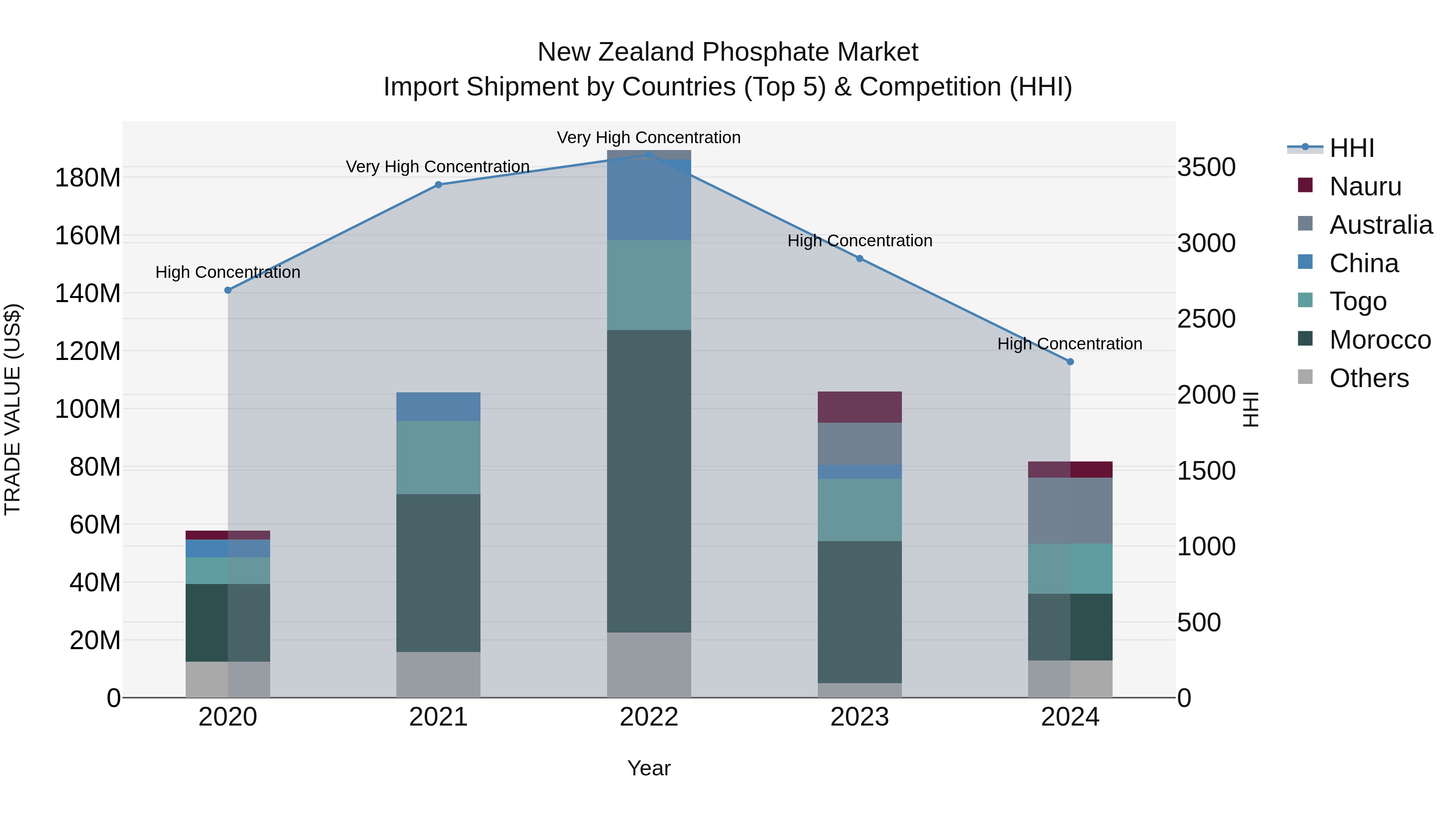
New Zealand`s phosphate import market in 2024 continued to be dominated by key suppliers such as Morocco, Australia, Togo, South Africa, and Nauru. Despite a slight decline in growth rate from 2023 to 2024, the compound annual growth rate (CAGR) over the four-year period was a robust 9.05%. The high Herfindahl-Hirschman Index (HHI) indicates a concentrated market structure. Overall, New Zealand`s reliance on phosphate imports from these top countries underscores the importance of stable and diverse supply chains in ensuring a consistent flow of this essential resource.
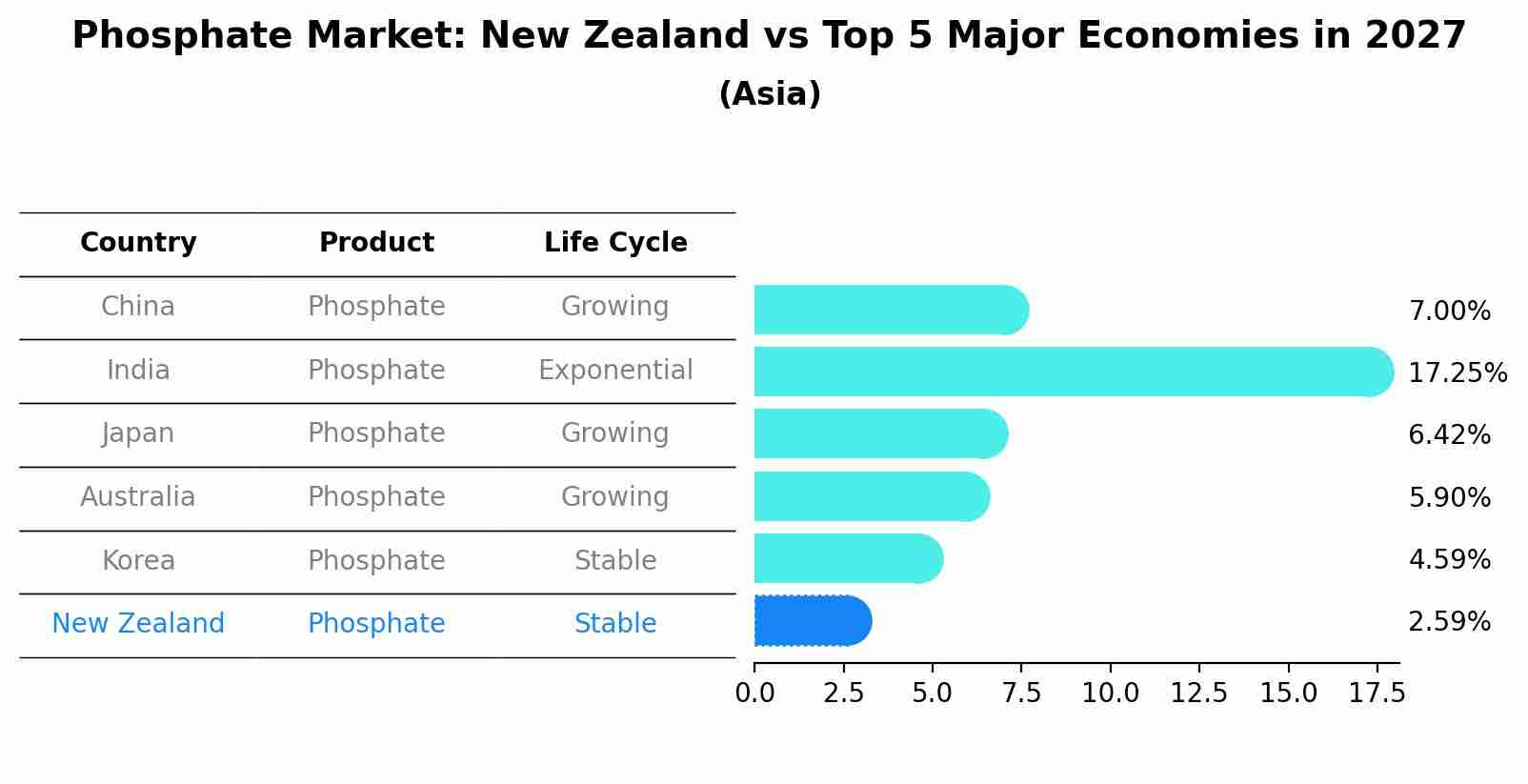
Phosphate Market: New Zealand vs Top 5 Major Economies in 2027 (Asia)
By 2027, New Zealand's Phosphate market is forecasted to achieve a stable growth rate of 2.59%, with China leading the Asia region, followed by India, Japan, Australia and South Korea.
Key Highlights of the Report:
- New Zealand Phosphate Market Outlook
- Market Size of New Zealand Phosphate Market, 2025
- Forecast of New Zealand Phosphate Market, 2032
- Historical Data and Forecast of New Zealand Phosphate Revenues & Volume for the Period 2022 - 2032F
- New Zealand Phosphate Market Trend Evolution
- New Zealand Phosphate Market Drivers and Challenges
- New Zealand Phosphate Price Trends
- New Zealand Phosphate Porter`s Five Forces
- New Zealand Phosphate Industry Life Cycle
- Historical Data and Forecast of New Zealand Phosphate Market Revenues & Volume By Type/Derivative for the Period 2022 - 2032F
- Historical Data and Forecast of New Zealand Phosphate Market Revenues & Volume By Ammonium Phosphate for the Period 2022 - 2032F
- Historical Data and Forecast of New Zealand Phosphate Market Revenues & Volume By Calcium Phosphate for the Period 2022 - 2032F
- Historical Data and Forecast of New Zealand Phosphate Market Revenues & Volume By Phosphoric Acid for the Period 2022 - 2032F
- Historical Data and Forecast of New Zealand Phosphate Market Revenues & Volume By Application for the Period 2022 - 2032F
- Historical Data and Forecast of New Zealand Phosphate Market Revenues & Volume By Fertilizers for the Period 2022 - 2032F
- Historical Data and Forecast of New Zealand Phosphate Market Revenues & Volume By Foods & Beverages for the Period 2022 - 2032F
- Historical Data and Forecast of New Zealand Phosphate Market Revenues & Volume By Detergents for the Period 2022 - 2032F
- Historical Data and Forecast of New Zealand Phosphate Market Revenues & Volume By Type of Resource for the Period 2022 - 2032F
- Historical Data and Forecast of New Zealand Phosphate Market Revenues & Volume By Sedimentary Marine Deposits for the Period 2022 - 2032F
- Historical Data and Forecast of New Zealand Phosphate Market Revenues & Volume By Igneous & Weathered for the Period 2022 - 2032F
- Historical Data and Forecast of New Zealand Phosphate Market Revenues & Volume By Biogenic for the Period 2022 - 2032F
- New Zealand Phosphate Import Export Trade Statistics
- Market Opportunity Assessment By Type/Derivative
- Market Opportunity Assessment By Application
- Market Opportunity Assessment By Type of Resource
- New Zealand Phosphate Top Companies Market Share
- New Zealand Phosphate Competitive Benchmarking By Technical and Operational Parameters
- New Zealand Phosphate Company Profiles
- New Zealand Phosphate Key Strategic Recommendations






































