New Zealand Primer Market Top 5 Importing Countries and Market Competition (HHI) Analysis
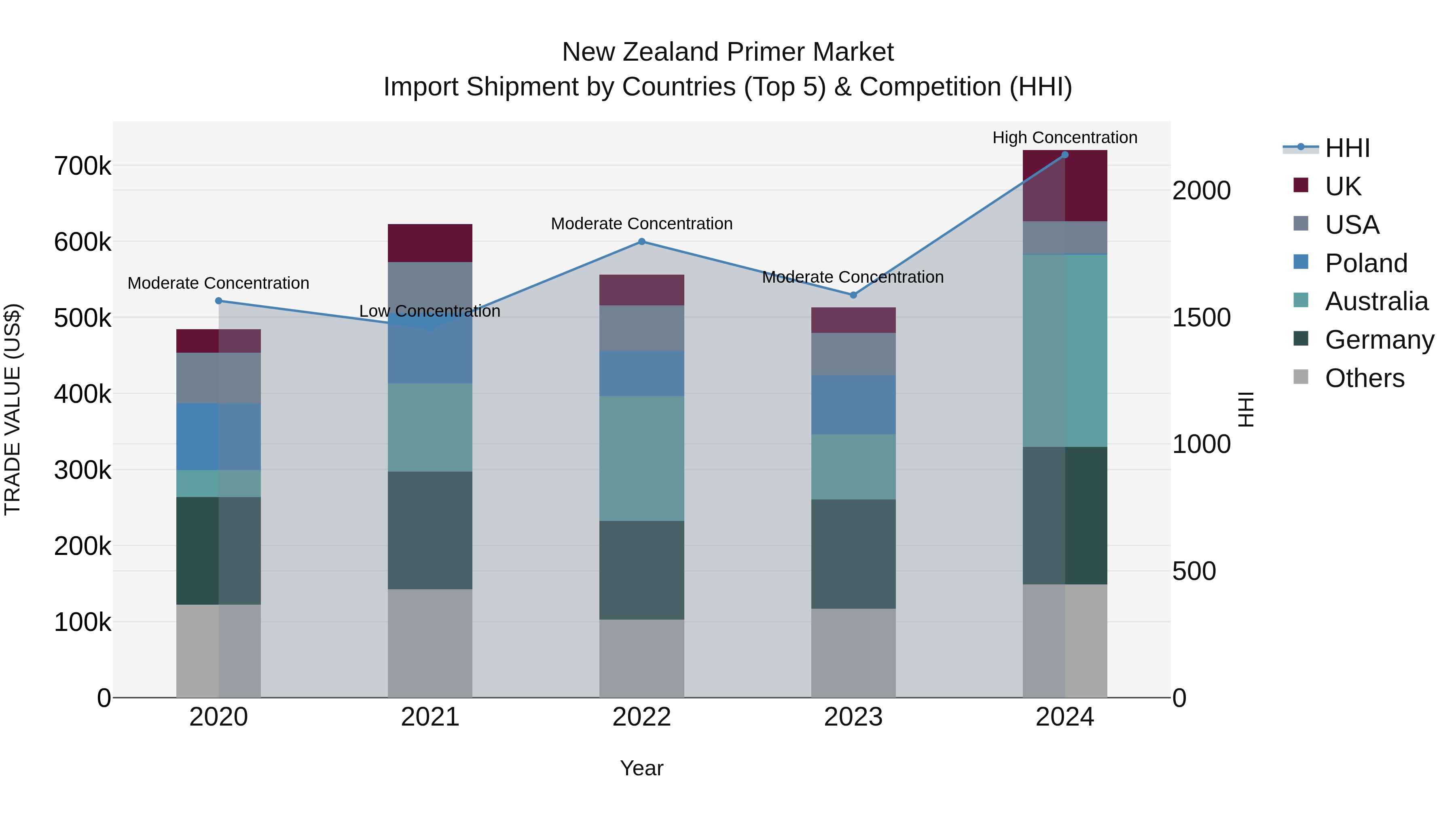
In 2024, the New Zealand primer import market saw significant growth, with top exporting countries including Australia, Germany, UK, China, and USA. The market concentration, as measured by the Herfindahl-Hirschman Index (HHI), increased from moderate to high in just one year, indicating a more consolidated market landscape. The impressive Compound Annual Growth Rate (CAGR) of 10.4% from 2020 to 2024 showcases sustained market expansion, while the remarkable growth rate of 40.26% from 2023 to 2024 highlights the accelerating pace of development in the industry.
New Zealand Primer Market Synopsis
The New Zealand primer market is characterized by a diverse range of products catering to various consumer needs. The market offers a wide selection of primers for different surfaces such as wood, metal, and concrete, with options for both interior and exterior applications. Key players in the market include global brands as well as local manufacturers, providing consumers with a variety of choices in terms of quality, price points, and eco-friendly options. The market is influenced by factors such as increasing demand for sustainable and low-VOC products, as well as the growing trend of DIY home improvement projects. Market players are focusing on product innovation, including quick-drying formulas and multi-surface primers, to meet the evolving needs of consumers. Overall, the New Zealand primer market is competitive and dynamic, offering opportunities for growth and innovation.
New Zealand Primer Market Trends
The New Zealand Primer Market is experiencing a shift towards eco-friendly and sustainable products, driven by increasing consumer awareness of environmental issues. There is a growing demand for low VOC (volatile organic compounds) and water-based primers that have minimal impact on indoor air quality. Manufacturers are also focusing on developing primers with enhanced durability and performance, catering to the needs of both DIY enthusiasts and professionals. Additionally, there is a trend towards multi-purpose primers that can be used on various surfaces, providing convenience and cost savings for consumers. With a strong emphasis on quality and innovation, the New Zealand Primer Market is expected to continue evolving to meet the changing preferences and priorities of consumers.
New Zealand Primer Market Challenges
In the New Zealand primer market, some challenges faced include intense competition among existing brands and new entrants, leading to price wars and margin pressures. The market is also influenced by changing consumer preferences towards eco-friendly and sustainable products, requiring primer manufacturers to adapt their formulations and marketing strategies. Additionally, fluctuations in raw material prices and supply chain disruptions can impact production costs and availability of products in the market. Regulatory requirements and standards for chemical ingredients in primers also pose compliance challenges for manufacturers. Overall, staying ahead in the New Zealand primer market requires companies to innovate, differentiate their products, and keep up with consumer trends while managing cost pressures and regulatory compliance.
New Zealand Primer Market Investment Opportunities
The New Zealand primer market presents opportunities for investors due to the country`s growing construction and renovation activities. With an increasing focus on sustainability and environmentally friendly products, there is a demand for eco-friendly primers that comply with strict regulations. Investing in innovative primer formulations that offer high performance, durability, and low VOC content can be lucrative. Additionally, targeting niche markets such as specialty primers for specific surfaces or applications can provide a competitive edge. Collaborating with local suppliers and manufacturers to develop tailored solutions for the New Zealand market can also be advantageous. Overall, investing in the New Zealand primer market offers potential for growth and profitability in line with the country`s construction industry trends.
Jordan Agar Market Government Policies
The New Zealand government has implemented several policies related to the primer market to ensure consumer safety and environmental protection. The Environmental Protection Authority (EPA) regulates the classification, labelling, and packaging of primers to prevent adverse effects on human health and the environment. Additionally, the government has set standards for volatile organic compounds (VOCs) in primers to reduce air pollution and promote sustainability. Furthermore, there are strict regulations on the disposal of leftover or unused primer products to minimize waste and potential harm to the ecosystem. Overall, these policies aim to promote responsible production, usage, and disposal of primers in New Zealand, aligning with the country`s commitment to environmental conservation and public health.
New Zealand Primer Market Future Outlook
The future outlook for the New Zealand Primer Market appears promising, with a steady growth trajectory expected in the coming years. Factors contributing to this positive outlook include the country`s thriving construction industry, increasing demand for eco-friendly and sustainable products, and a growing focus on enhancing the durability and longevity of painted surfaces. Additionally, advancements in primer technology, such as improved formulations for better adhesion and protection, are likely to drive market expansion. As consumers become more conscious of the importance of preparatory coatings in achieving high-quality paint finishes, the demand for primers is anticipated to rise. Overall, the New Zealand Primer Market is poised for growth opportunities, driven by evolving consumer preferences and innovation in product offerings.
Key Highlights of the Report:
- New Zealand Primer Market Outlook
- Market Size of New Zealand Primer Market, 2024
- Forecast of New Zealand Primer Market, 2031
- Historical Data and Forecast of New Zealand Primer Revenues & Volume for the Period 2021- 2031
- New Zealand Primer Market Trend Evolution
- New Zealand Primer Market Drivers and Challenges
- New Zealand Primer Price Trends
- New Zealand Primer Porter's Five Forces
- New Zealand Primer Industry Life Cycle
- Historical Data and Forecast of New Zealand Primer Market Revenues & Volume By Ingredient for the Period 2021- 2031
- Historical Data and Forecast of New Zealand Primer Market Revenues & Volume By Resin for the Period 2021- 2031
- Historical Data and Forecast of New Zealand Primer Market Revenues & Volume By Additives for the Period 2021- 2031
- Historical Data and Forecast of New Zealand Primer Market Revenues & Volume By Others for the Period 2021- 2031
- Historical Data and Forecast of New Zealand Primer Market Revenues & Volume By End-User Industry for the Period 2021- 2031
- Historical Data and Forecast of New Zealand Primer Market Revenues & Volume By Automotive for the Period 2021- 2031
- Historical Data and Forecast of New Zealand Primer Market Revenues & Volume By Building and Construction for the Period 2021- 2031
- Historical Data and Forecast of New Zealand Primer Market Revenues & Volume By Furniture for the Period 2021- 2031
- Historical Data and Forecast of New Zealand Primer Market Revenues & Volume By Industrial for the Period 2021- 2031
- Historical Data and Forecast of New Zealand Primer Market Revenues & Volume By Packaging for the Period 2021- 2031
- Historical Data and Forecast of New Zealand Primer Market Revenues & Volume By Others for the Period 2021- 2031
- New Zealand Primer Import Export Trade Statistics
- Market Opportunity Assessment By Ingredient
- Market Opportunity Assessment By End-User Industry
- New Zealand Primer Top Companies Market Share
- New Zealand Primer Competitive Benchmarking By Technical and Operational Parameters
- New Zealand Primer Company Profiles
- New Zealand Primer Key Strategic Recommendations






































