New Zealand Printed Signage Market Top 5 Importing Countries and Market Competition (HHI) Analysis
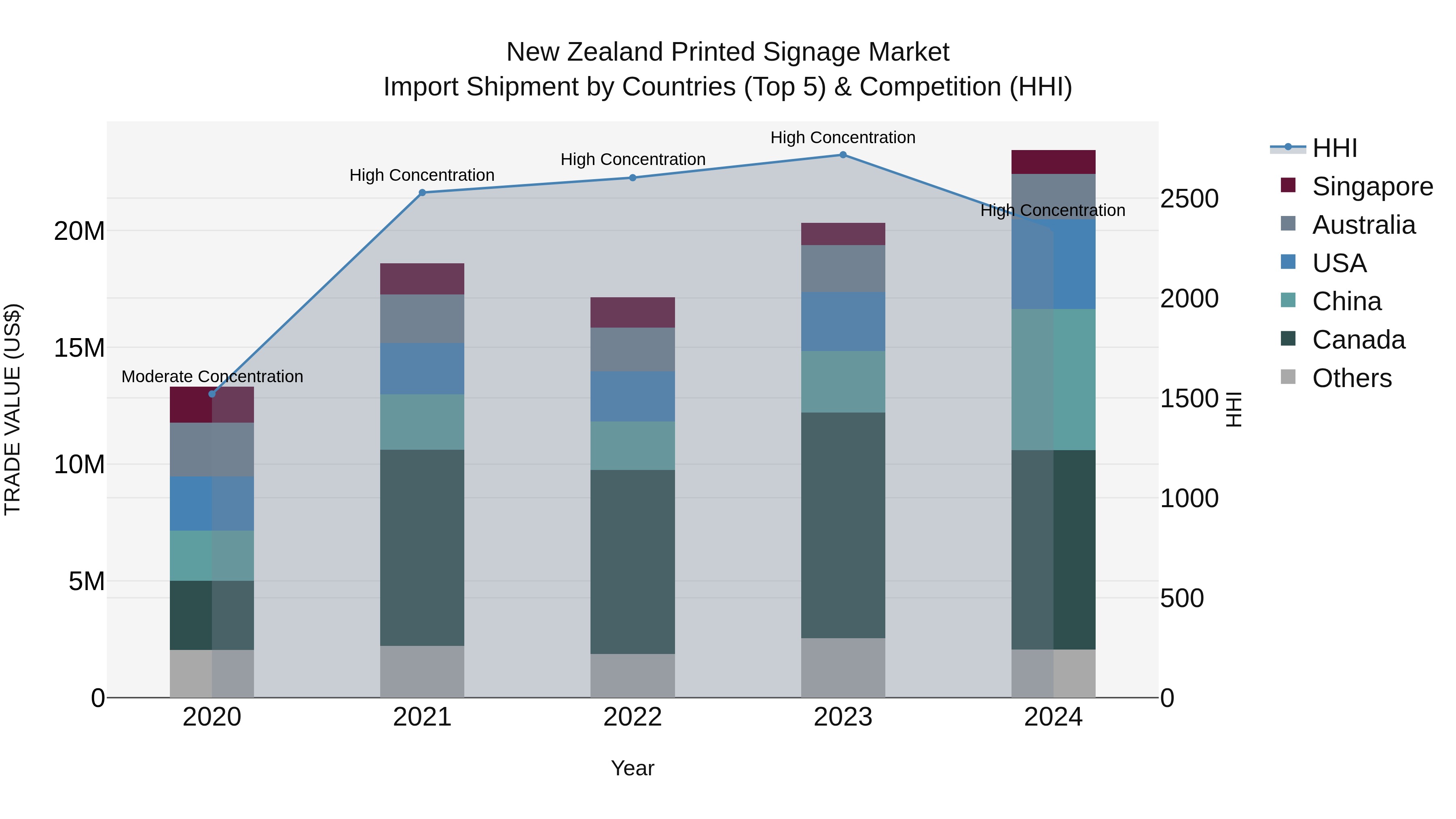
The New Zealand printed signage import market continues to thrive in 2024, with top exporting countries including Canada, China, USA, Australia, and Singapore. The market shows high concentration with a high Herfindahl-Hirschman Index (HHI) and a significant Compound Annual Growth Rate (CAGR) of 15.17% from 2020 to 2024. The impressive growth rate of 15.29% from 2023 to 2024 indicates a strong momentum in the industry, positioning New Zealand as a key player in the global printed signage import market.
New Zealand Printed Signage Market Synopsis
The New Zealand Printed Signage Market is experiencing steady growth driven by increasing demand from various sectors such as retail, hospitality, and construction. The market is characterized by a wide range of products including banners, posters, billboards, and vehicle wraps, with a growing trend towards digital and customized signage solutions. Technological advancements in printing technologies have enabled more cost-effective and high-quality signage production. Sustainability and eco-friendly materials are becoming key considerations for both businesses and consumers, leading to a shift towards more environmentally friendly options in the market. As the economy continues to expand and businesses invest in marketing and branding efforts, the New Zealand Printed Signage Market is expected to see further growth and innovation in the coming years.
New Zealand Printed Signage Market Trends
The New Zealand Printed Signage Market is experiencing a shift towards digital and interactive signage solutions, driven by the increasing demand for personalized and engaging customer experiences. Businesses are investing in dynamic displays, LED screens, and interactive touchpoints to capture consumer attention and enhance brand visibility. Sustainability is also a growing trend, with a focus on eco-friendly materials and processes to reduce environmental impact. Personalized and localized content is becoming more prevalent, leveraging data analytics and digital printing technologies to deliver targeted messaging. Additionally, there is a rising interest in experiential marketing through signage, with immersive installations and augmented reality features gaining popularity. Overall, the market is evolving towards innovative, tech-savvy, and environmentally conscious signage solutions to meet the changing needs of businesses and consumers in New Zealand.
New Zealand Printed Signage Market Challenges
In the New Zealand Printed Signage Market, one of the key challenges faced is intense competition due to the presence of numerous players offering similar products and services. This results in price pressure and the need for companies to differentiate themselves through innovation and quality. Another challenge is the impact of economic fluctuations on businesses, as a slowdown in the economy can lead to reduced spending on marketing and advertising, affecting demand for printed signage. Additionally, there is a growing trend towards digital and online advertising, which poses a threat to traditional printed signage companies. Adapting to technological advancements and shifting consumer preferences while maintaining profitability and market share are crucial challenges faced by businesses operating in the New Zealand Printed Signage Market.
New Zealand Printed Signage Market Investment Opportunities
The New Zealand Printed Signage Market presents various investment opportunities due to the country`s growing economy and increasing focus on marketing and advertising. With businesses seeking innovative ways to stand out and attract customers, there is a rising demand for high-quality printed signage for retail stores, events, exhibitions, and outdoor advertising. Investing in state-of-the-art printing technology, eco-friendly materials, and offering customizable solutions can help tap into this lucrative market. Additionally, providing digital signage solutions and incorporating sustainability practices can further differentiate a company and attract environmentally conscious clients. Collaborating with local businesses, leveraging digital marketing strategies, and staying updated with industry trends can position investors for success in the dynamic New Zealand Printed Signage Market.
Jordan Agar Market Government Policies
In New Zealand, the Printed Signage Market is subject to government regulations and policies aimed at ensuring safety, environmental sustainability, and fair competition. The government mandates compliance with building codes and standards to guarantee the structural integrity and safety of signage installations. Additionally, environmental regulations promote the use of eco-friendly materials and practices in the production and disposal of printed signage, encouraging businesses to adopt sustainable solutions. Competition laws are in place to prevent anti-competitive behavior and ensure a level playing field for businesses operating in the market. Overall, government policies in New Zealand`s Printed Signage Market focus on fostering a safe, sustainable, and fair business environment for industry players.
New Zealand Printed Signage Market Future Outlook
The New Zealand Printed Signage Market is poised for steady growth in the coming years, driven by factors such as increasing demand for personalized and visually appealing signage solutions across various industries including retail, hospitality, and healthcare. Technological advancements in printing techniques and materials are expected to further enhance the quality and durability of printed signage, attracting more businesses to invest in this advertising medium. Moreover, the growing trend of eco-friendly and sustainable signage options is likely to shape the market landscape, with consumers and businesses showing a preference for environmentally conscious products. Overall, the market is anticipated to expand as businesses continue to recognize the importance of effective signage in attracting customers and promoting their brand identity in an increasingly competitive market environment.
Key Highlights of the Report:
- New Zealand Printed Signage Market Outlook
- Market Size of New Zealand Printed Signage Market, 2024
- Forecast of New Zealand Printed Signage Market, 2031
- Historical Data and Forecast of New Zealand Printed Signage Revenues & Volume for the Period 2021- 2031
- New Zealand Printed Signage Market Trend Evolution
- New Zealand Printed Signage Market Drivers and Challenges
- New Zealand Printed Signage Price Trends
- New Zealand Printed Signage Porter's Five Forces
- New Zealand Printed Signage Industry Life Cycle
- Historical Data and Forecast of New Zealand Printed Signage Market Revenues & Volume By Product for the Period 2021- 2031
- Historical Data and Forecast of New Zealand Printed Signage Market Revenues & Volume By Billboard for the Period 2021- 2031
- Historical Data and Forecast of New Zealand Printed Signage Market Revenues & Volume By Backlit Display for the Period 2021- 2031
- Historical Data and Forecast of New Zealand Printed Signage Market Revenues & Volume By Pop Display for the Period 2021- 2031
- Historical Data and Forecast of New Zealand Printed Signage Market Revenues & Volume By Banner for the Period 2021- 2031
- Historical Data and Forecast of New Zealand Printed Signage Market Revenues & Volume By Corporate Graphics for the Period 2021- 2031
- Historical Data and Forecast of New Zealand Printed Signage Market Revenues & Volume By Others for the Period 2021- 2031
- Historical Data and Forecast of New Zealand Printed Signage Market Revenues & Volume By Type for the Period 2021- 2031
- Historical Data and Forecast of New Zealand Printed Signage Market Revenues & Volume By Indoor Printed Signage for the Period 2021- 2031
- Historical Data and Forecast of New Zealand Printed Signage Market Revenues & Volume By Outdoor Printed Signage for the Period 2021- 2031
- Historical Data and Forecast of New Zealand Printed Signage Market Revenues & Volume By End-user Vertical for the Period 2021- 2031
- Historical Data and Forecast of New Zealand Printed Signage Market Revenues & Volume By BFSI for the Period 2021- 2031
- Historical Data and Forecast of New Zealand Printed Signage Market Revenues & Volume By Retail for the Period 2021- 2031
- Historical Data and Forecast of New Zealand Printed Signage Market Revenues & Volume By Sports and Leisure for the Period 2021- 2031
- Historical Data and Forecast of New Zealand Printed Signage Market Revenues & Volume By Entertainment for the Period 2021- 2031
- Historical Data and Forecast of New Zealand Printed Signage Market Revenues & Volume By Transportation and Logistics for the Period 2021- 2031
- Historical Data and Forecast of New Zealand Printed Signage Market Revenues & Volume By Healthcare for the Period 2021- 2031
- Historical Data and Forecast of New Zealand Printed Signage Market Revenues & Volume By Others for the Period 2021- 2031
- New Zealand Printed Signage Import Export Trade Statistics
- Market Opportunity Assessment By Product
- Market Opportunity Assessment By Type
- Market Opportunity Assessment By End-user Vertical
- New Zealand Printed Signage Top Companies Market Share
- New Zealand Printed Signage Competitive Benchmarking By Technical and Operational Parameters
- New Zealand Printed Signage Company Profiles
- New Zealand Printed Signage Key Strategic Recommendations






































