New Zealand Residential Hvac Market Top 5 Importing Countries and Market Competition (HHI) Analysis
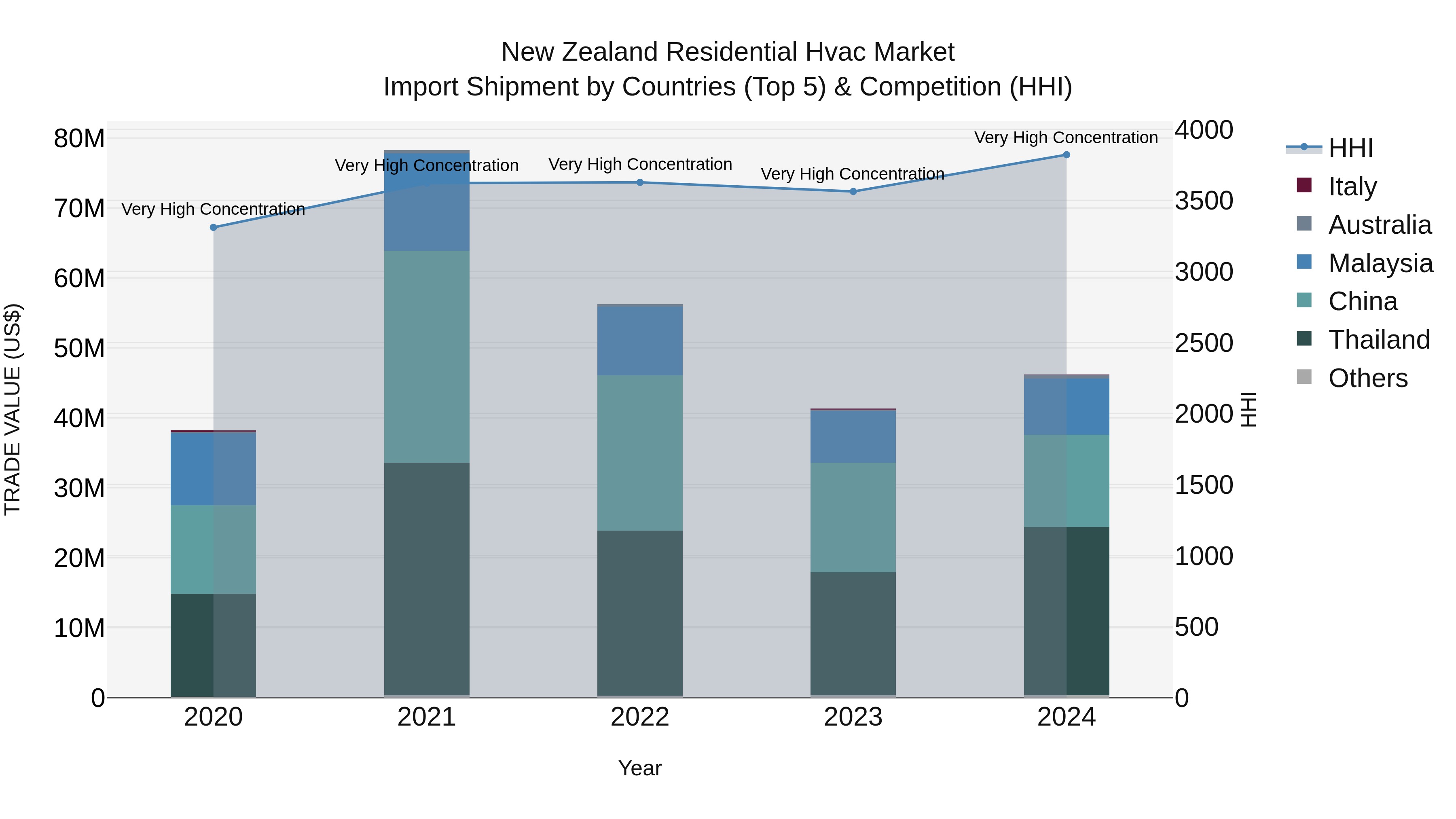
The residential HVAC import market in New Zealand continues to thrive, with significant contributions from top exporters such as Thailand, China, Malaysia, Australia, and Japan. The high Herfindahl-Hirschman Index (HHI) indicates a concentrated market, suggesting strong competition among these key players. The compound annual growth rate (CAGR) of 4.85% from 2020 to 2024 highlights steady expansion, while the impressive growth rate of 11.78% in 2024 demonstrates a particularly robust performance. This data underscores the resilience and attractiveness of the New Zealand residential HVAC import sector for both domestic and international suppliers.
Key Highlights of the Report:
- New Zealand Residential HVAC Market Outlook
- Market Size of New Zealand Residential HVAC Market, 2025
- Forecast of New Zealand Residential HVAC Market, 2032
- Historical Data and Forecast of New Zealand Residential HVAC Revenues & Volume for the Period 2022 - 2032F
- New Zealand Residential HVAC Market Trend Evolution
- New Zealand Residential HVAC Market Drivers and Challenges
- New Zealand Residential HVAC Price Trends
- New Zealand Residential HVAC Porter's Five Forces
- New Zealand Residential HVAC Industry Life Cycle
- Historical Data and Forecast of New Zealand Residential HVAC Market Revenues & Volume By Type for the Period 2022 - 2032F
- Historical Data and Forecast of New Zealand Residential HVAC Market Revenues & Volume By Central AC for the Period 2022 - 2032F
- Historical Data and Forecast of New Zealand Residential HVAC Market Revenues & Volume By Ductless for the Period 2022 - 2032F
- Historical Data and Forecast of New Zealand Residential HVAC Market Revenues & Volume By Window Unit for the Period 2022 - 2032F
- Historical Data and Forecast of New Zealand Residential HVAC Market Revenues & Volume By Technology for the Period 2022 - 2032F
- Historical Data and Forecast of New Zealand Residential HVAC Market Revenues & Volume By Split System for the Period 2022 - 2032F
- Historical Data and Forecast of New Zealand Residential HVAC Market Revenues & Volume By Heat Pump for the Period 2022 - 2032F
- Historical Data and Forecast of New Zealand Residential HVAC Market Revenues & Volume By VRF System for the Period 2022 - 2032F
- Historical Data and Forecast of New Zealand Residential HVAC Market Revenues & Volume By Installation Type for the Period 2022 - 2032F
- Historical Data and Forecast of New Zealand Residential HVAC Market Revenues & Volume By Indoor/Outdoor for the Period 2022 - 2032F
- Historical Data and Forecast of New Zealand Residential HVAC Market Revenues & Volume By Wall-Mounted for the Period 2022 - 2032F
- Historical Data and Forecast of New Zealand Residential HVAC Market Revenues & Volume By Window-Fixed for the Period 2022 - 2032F
- Historical Data and Forecast of New Zealand Residential HVAC Market Revenues & Volume By Application for the Period 2022 - 2032F
- Historical Data and Forecast of New Zealand Residential HVAC Market Revenues & Volume By Houses for the Period 2022 - 2032F
- Historical Data and Forecast of New Zealand Residential HVAC Market Revenues & Volume By Apartments for the Period 2022 - 2032F
- Historical Data and Forecast of New Zealand Residential HVAC Market Revenues & Volume By Villas for the Period 2022 - 2032F
- Historical Data and Forecast of New Zealand Residential HVAC Market Revenues & Volume By Distribution Channel for the Period 2022 - 2032F
- Historical Data and Forecast of New Zealand Residential HVAC Market Revenues & Volume By Online for the Period 2022 - 2032F
- Historical Data and Forecast of New Zealand Residential HVAC Market Revenues & Volume By Offline for the Period 2022 - 2032F
- Historical Data and Forecast of New Zealand Residential HVAC Market Revenues & Volume By Specialty Stores for the Period 2022 - 2032F
- New Zealand Residential HVAC Import Export Trade Statistics
- Market Opportunity Assessment By Type
- Market Opportunity Assessment By Technology
- Market Opportunity Assessment By Installation Type
- Market Opportunity Assessment By Application
- Market Opportunity Assessment By Distribution Channel
- New Zealand Residential HVAC Top Companies Market Share
- New Zealand Residential HVAC Competitive Benchmarking By Technical and Operational Parameters
- New Zealand Residential HVAC Company Profiles
- New Zealand Residential HVAC Key Strategic Recommendations






































