New Zealand Smart Toilet Market Top 5 Importing Countries and Market Competition (HHI) Analysis
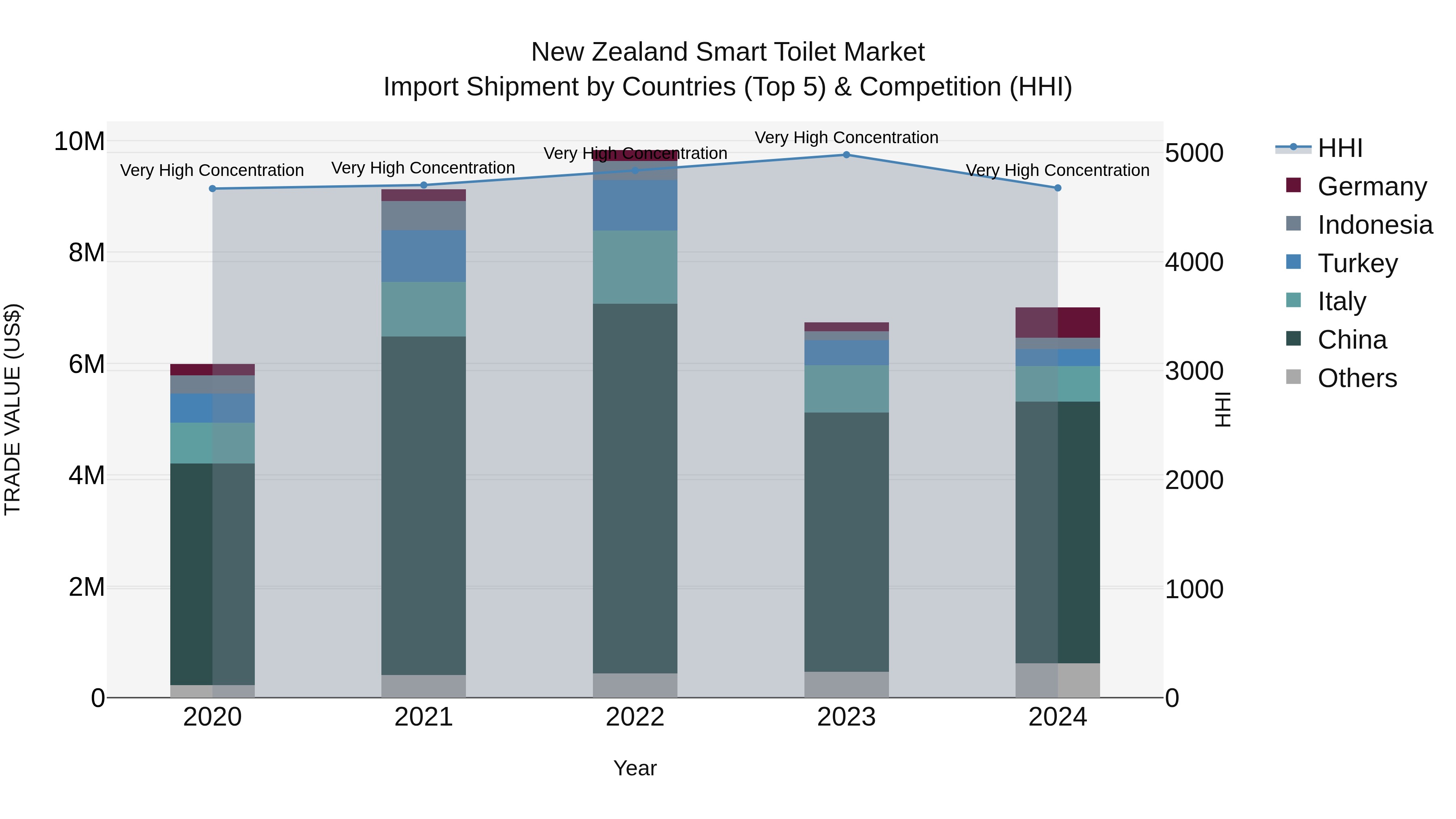
New Zealand`s smart toilet import market continues to thrive in 2024, with top exporting countries including China, Italy, Germany, Turkey, and Indonesia. The high Herfindahl-Hirschman Index (HHI) concentration indicates a competitive market landscape. The compound annual growth rate (CAGR) from 2020 to 2024 stands at a steady 3.97%, with a notable growth rate of 3.91% from 2023 to 2024. These figures demonstrate sustained interest and demand for smart toilet technology in New Zealand, showcasing a promising outlook for the industry in the years to come.
New Zealand Smart Toilet Market Growth Rate
According to 6Wresearch internal database and industry insights, the New Zealand Smart Toilet Market is growing at a compound annual growth rate (CAGR) of 8.15% during the forecast period (2026-2032).
Topics Covered in the New Zealand Smart Toilet Market Report
The New Zealand Smart Toilet Market report thoroughly covers the market by technology, type, usage, and distribution channel. The market report provides an unbiased and detailed analysis of ongoing market trends, opportunities/high growth areas, and market drivers, which would help stakeholders devise and align their market strategies according to the current and future market dynamics.
New Zealand Smart Toilet Market Highlights
| Report Name | New Zealand Smart Toilet Market |
| Forecast Period | 2026-2032 |
| CAGR | 8.15% |
| Growing Sector | Residential |
New Zealand Smart Toilet Market Synopsis
The New Zealand Smart Toilet Market is set to experience strong growth, driven by rising demand for automated sanitary ware in both domestic and commercial sectors, particularly due to the rising focus on water conservation and premium lifestyle standards. Moreover, government policies favouring green building certifications and water-efficient fixtures are further supporting market growth. The increasing adoption of smart home technology, especially in urban areas like Auckland and Wellington, coupled with rising disposable incomes which is fueling demand for smart toilet products in New Zealand.
Evaluation of Growth Drivers in the New Zealand Smart Toilet Market
Below mentioned are some growth drivers and their impact on market dynamics:
| Drivers | Primary Segments Affected | Why It Matters |
| Water Efficiency & Sustainability | All Segments | Minimize utility costs and meets environmental standards. |
| Smart Home Integration | Technology (Mobile App) | Improves user convenience through connected ecosystems. |
| Aging Population Needs | Usage (Residential) | Offers independence across automated hygiene features. |
| Technological Innovation | Type (Wall Hung, One-Piece) | Drives to demand for self-cleaning and health-monitoring tools. |
| Urbanization and Micro-Living | Type (Wall Hung) | Addresses space constraints in modern urban apartments. |
The New Zealand Smart Toilet Market is projected to grow significantly, with a CAGR of 8.15% during the forecast period of 2026-2032. This increase is driven by the rising popularity of smart toilets in both homes and businesses. Factors such as the increasing use of "AgeTech" for senior citizens and a heightened emphasis on sustainability are also contributing to market growth. The government backing, embracing water-saving guidelines and financial support for smart infrastructure projects, is further growing this expansion. Moreover, the demand for connected products, like smart home integration, and enhanced user experiences via technological advancements are assumed to fuel the market's continued expansion that meets both modern convenience and eco-friendly targets.
Evaluation of Restraints in the New Zealand Smart Toilet Market
Below mentioned are some major restraints and their influence on market dynamics:
| Restraints | Primary Segments Affected | What This Means |
| High Initial Costs | All Segments | Limits adoption to luxury and high-income groups. |
| Complex Installation | All Segments | Requires specialized plumbing and electrical expertise. |
| Cybersecurity Concerns | Technology (Mobile App) | Hesitancy regarding data privacy in connected devices. |
| Maintenance Requirements | All Segments | Increases long-term ownership costs for the user. |
| Electricity Dependency | All Segments | Functions may be limited during power outages or failures. |
New Zealand Smart Toilet Market Challenges
The New Zealand smart toilet market faces challenges. High initial costs for buying and installing these toilets affect consumer choices, especially in areas where people are more price conscious. Also, the specialized nature of these toilets means that the necessary maintenance services are not well-developed, which limits the ability to provide quick repairs. The availability of traditional, high-quality toilets, which are also less expensive, is a competing factor for smart toilets, leading to a decrease in demand in areas where cost is a major concern.
New Zealand Smart Toilet Market Trends
Below mentioned are some major trends contributing to the New Zealand Smart Toilet Market Growth:
- Health-Monitoring Sensors: Among health-conscious consumers, integration of sensors that track biological data for real-time health tracking is gaining popularity.
- Eco-Friendly Dual Flush Systems: With a high focus on sustainability, dual-flush systems that reduce water consumption are gaining popularity.
- Voice and App Control Extension: The voice assistants and mobile apps are catering in the high demand for ultra-hygienic settings, which has grown due to the expansion in hands-free operations.
Investment Opportunities in the New Zealand Smart Toilet Market
Below are some investment opportunities in the New Zealand Smart Toilet Industry:
- Retrofit Conversion Kits: The development of easy-to-install smart washlet seats and kits will attract consumers who wish to update existing bathrooms without full renovations.
- Elderly-Centric Innovation: The growing retiree demographic is driving demand for specialized, user-friendly products that provide automated mobility support and simplified operation.
- Green Building Partnerships: Collaborating with developers on eco-certified residential projects capitalizes on the increasing demand for sustainable living.
Top 5 Leading Players in the New Zealand Smart Toilet Market
Below mentioned are the top leading players in the New Zealand Smart Toilet Market share:
1. Kohler Co.
| Company Name | Kohler Co. |
| Headquarters | Wisconsin, USA |
| Established | 1873 |
| Website | Click Here |
Kohler is a premier player in the New Zealand market, offering high-end intelligent toilets like the Numi series. They focus on merging artistic design with advanced technology, such as personalized cleansing and ambient lighting, to secure a significant luxury market share.
2. TOTO Ltd.
| Company Name | TOTO Ltd. |
| Headquarters | Fukuoka, Japan |
| Established | 1917 |
| Website | Click Here |
TOTO is globally renowned for its Washlet technology and has a strong presence in New Zealand’s commercial and residential sectors. The company emphasizes hygiene-centric innovations, including Actilight and ewater+ technologies, which ensure superior cleanliness.
3. LIXIL Corporation (American Standard/Grohe)
| Company Name | LIXIL Corporation (American Standard/Grohe) |
| Headquarters | Tokyo, Japan |
| Established | 2011 (LIXIL Group) |
| Website | Click Here |
LIXIL operates through major brands like Grohe and American Standard in New Zealand. They provide a diverse range of smart toilets featuring power-stream flushing and antibacterial glazes, catering to both the premium hospitality and residential segments.
4. GWA Group Limited (Caroma)
| Company Name | GWA Group Limited (Caroma) |
| Headquarters | Brisbane, Australia |
| Established | 1941 |
| Website | Click Here |
As a dominant local-region player, Caroma specializes in water-efficient bathroom solutions tailored for the Australasian market. Their smart toilet offerings focus on reliability and compliance with New Zealand's strict water-saving standards.
5. Roca Sanitario, S.A.
| Company Name | Roca Sanitario, S.A. |
| Headquarters | Barcelona, Spain |
| Established | 1917 |
| Website | - |
Roca is known for its "In-Wash" smart toilet range, combining minimalist European design with intuitive technology. The company focuses on sustainable manufacturing and high-quality materials to appeal to New Zealand’s environmentally conscious consumers.
Government Regulations Introduced in the New Zealand Smart Toilet Market
According to the New Zealand government data, the development of the New Zealand Smart Toilet Market is heavily influenced by government regulations. The Building Act 2004 and the New Zealand Building Code (Clause G1) are critical legislative frameworks designed to ensure safety, sustainability, and quality in building construction in New Zealand. They're simplifying the process for getting the green light on retrofitting projects and offering financial support for smart infrastructure in new construction. These actions benefit the market, and they also demonstrate country’s dedication to both sustainable practices and innovative urban progress.
Future Insights of the New Zealand Smart Toilet Market
The outcome for the New Zealand Smart Toilet Market appears favourable, with robust increase of forecasts. The market is driven by the rising smart home adoption both nationally and globally. The increasing demand for touchless products in non-residential sectors, including luxury hotels and healthcare facilities, will endure in driving market growth. The surge of online home-improvement retail and an emphasis on health-tracking innovations will facilitate industry growth. In addition, government actions that promote water conservation and develop modern housing infrastructure would further improve the market picture.
Market Segmentation Analysis
The report offers a comprehensive study of the subsequent market segments and their leading categories:
Mobile Application to Dominate the Market - By Technology
According to Kanak Phartiyal, Senior Research Analyst at 6Wresearch, Mobile application-controlled toilets dominate the technological segment by which users can customize settings for water temperature, and seat heating via smartphones making this technology highly pursued in the premium residential market.
Wall Hung Toilet to Dominate the Market – By Type
The Wall Hung Toilet segment is quickly growing in New Zealand due to its space-saving benefits and ease of cleaning. The visually appeal and floor-clearing design of wall-hung units have become the preferred choice for modern renovations.
Residential to Dominate the Market – By Usage
The residential sector holds the largest market share, as homeowners increasingly see smart toilets as a core element of personal hygiene. The growing trend of "aging-in-place" has also grown demand automated assistance for the elderly.
Offline Stores to Dominate the Market – By Distribution Channel
Offline stores, including specialty showrooms remain the dominant distribution channel due to the high-involvement nature of the purchase, where consumers prefer physical inspections and verified installation services before investing in premium fixtures.
Key attractiveness of the report
- 10 Years Market Numbers.
- Historical Data Starting from 2022 to 2025.
- Base Year: 2025
- Forecast Data until 2032.
- Key Performance Indicators Impacting the Market.
- Major Upcoming Developments and Projects.
Key Highlights of the Report:
- New Zealand Smart Toilet Market Outlook
- Market Size of New Zealand Smart Toilet Market, 2025
- Forecast of New Zealand Smart Toilet Market, 2032
- Historical Data and Forecast of New Zealand Smart Toilet Revenues & Volume for the Period 2022 - 2032F
- New Zealand Smart Toilet Market Trend Evolution
- New Zealand Smart Toilet Market Drivers and Challenges
- New Zealand Smart Toilet Price Trends
- New Zealand Smart Toilet Porter`s Five Forces
- New Zealand Smart Toilet Industry Life Cycle
- Historical Data and Forecast of New Zealand Smart Toilet Market Revenues & Volume By Technology for the Period 2022 - 2032F
- Historical Data and Forecast of New Zealand Smart Toilet Market Revenues & Volume By Mobile Application for the Period 2022 - 2032F
- Historical Data and Forecast of New Zealand Smart Toilet Market Revenues & Volume By Non-Mobile Application for the Period 2022 - 2032F
- Historical Data and Forecast of New Zealand Smart Toilet Market Revenues & Volume By Type for the Period 2022 - 2032F
- Historical Data and Forecast of New Zealand Smart Toilet Market Revenues & Volume By Wall Hung Toilet for the Period 2022 - 2032F
- Historical Data and Forecast of New Zealand Smart Toilet Market Revenues & Volume By Close-Coupled for the Period 2022 - 2032F
- Historical Data and Forecast of New Zealand Smart Toilet Market Revenues & Volume By Single Floor Standing Toilet for the Period 2022 - 2032F
- Historical Data and Forecast of New Zealand Smart Toilet Market Revenues & Volume By One-Piece Toilet for the Period 2022 - 2032F
- Historical Data and Forecast of New Zealand Smart Toilet Market Revenues & Volume By Others for the Period 2022 - 2032F
- Historical Data and Forecast of New Zealand Smart Toilet Market Revenues & Volume By Usage for the Period 2022 - 2032F
- Historical Data and Forecast of New Zealand Smart Toilet Market Revenues & Volume By Residential for the Period 2022 - 2032F
- Historical Data and Forecast of New Zealand Smart Toilet Market Revenues & Volume By Commercial for the Period 2022 - 2032F
- Historical Data and Forecast of New Zealand Smart Toilet Market Revenues & Volume By Distribution Channel for the Period 2022 - 2032F
- Historical Data and Forecast of New Zealand Smart Toilet Market Revenues & Volume By Online Stores for the Period 2022 - 2032F
- Historical Data and Forecast of New Zealand Smart Toilet Market Revenues & Volume By Offline Stores for the Period 2022 - 2032F
- New Zealand Smart Toilet Import Export Trade Statistics
- Market Opportunity Assessment By Technology
- Market Opportunity Assessment By Type
- Market Opportunity Assessment By Usage
- Market Opportunity Assessment By Distribution Channel
- New Zealand Smart Toilet Top Companies Market Share
- New Zealand Smart Toilet Competitive Benchmarking By Technical and Operational Parameters
- New Zealand Smart Toilet Company Profiles
- New Zealand Smart Toilet Key Strategic Recommendations






































