New Zealand Solvent Market Top 5 Importing Countries and Market Competition (HHI) Analysis
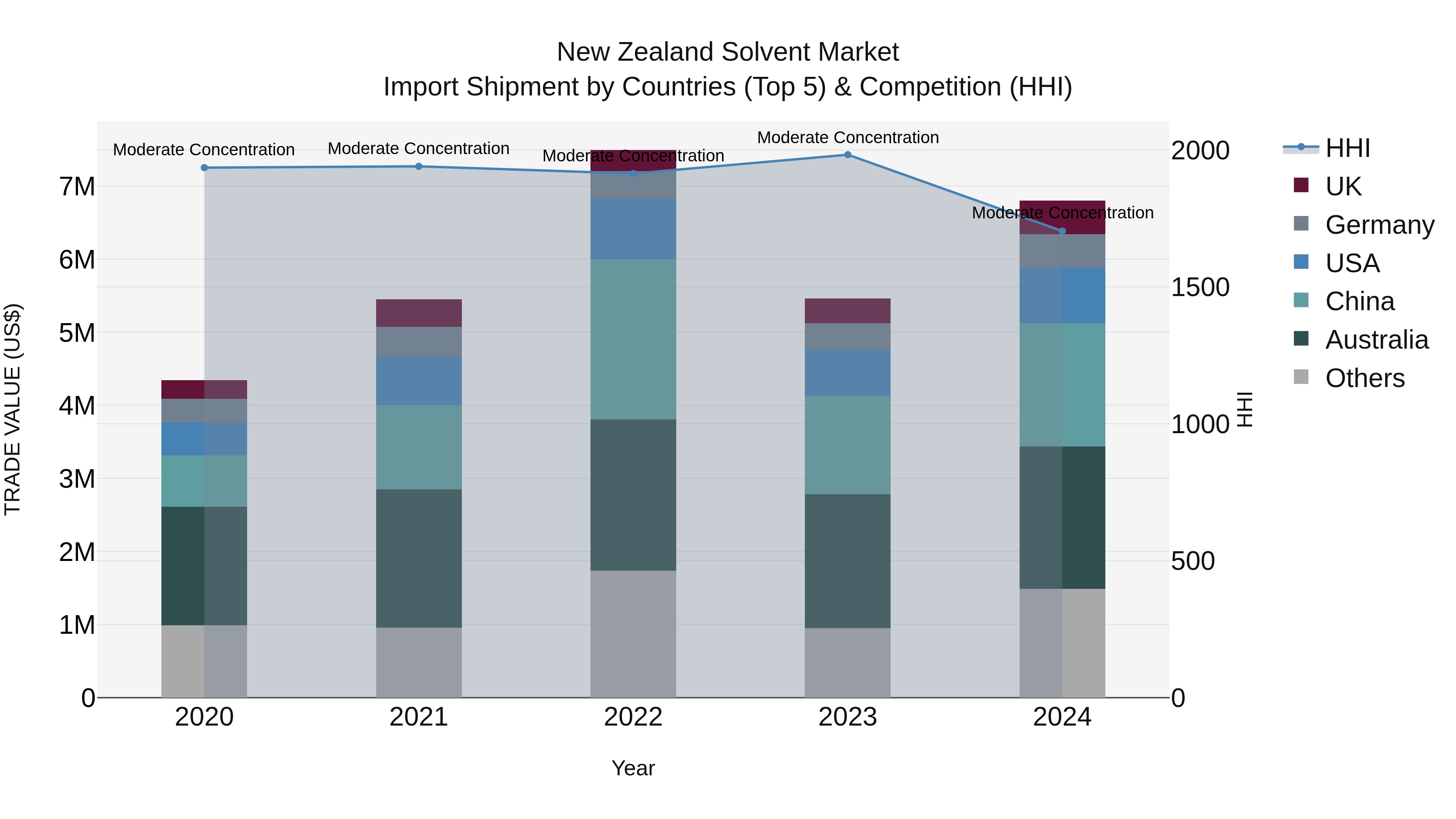
The New Zealand solvent import market continued to show robust growth in 2024, with key exporting countries including Australia, China, USA, UK, and Germany. The market concentration, as measured by the Herfindahl-Hirschman Index (HHI), remained at a moderate level, indicating a competitive landscape. The compound annual growth rate (CAGR) for the period 2020-2024 was strong at 11.84%, with a notable growth spurt of 24.52% from 2023 to 2024. These trends suggest a healthy demand for solvents in New Zealand and a diverse range of sources for import supply.
Key Highlights of the Report:
- New Zealand Solvent Market Outlook
- Market Size of New Zealand Solvent Market, 2025
- Forecast of New Zealand Solvent Market, 2032
- Historical Data and Forecast of New Zealand Solvent Revenues & Volume for the Period 2022 - 2032
- New Zealand Solvent Market Trend Evolution
- New Zealand Solvent Market Drivers and Challenges
- New Zealand Solvent Price Trends
- New Zealand Solvent Porter's Five Forces
- New Zealand Solvent Industry Life Cycle
- Historical Data and Forecast of New Zealand Solvent Market Revenues & Volume By Product for the Period 2022 - 2032
- Historical Data and Forecast of New Zealand Solvent Market Revenues & Volume By Alcohols for the Period 2022 - 2032
- Historical Data and Forecast of New Zealand Solvent Market Revenues & Volume By Hydrocarbons for the Period 2022 - 2032
- Historical Data and Forecast of New Zealand Solvent Market Revenues & Volume By Ketones for the Period 2022 - 2032
- Historical Data and Forecast of New Zealand Solvent Market Revenues & Volume By Esters for the Period 2022 - 2032
- Historical Data and Forecast of New Zealand Solvent Market Revenues & Volume By Chlorinated for the Period 2022 - 2032
- Historical Data and Forecast of New Zealand Solvent Market Revenues & Volume By Others for the Period 2022 - 2032
- Historical Data and Forecast of New Zealand Solvent Market Revenues & Volume By Source for the Period 2022 - 2032
- Historical Data and Forecast of New Zealand Solvent Market Revenues & Volume By Petrochemical-based for the Period 2022 - 2032
- Historical Data and Forecast of New Zealand Solvent Market Revenues & Volume By Bio and Green for the Period 2022 - 2032
- Historical Data and Forecast of New Zealand Solvent Market Revenues & Volume By Application for the Period 2022 - 2032
- Historical Data and Forecast of New Zealand Solvent Market Revenues & Volume By Paints and Coatings for the Period 2022 - 2032
- Historical Data and Forecast of New Zealand Solvent Market Revenues & Volume By Printing Inks for the Period 2022 - 2032
- Historical Data and Forecast of New Zealand Solvent Market Revenues & Volume By Pharmaceuticals for the Period 2022 - 2032
- Historical Data and Forecast of New Zealand Solvent Market Revenues & Volume By Cosmetics and Adhesives for the Period 2022 - 2032
- Historical Data and Forecast of New Zealand Solvent Market Revenues & Volume By Others for the Period 2022 - 2032
- New Zealand Solvent Import Export Trade Statistics
- Market Opportunity Assessment By Product
- Market Opportunity Assessment By Source
- Market Opportunity Assessment By Application
- New Zealand Solvent Top Companies Market Share
- New Zealand Solvent Competitive Benchmarking By Technical and Operational Parameters
- New Zealand Solvent Company Profiles
- New Zealand Solvent Key Strategic Recommendations






































