New Zealand Synthetic Rope Market Top 5 Importing Countries and Market Competition (HHI) Analysis
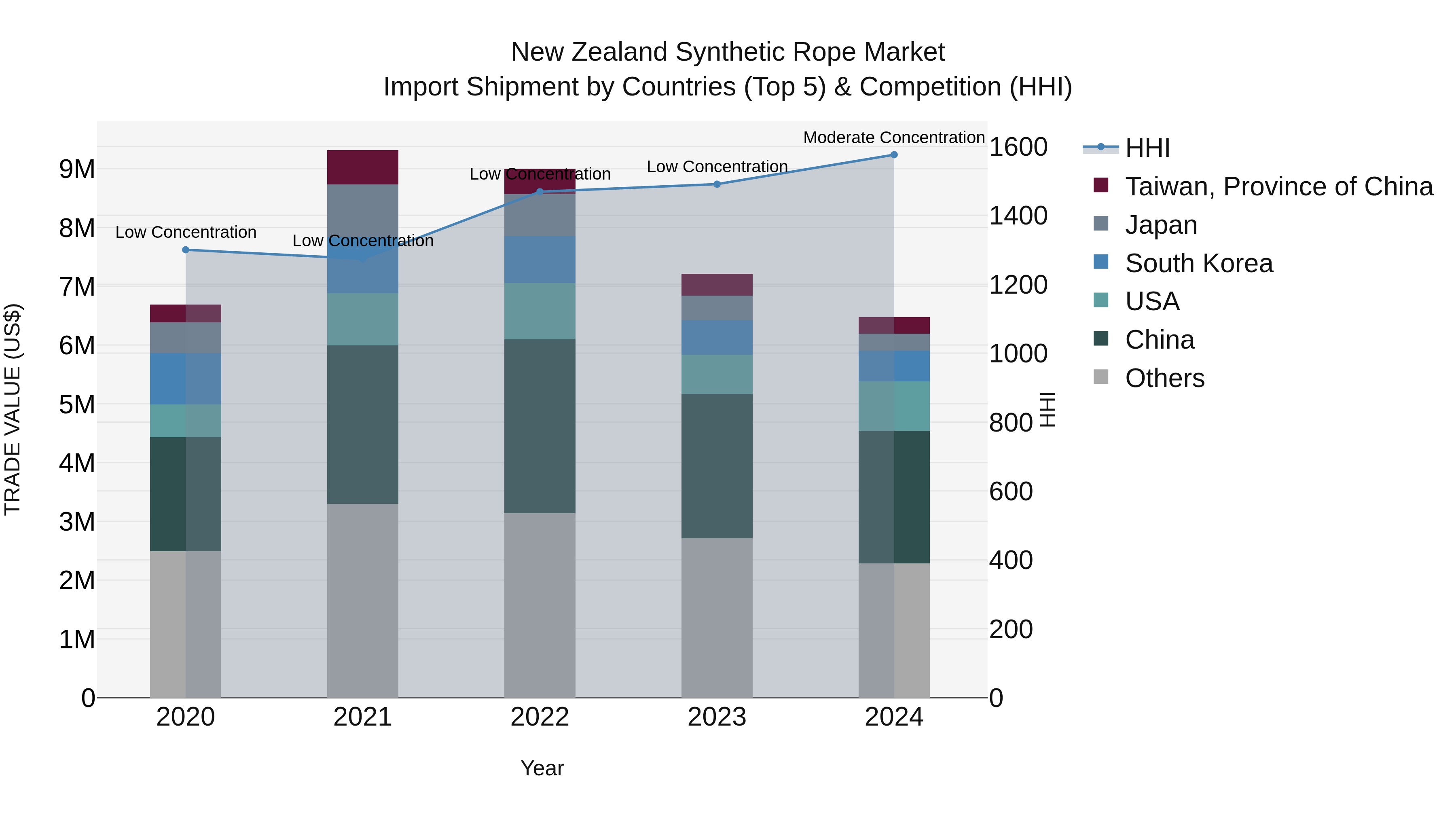
New Zealand saw a shift in synthetic rope import sources in 2024, with China, USA, South Korea, Lithuania, and Japan leading the way. The market witnessed a change from low to moderate concentration, indicating a potential evolution in the competitive landscape. Despite a negative compound annual growth rate (CAGR) of -0.8% from 2020 to 2024, the growth rate in 2024 alone stands at -10.14%. These fluctuations suggest a dynamic market environment that importers and stakeholders should monitor closely for future opportunities and challenges.
Synthetic Rope Market: New Zealand vs Top 5 Major Economies in 2027 (Asia)
By 2027, New Zealand's Synthetic Rope market is forecasted to achieve a stable growth rate of 1.91%, with China leading the Asia region, followed by India, Japan, Australia and South Korea.

Key Highlights of the Report:
- New Zealand Synthetic Rope Market Outlook
- Market Size of New Zealand Synthetic Rope Market, 2025
- Forecast of New Zealand Synthetic Rope Market, 2032
- Historical Data and Forecast of New Zealand Synthetic Rope Revenues & Volume for the Period 2022 - 2032F
- New Zealand Synthetic Rope Market Trend Evolution
- New Zealand Synthetic Rope Market Drivers and Challenges
- New Zealand Synthetic Rope Price Trends
- New Zealand Synthetic Rope Porter`s Five Forces
- New Zealand Synthetic Rope Industry Life Cycle
- Historical Data and Forecast of New Zealand Synthetic Rope Market Revenues & Volume By Material for the Period 2022 - 2032F
- Historical Data and Forecast of New Zealand Synthetic Rope Market Revenues & Volume By Polypropylene for the Period 2022 - 2032F
- Historical Data and Forecast of New Zealand Synthetic Rope Market Revenues & Volume By Polyester for the Period 2022 - 2032F
- Historical Data and Forecast of New Zealand Synthetic Rope Market Revenues & Volume By Nylon for the Period 2022 - 2032F
- Historical Data and Forecast of New Zealand Synthetic Rope Market Revenues & Volume By Polyethylene for the Period 2022 - 2032F
- Historical Data and Forecast of New Zealand Synthetic Rope Market Revenues & Volume By Specialty Fibers for the Period 2022 - 2032F
- Historical Data and Forecast of New Zealand Synthetic Rope Market Revenues & Volume By End Use Industry for the Period 2022 - 2032F
- Historical Data and Forecast of New Zealand Synthetic Rope Market Revenues & Volume By Marine & Fishing for the Period 2022 - 2032F
- Historical Data and Forecast of New Zealand Synthetic Rope Market Revenues & Volume By Oil & Gas for the Period 2022 - 2032F
- Historical Data and Forecast of New Zealand Synthetic Rope Market Revenues & Volume By Sports & Leisure for the Period 2022 - 2032F
- Historical Data and Forecast of New Zealand Synthetic Rope Market Revenues & Volume By Construction for the Period 2022 - 2032F
- Historical Data and Forecast of New Zealand Synthetic Rope Market Revenues & Volume By Others for the Period 2022 - 2032F
- New Zealand Synthetic Rope Import Export Trade Statistics
- Market Opportunity Assessment By Material
- Market Opportunity Assessment By End Use Industry
- New Zealand Synthetic Rope Top Companies Market Share
- New Zealand Synthetic Rope Competitive Benchmarking By Technical and Operational Parameters
- New Zealand Synthetic Rope Company Profiles
- New Zealand Synthetic Rope Key Strategic Recommendations






































