New Zealand Textile Chemicals Market Top 5 Importing Countries and Market Competition (HHI) Analysis
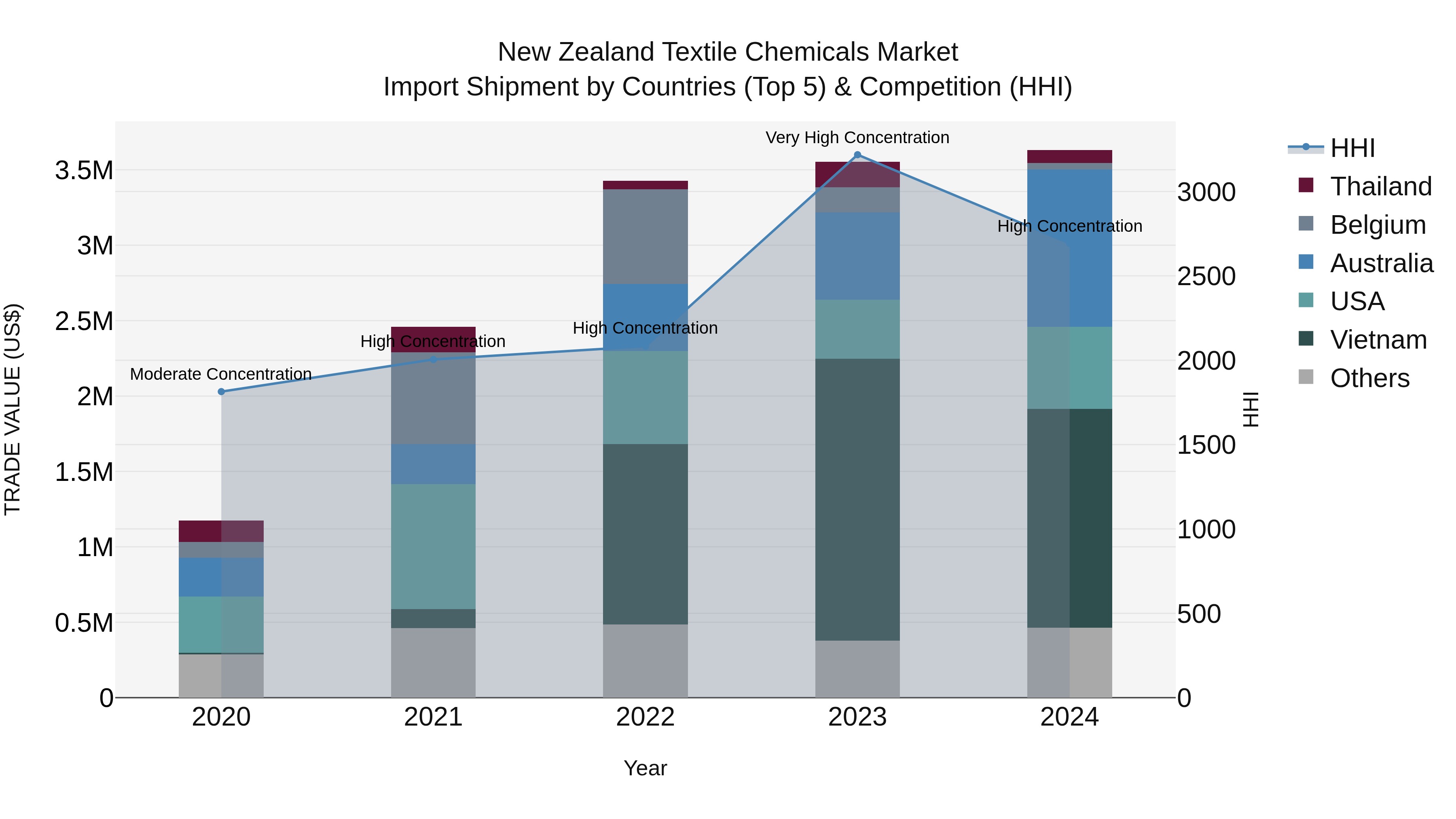
New Zealand`s textile chemicals import market continued to see significant growth in 2024, with key exporting countries including Vietnam, Australia, USA, Germany, and UK. The market concentration, as measured by the HHI, remained high in 2024, indicating a competitive landscape. The impressive compound annual growth rate (CAGR) of 32.59% from 2020 to 2024 reflects the increasing demand for textile chemicals in the region. Although the growth rate slightly slowed from 2023 to 2024 at 2.19%, the market is still showing resilience and opportunities for both domestic and international suppliers.
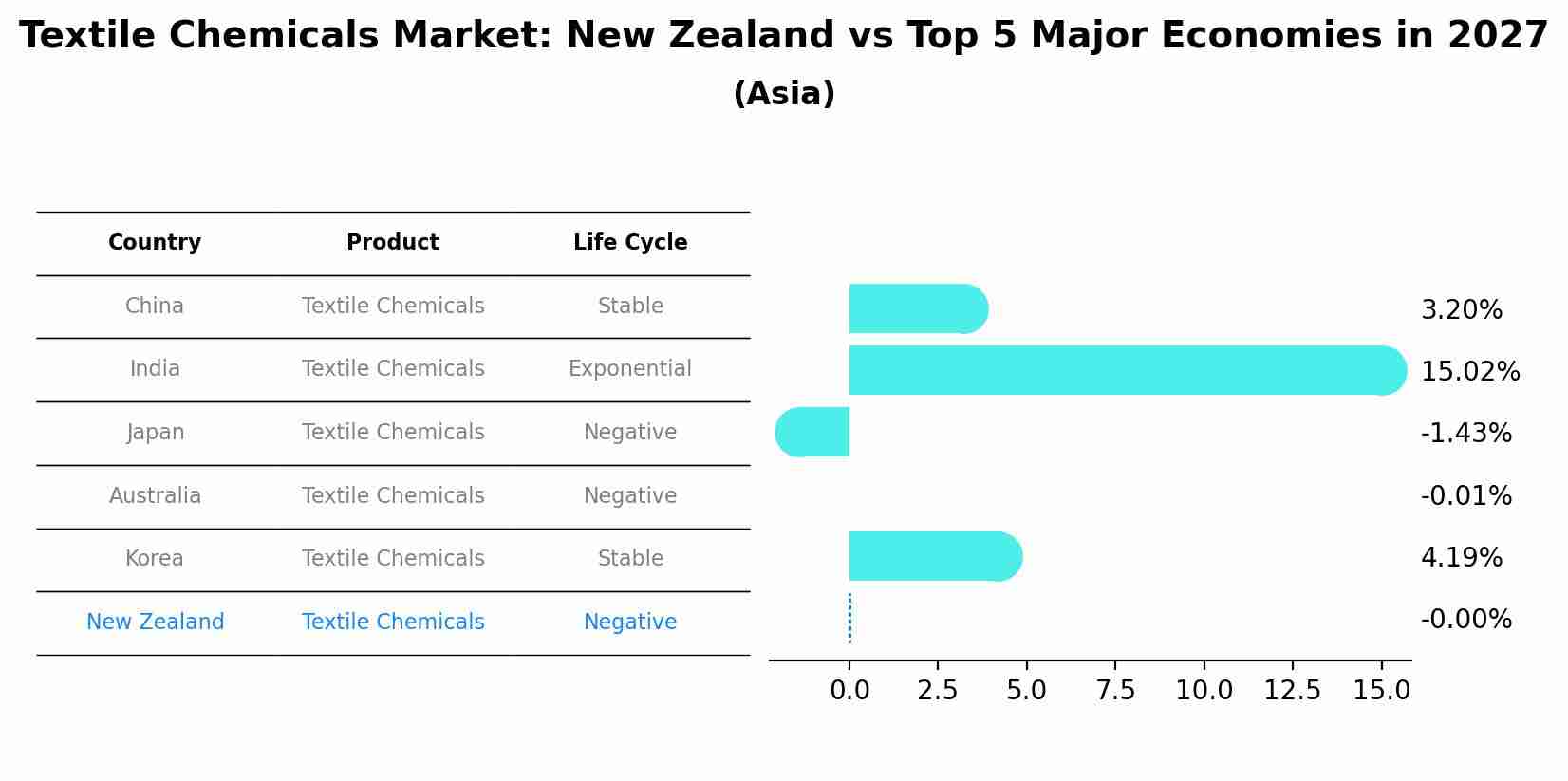
Textile Chemicals Market: New Zealand vs Top 5 Major Economies in 2027 (Asia)
The Textile Chemicals market in New Zealand is projected to grow at a negative growth rate of -0.00% by 2027, within the Asia region led by China, along with other countries like India, Japan, Australia and South Korea, collectively shaping a dynamic and evolving market environment driven by innovation and increasing adoption of emerging technologies.
Key Highlights of the Report:
- New Zealand Textile Chemicals Market Outlook
- Market Size of New Zealand Textile Chemicals Market, 2025
- Forecast of New Zealand Textile Chemicals Market, 2032
- Historical Data and Forecast of New Zealand Textile Chemicals Revenues & Volume for the Period 2022 - 2032F
- New Zealand Textile Chemicals Market Trend Evolution
- New Zealand Textile Chemicals Market Drivers and Challenges
- New Zealand Textile Chemicals Price Trends
- New Zealand Textile Chemicals Porter`s Five Forces
- New Zealand Textile Chemicals Industry Life Cycle
- Historical Data and Forecast of New Zealand Textile Chemicals Market Revenues & Volume By Process for the Period 2022 - 2032F
- Historical Data and Forecast of New Zealand Textile Chemicals Market Revenues & Volume By Pretreatment for the Period 2022 - 2032F
- Historical Data and Forecast of New Zealand Textile Chemicals Market Revenues & Volume By Coating for the Period 2022 - 2032F
- Historical Data and Forecast of New Zealand Textile Chemicals Market Revenues & Volume By Treatment of Finished Products for the Period 2022 - 2032F
- Historical Data and Forecast of New Zealand Textile Chemicals Market Revenues & Volume By Product for the Period 2022 - 2032F
- Historical Data and Forecast of New Zealand Textile Chemicals Market Revenues & Volume By Coating & Sizing Chemicals for the Period 2022 - 2032F
- Historical Data and Forecast of New Zealand Textile Chemicals Market Revenues & Volume By Colorants & Auxiliaries for the Period 2022 - 2032F
- Historical Data and Forecast of New Zealand Textile Chemicals Market Revenues & Volume By Finishing Agents for the Period 2022 - 2032F
- Historical Data and Forecast of New Zealand Textile Chemicals Market Revenues & Volume By Surfactants for the Period 2022 - 2032F
- Historical Data and Forecast of New Zealand Textile Chemicals Market Revenues & Volume By Denim Finishing Agents for the Period 2022 - 2032F
- Historical Data and Forecast of New Zealand Textile Chemicals Market Revenues & Volume By Application for the Period 2022 - 2032F
- Historical Data and Forecast of New Zealand Textile Chemicals Market Revenues & Volume By Apparel for the Period 2022 - 2032F
- Historical Data and Forecast of New Zealand Textile Chemicals Market Revenues & Volume By Home Furnishing for the Period 2022 - 2032F
- Historical Data and Forecast of New Zealand Textile Chemicals Market Revenues & Volume By Technical Textiles for the Period 2022 - 2032F
- New Zealand Textile Chemicals Import Export Trade Statistics
- Market Opportunity Assessment By Process
- Market Opportunity Assessment By Product
- Market Opportunity Assessment By Application
- New Zealand Textile Chemicals Top Companies Market Share
- New Zealand Textile Chemicals Competitive Benchmarking By Technical and Operational Parameters
- New Zealand Textile Chemicals Company Profiles
- New Zealand Textile Chemicals Key Strategic Recommendations






































