New Zealand Timing Belt Market Growth Rate Analysis (2025 - 2031)
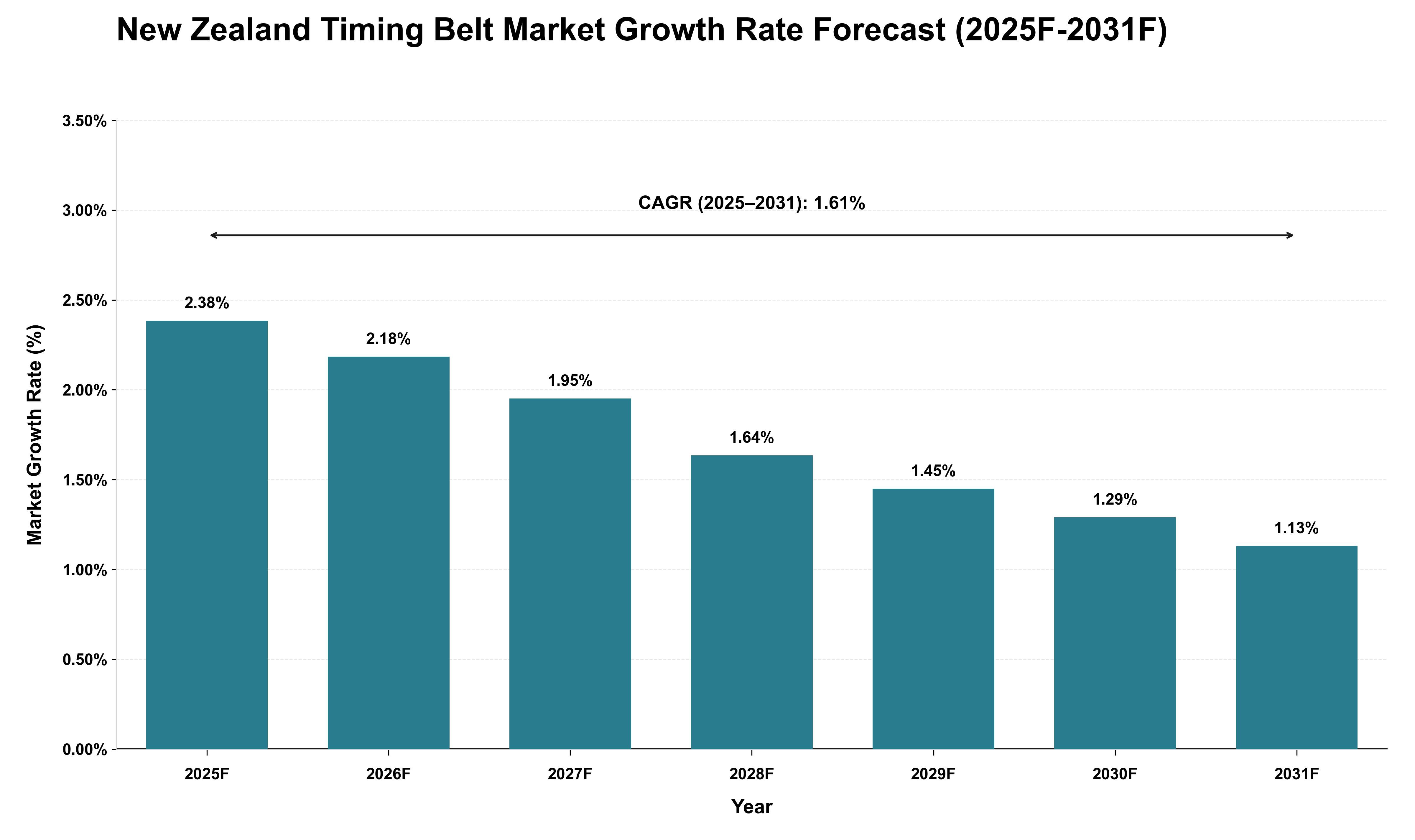
The New Zealand timing belt market will experience a gradual growth trajectory driven by several macroeconomic factors, including automotive production trends and maintenance demand. As vehicle ownership rates continue to rise, the need for replacement parts, particularly timing belts, will remain robust. The projected CAGR of 1.61% reflects a deceleration in annual growth rates from 2.38% in 2025 to 1.13% by 2031, indicating a shift towards more stable consumption patterns as the market adjusts to evolving automotive technologies and consumer preferences. Import dependencies may influence pricing dynamics and availability, particularly as global supply chains adapt to changing trade policies and environmental regulations. Additionally, cyclical trends in vehicle servicing intervals will play a critical role; as vehicles age, the demand for timing belt replacements will likely increase initially but may taper off as newer models with longer-lasting components enter the market.
Key Highlights of the Report:
- New Zealand Timing Belt Market Outlook
- Market Size of New Zealand Timing Belt Market, 2025
- Forecast of New Zealand Timing Belt Market, 2032
- Historical Data and Forecast of New Zealand Timing Belt Revenues & Volume for the Period 2022 - 2032F
- New Zealand Timing Belt Market Trend Evolution
- New Zealand Timing Belt Market Drivers and Challenges
- New Zealand Timing Belt Price Trends
- New Zealand Timing Belt Porter`s Five Forces
- New Zealand Timing Belt Industry Life Cycle
- Historical Data and Forecast of New Zealand Timing Belt Market Revenues & Volume By Drive Type for the Period 2022 - 2032F
- Historical Data and Forecast of New Zealand Timing Belt Market Revenues & Volume By Dry Belts for the Period 2022 - 2032F
- Historical Data and Forecast of New Zealand Timing Belt Market Revenues & Volume By Chain for the Period 2022 - 2032F
- Historical Data and Forecast of New Zealand Timing Belt Market Revenues & Volume By Belt in Oil for the Period 2022 - 2032F
- Historical Data and Forecast of New Zealand Timing Belt Market Revenues & Volume By Component for the Period 2022 - 2032F
- Historical Data and Forecast of New Zealand Timing Belt Market Revenues & Volume By Idler Pulley for the Period 2022 - 2032F
- Historical Data and Forecast of New Zealand Timing Belt Market Revenues & Volume By Sprocket for the Period 2022 - 2032F
- Historical Data and Forecast of New Zealand Timing Belt Market Revenues & Volume By Tensioner for the Period 2022 - 2032F
- Historical Data and Forecast of New Zealand Timing Belt Market Revenues & Volume By Timing Shield/Cover for the Period 2022 - 2032F
- Historical Data and Forecast of New Zealand Timing Belt Market Revenues & Volume By ICE & Hybrid for the Period 2022 - 2032F
- Historical Data and Forecast of New Zealand Timing Belt Market Revenues & Volume By Passenger Car for the Period 2022 - 2032F
- Historical Data and Forecast of New Zealand Timing Belt Market Revenues & Volume By Commercial Vehicle for the Period 2022 - 2032F
- Historical Data and Forecast of New Zealand Timing Belt Market Revenues & Volume By HEV for the Period 2022 - 2032F
- Historical Data and Forecast of New Zealand Timing Belt Market Revenues & Volume By PHEV for the Period 2022 - 2032F
- New Zealand Timing Belt Import Export Trade Statistics
- Market Opportunity Assessment By Drive Type
- Market Opportunity Assessment By Component
- Market Opportunity Assessment By ICE & Hybrid
- New Zealand Timing Belt Top Companies Market Share
- New Zealand Timing Belt Competitive Benchmarking By Technical and Operational Parameters
- New Zealand Timing Belt Company Profiles
- New Zealand Timing Belt Key Strategic Recommendations






































