Nigeria Anhydrite Market Top 5 Importing Countries and Market Competition (HHI) Analysis
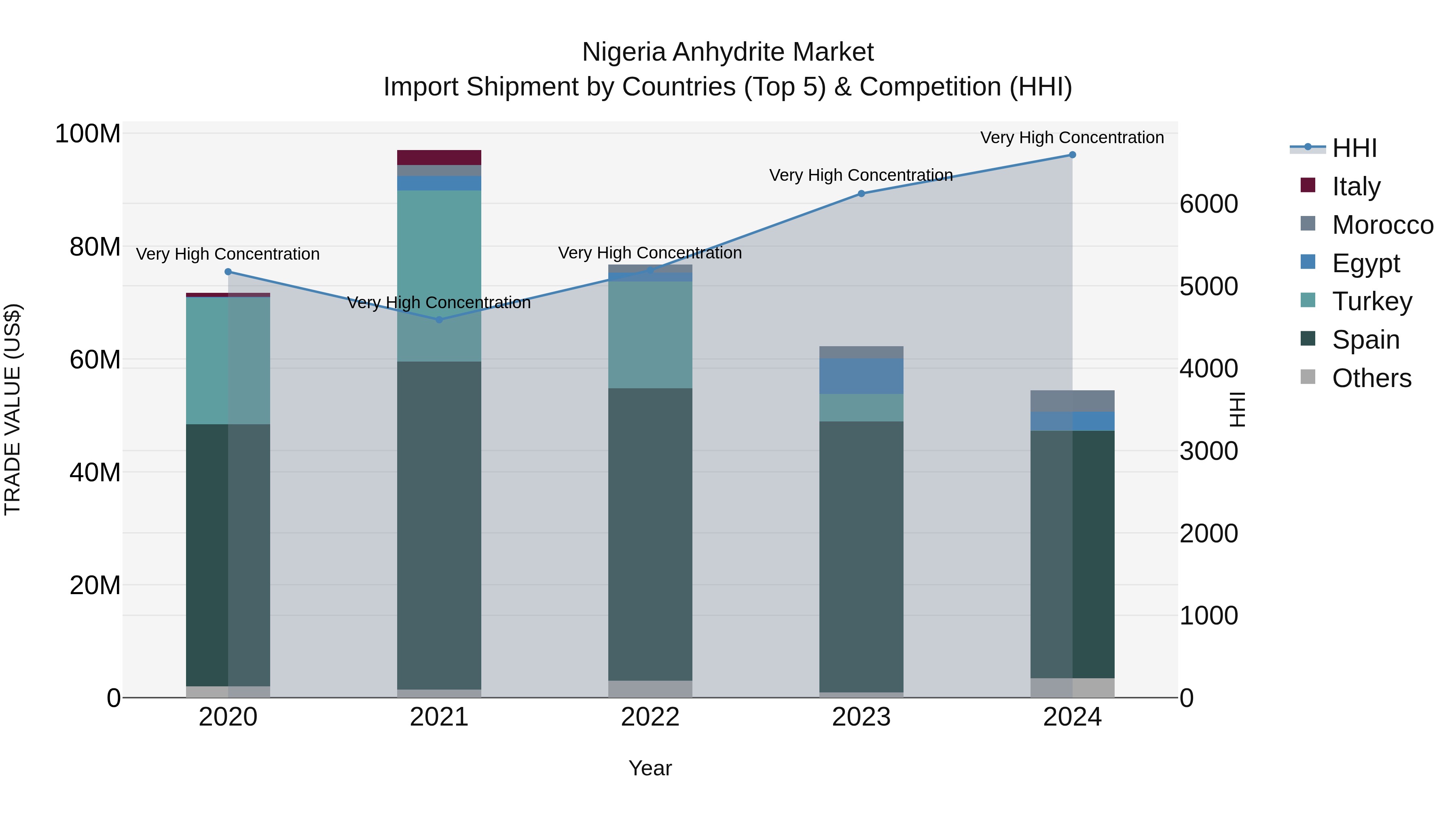
Despite a decline in the anhydrite import shipments to Nigeria in 2024, the market remained highly concentrated with the top exporting countries being Spain, Morocco, Egypt, Andorra, and Oman. The high Herfindahl-Hirschman Index (HHI) indicates a consolidated market structure. The negative compound annual growth rate (CAGR) of -6.64% from 2020 to 2024 and a further decline in growth rate of -12.53% from 2023 to 2024 suggest challenges in the Nigerian anhydrite import market, possibly influenced by various economic factors and global trade dynamics.
Nigeria Anhydrite Market Synopsis
The Nigeria Anhydrite market is witnessing steady growth driven by increasing demand from industries such as construction, agriculture, and healthcare. Anhydrite, a mineral form of calcium sulfate, is primarily used in the production of cement, fertilizers, and as a drying agent in various industrial processes. The construction sector, in particular, is a major consumer of anhydrite due to its use in gypsum-based products like plasterboard and cement. Additionally, the agriculture sector utilizes anhydrite as a soil conditioner to improve crop yield. The healthcare industry also contributes to the market through the use of anhydrite in pharmaceuticals and medical devices. Overall, the Nigeria Anhydrite market shows promising growth prospects, driven by diverse industrial applications and increasing infrastructure development in the country.
Nigeria Anhydrite Market Trends
The Nigeria anhydrite market is experiencing steady growth driven by the expanding construction and agriculture sectors. Anhydrite is increasingly being utilized as a soil conditioner in agriculture due to its ability to improve soil structure and enhance nutrient absorption. In the construction industry, anhydrite is being used as a binder in self-leveling flooring compounds and as a raw material in the production of gypsum products. The market is also benefiting from the rising demand for anhydrite in industrial applications such as cement production. Key players in the Nigeria anhydrite market are focusing on product innovation and strategic collaborations to gain a competitive edge. Overall, the market is expected to continue its growth trajectory in the coming years, supported by favorable government policies and increasing infrastructure development projects.
Nigeria Anhydrite Market Challenges
In the Nigeria Anhydrite market, a key challenge is the limited awareness and understanding of the product among potential consumers and industries. Anhydrite is a lesser-known mineral compared to other building materials like gypsum, leading to a lack of demand and market penetration. Additionally, the inconsistent quality of anhydrite deposits in Nigeria can pose challenges in maintaining product standards and meeting customer requirements. Infrastructure constraints, such as limited transportation facilities and inadequate processing plants, also hinder the growth of the anhydrite market in Nigeria. Overcoming these challenges would require targeted marketing efforts to educate consumers, investments in quality control measures, and improvements in the logistical and processing infrastructure to enhance the competitiveness of anhydrite in the local market.
Nigeria Anhydrite Market Investment Opportunities
The Nigeria Anhydrite Market presents several investment opportunities. With the growing construction industry in Nigeria, there is an increasing demand for anhydrite as a key raw material in construction materials such as cement and plaster. Investing in anhydrite mining and processing facilities can be lucrative, as the market is set to expand further with infrastructure development projects in the country. Additionally, anhydrite is also used in agriculture as a soil conditioner, offering opportunities for investment in the agricultural sector. Collaborating with local construction companies and manufacturers to supply anhydrite can also be a profitable venture. Overall, the Nigeria Anhydrite Market offers diverse investment prospects driven by the country`s infrastructure development and agricultural sectors.
Nigeria Anhydrite Market Future Outlook
The Nigeria Anhydrite Market is expected to witness steady growth in the coming years due to the increasing demand for anhydrite in various industries such as construction, agriculture, and cement production. As Nigeria continues to invest in infrastructure development and urbanization projects, the demand for anhydrite as a key ingredient in construction materials like gypsum plaster and cement is projected to rise. Additionally, the growing agricultural sector in the country is driving the demand for anhydrite as a soil conditioner to improve crop yields. With favorable government initiatives supporting industrial growth and the construction sector, the Nigeria Anhydrite Market is poised for expansion in the foreseeable future. However, challenges such as fluctuating raw material prices and environmental concerns may impact market dynamics.
Key Highlights of the Report:
- Nigeria Anhydrite Market Outlook
- Market Size of Nigeria Anhydrite Market, 2024
- Forecast of Nigeria Anhydrite Market, 2031
- Historical Data and Forecast of Nigeria Anhydrite Revenues & Volume for the Period 2021 - 2031
- Nigeria Anhydrite Market Trend Evolution
- Nigeria Anhydrite Market Drivers and Challenges
- Nigeria Anhydrite Price Trends
- Nigeria Anhydrite Porter's Five Forces
- Nigeria Anhydrite Industry Life Cycle
- Historical Data and Forecast of Nigeria Anhydrite Market Revenues & Volume By Type for the Period 2021 - 2031
- Historical Data and Forecast of Nigeria Anhydrite Market Revenues & Volume By Natural for the Period 2021 - 2031
- Historical Data and Forecast of Nigeria Anhydrite Market Revenues & Volume By Synthetic for the Period 2021 - 2031
- Historical Data and Forecast of Nigeria Anhydrite Market Revenues & Volume By Application for the Period 2021 - 2031
- Historical Data and Forecast of Nigeria Anhydrite Market Revenues & Volume By Soil Treatment for the Period 2021 - 2031
- Historical Data and Forecast of Nigeria Anhydrite Market Revenues & Volume By Construction for the Period 2021 - 2031
- Historical Data and Forecast of Nigeria Anhydrite Market Revenues & Volume By Fertilizers for the Period 2021 - 2031
- Historical Data and Forecast of Nigeria Anhydrite Market Revenues & Volume By Industrial for the Period 2021 - 2031
- Historical Data and Forecast of Nigeria Anhydrite Market Revenues & Volume By Drying Agents for the Period 2021 - 2031
- Historical Data and Forecast of Nigeria Anhydrite Market Revenues & Volume By Others for the Period 2021 - 2031
- Nigeria Anhydrite Import Export Trade Statistics
- Market Opportunity Assessment By Type
- Market Opportunity Assessment By Application
- Nigeria Anhydrite Top Companies Market Share
- Nigeria Anhydrite Competitive Benchmarking By Technical and Operational Parameters
- Nigeria Anhydrite Company Profiles
- Nigeria Anhydrite Key Strategic Recommendations






































