Nigeria Apparel Accessories Market Top 5 Importing Countries and Market Competition (HHI) Analysis
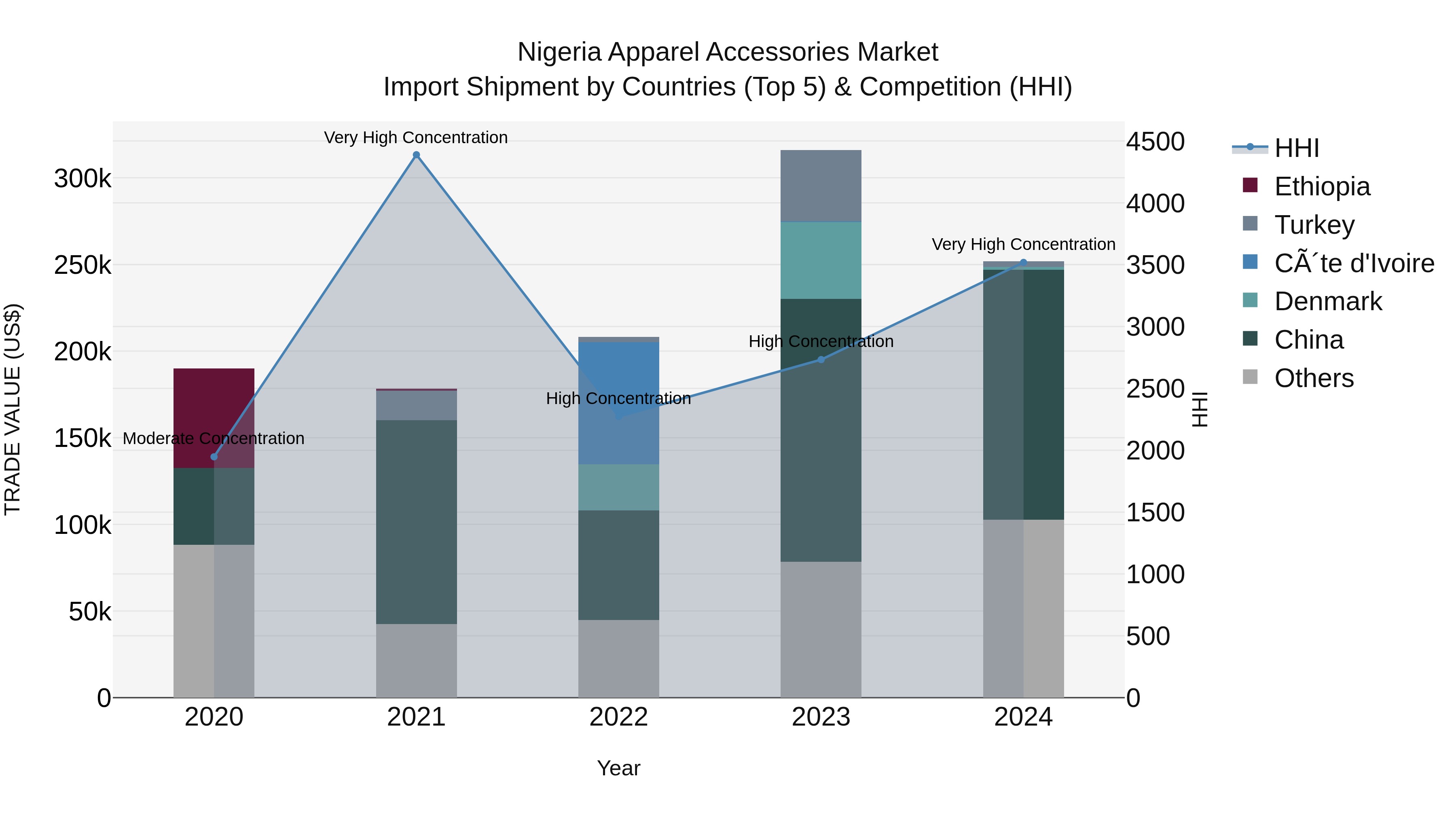
The Nigeria apparel accessories import market continues to show strong growth with a CAGR of 7.32% from 2020 to 2024. However, the market experienced a significant decline in growth rate from 2023 to 2024, with a -20.27% drop. The top countries exporting to Nigeria in 2024 are China, Metropolitan France, Indonesia, Italy, and Netherlands. The market concentration, as measured by HHI, has increased from high to very high in 2024, indicating a more consolidated market landscape. This trend suggests a competitive environment with dominant players in the apparel accessories import sector.
Nigeria Apparel Accessories Market Synopsis
The Nigeria Apparel Accessories Market is experiencing steady growth driven by increasing urbanization, rising disposable income, and a growing fashion-conscious consumer base. The market includes a wide range of products such as handbags, belts, jewelry, hats, and scarves, catering to diverse consumer preferences. Key players in the market offer a mix of local and international brands, with a focus on quality, affordability, and trendy designs. E-commerce platforms are playing a significant role in expanding the market reach, providing consumers with convenient access to a variety of apparel accessories. The market is also witnessing a shift towards sustainable and ethically sourced products, reflecting a growing awareness of environmental and social responsibility among consumers. Overall, the Nigeria Apparel Accessories Market presents opportunities for both domestic and foreign manufacturers to tap into the country`s growing fashion market.
Nigeria Apparel Accessories Market Trends
The Nigeria Apparel Accessories Market is experiencing a shift towards sustainability and ethically sourced products, driven by increased consumer awareness and demand for environmentally friendly options. Local artisans and small businesses are gaining popularity, offering unique and handmade accessories that cater to the growing interest in supporting local craftsmanship. Additionally, the market is witnessing a rise in the adoption of technology, with more brands incorporating e-commerce platforms and social media marketing to reach a wider audience. Influencer collaborations and brand partnerships are also on the rise, contributing to the market`s growth and diversification. Overall, the Nigeria Apparel Accessories Market is evolving to meet the changing preferences of consumers, focusing on sustainability, authenticity, and digital innovation.
Nigeria Apparel Accessories Market Challenges
In the Nigeria Apparel Accessories Market, some of the key challenges faced include intense competition from both local and international brands, the prevalence of counterfeit products, inconsistent government policies affecting the industry, inadequate infrastructure leading to logistical issues, and a relatively low purchasing power among a significant portion of the population. Additionally, the market also grapples with the impact of fluctuating exchange rates on import costs, limited access to finance for small and medium-sized businesses, and a lack of skilled labor in certain segments of the industry. Overcoming these challenges requires strategic marketing efforts, quality control measures to combat counterfeiting, advocacy for favorable policies, investments in infrastructure, and initiatives to enhance skills development within the sector.
Nigeria Apparel Accessories Market Investment Opportunities
The Nigeria apparel accessories market offers promising investment opportunities due to the country`s growing fashion industry and increasing consumer spending on clothing and accessories. With a large and youthful population, there is a high demand for trendy and affordable accessories such as jewelry, handbags, scarves, and footwear. Investing in the development of local brands, online retail platforms, and physical stores can be lucrative in this market. Additionally, there is potential for partnerships with local designers and artisans to create unique and culturally-inspired accessories that cater to both domestic and international markets. With the right marketing strategies and quality products, investors can tap into the thriving fashion scene in Nigeria and capitalize on the growing interest in apparel accessories.
Nigeria Apparel Accessories Market Future Outlook
The future outlook for the Nigeria Apparel Accessories Market appears to be positive, driven by factors such as increasing disposable income, changing fashion trends, and a growing young population with a strong interest in personal style. The market is expected to witness growth as consumers seek to express their individuality through accessories such as jewelry, handbags, and scarves. Furthermore, the rise of e-commerce platforms and social media influence is expected to boost market accessibility and visibility for both local and international brands. Key players in the market are likely to focus on expanding their product offerings, enhancing their online presence, and engaging in strategic marketing efforts to capitalize on the growing demand for apparel accessories in Nigeria.
Key Highlights of the Report:
- Nigeria Apparel Accessories Market Outlook
- Market Size of Nigeria Apparel Accessories Market, 2024
- Forecast of Nigeria Apparel Accessories Market, 2031
- Historical Data and Forecast of Nigeria Apparel Accessories Revenues & Volume for the Period 2021 - 2031
- Nigeria Apparel Accessories Market Trend Evolution
- Nigeria Apparel Accessories Market Drivers and Challenges
- Nigeria Apparel Accessories Price Trends
- Nigeria Apparel Accessories Porter's Five Forces
- Nigeria Apparel Accessories Industry Life Cycle
- Historical Data and Forecast of Nigeria Apparel Accessories Market Revenues & Volume By Product for the Period 2021 - 2031
- Historical Data and Forecast of Nigeria Apparel Accessories Market Revenues & Volume By Belts for the Period 2021 - 2031
- Historical Data and Forecast of Nigeria Apparel Accessories Market Revenues & Volume By Handbags for the Period 2021 - 2031
- Historical Data and Forecast of Nigeria Apparel Accessories Market Revenues & Volume By Scarves for the Period 2021 - 2031
- Historical Data and Forecast of Nigeria Apparel Accessories Market Revenues & Volume By Eye wear for the Period 2021 - 2031
- Historical Data and Forecast of Nigeria Apparel Accessories Market Revenues & Volume By Jewelry for the Period 2021 - 2031
- Historical Data and Forecast of Nigeria Apparel Accessories Market Revenues & Volume By Neckties for the Period 2021 - 2031
- Historical Data and Forecast of Nigeria Apparel Accessories Market Revenues & Volume By Gloves for the Period 2021 - 2031
- Historical Data and Forecast of Nigeria Belts Apparel Accessories Market Revenues & Volume By Others for the Period 2021 - 2031
- Historical Data and Forecast of Nigeria Apparel Accessories Market Revenues & Volume By Demographic for the Period 2021 - 2031
- Historical Data and Forecast of Nigeria Apparel Accessories Market Revenues & Volume By Men for the Period 2021 - 2031
- Historical Data and Forecast of Nigeria Apparel Accessories Market Revenues & Volume By Women for the Period 2021 - 2031
- Historical Data and Forecast of Nigeria Apparel Accessories Market Revenues & Volume By Children for the Period 2021 - 2031
- Historical Data and Forecast of Nigeria Apparel Accessories Market Revenues & Volume By Price for the Period 2021 - 2031
- Historical Data and Forecast of Nigeria Apparel Accessories Market Revenues & Volume By Economical Apparel Accessories for the Period 2021 - 2031
- Historical Data and Forecast of Nigeria Apparel Accessories Market Revenues & Volume By Mid-range Apparel Accessories for the Period 2021 - 2031
- Historical Data and Forecast of Nigeria Apparel Accessories Market Revenues & Volume By Premium Apparel Accessories for the Period 2021 - 2031
- Historical Data and Forecast of Nigeria Apparel Accessories Market Revenues & Volume By Super-premium Apparel Accessories for the Period 2021 - 2031
- Historical Data and Forecast of Nigeria Apparel Accessories Market Revenues & Volume By Sales Channel for the Period 2021 - 2031
- Historical Data and Forecast of Nigeria Apparel Accessories Market Revenues & Volume By Apparel Accessories Sold through Modern Trade for the Period 2021 - 2031
- Historical Data and Forecast of Nigeria Apparel Accessories Market Revenues & Volume By Apparel Accessories Sold at Franchise Outlets for the Period 2021 - 2031
- Historical Data and Forecast of Nigeria Apparel Accessories Market Revenues & Volume By Apparel Accessories Sold at Specialty Stores for the Period 2021 - 2031
- Historical Data and Forecast of Nigeria Apparel Accessories Market Revenues & Volume By Others for the Period 2021 - 2031
- Nigeria Apparel Accessories Import Export Trade Statistics
- Market Opportunity Assessment By Product
- Market Opportunity Assessment By Demographic
- Market Opportunity Assessment By Price
- Market Opportunity Assessment By Sales Channel
- Nigeria Apparel Accessories Top Companies Market Share
- Nigeria Apparel Accessories Competitive Benchmarking By Technical and Operational Parameters
- Nigeria Apparel Accessories Company Profiles
- Nigeria Apparel Accessories Key Strategic Recommendations






































