Nigeria Aquatic Herbicides Market Top 5 Importing Countries and Market Competition (HHI) Analysis
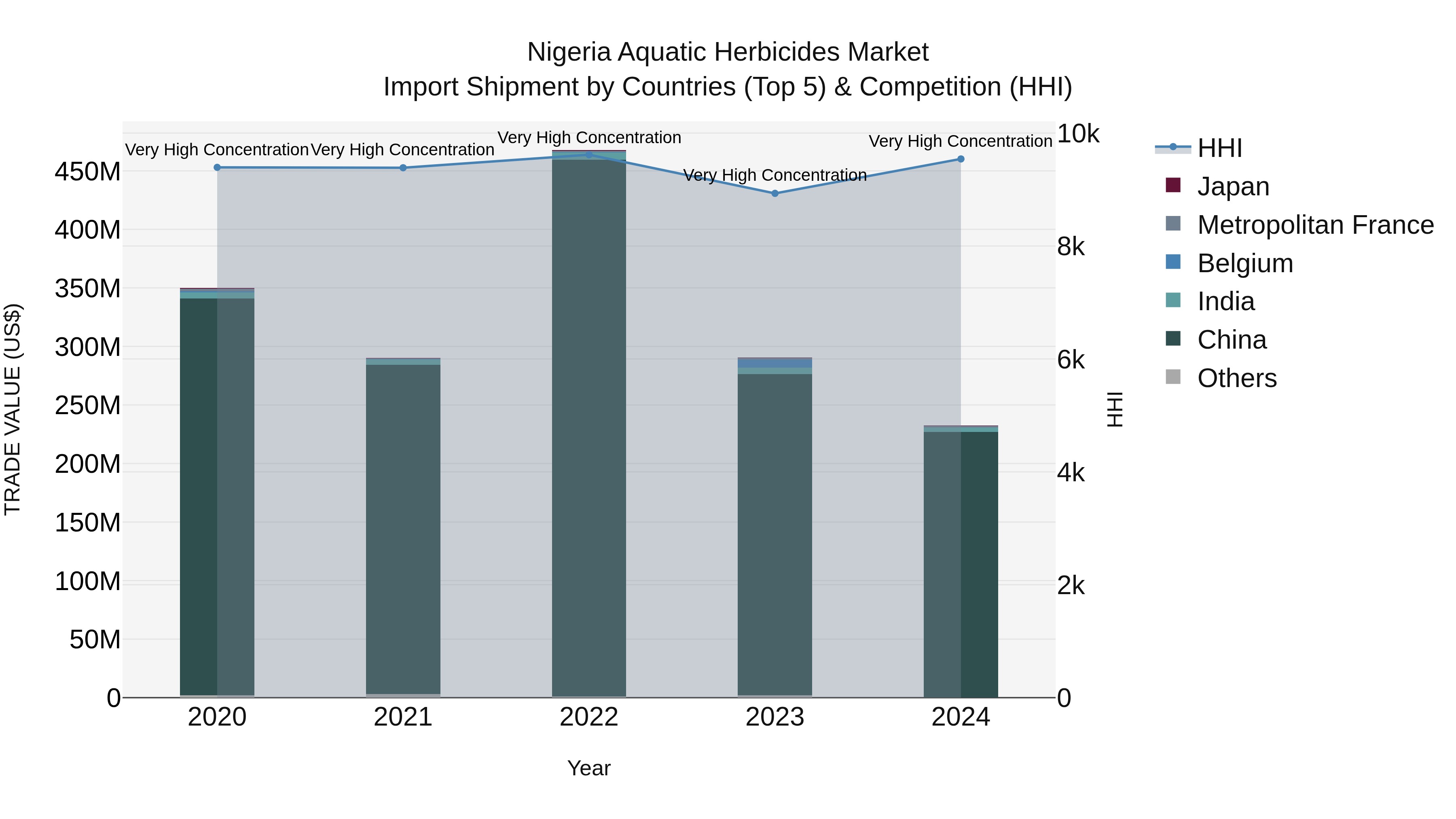
Despite a decline in the growth rate of aquatic herbicides import shipments to Nigeria in 2024, the market continues to be dominated by top exporters such as China, India, Metropolitan France, Japan, and Malaysia. The high Herfindahl-Hirschman Index (HHI) concentration signifies limited competition in the market. The negative Compound Annual Growth Rate (CAGR) from 2020-24 and a further decrease in the growth rate from 2023-24 indicate potential challenges and evolving dynamics within the aquatic herbicides import sector in Nigeria. Monitoring trends and understanding market shifts will be crucial for businesses operating in this space.
Nigeria Aquatic Herbicides Market Synopsis
The Nigeria Aquatic Herbicides Market is experiencing steady growth driven by increasing awareness among farmers and agricultural organizations regarding the importance of controlling aquatic weeds to enhance crop yields. The market is primarily dominated by key players offering a wide range of herbicides tailored for different types of aquatic vegetation. Factors such as government initiatives to promote sustainable agriculture, rising adoption of modern farming practices, and the expansion of aquaculture activities are further fueling the market growth. Additionally, ongoing research and development efforts to introduce innovative herbicide formulations with improved efficiency and environmental safety are expected to drive market expansion in the coming years. Overall, the Nigeria Aquatic Herbicides Market presents lucrative opportunities for manufacturers and suppliers looking to capitalize on the country`s evolving agricultural landscape.
Nigeria Aquatic Herbicides Market Trends
The Nigeria Aquatic Herbicides Market is experiencing growth due to increasing awareness about the negative impacts of invasive aquatic plants on water bodies. There is a rising demand for effective and environmentally friendly herbicides to control these invasive species and maintain the health of aquatic ecosystems. Key trends include the adoption of bio-based herbicides, advancements in herbicide technology for targeted application, and increasing government initiatives to promote sustainable water management practices. Opportunities in the market lie in the development of innovative formulations that are safe for aquatic life, expanding distribution networks to reach more regions in Nigeria, and offering training and support services to educate users on proper herbicide application techniques. Overall, the Nigeria Aquatic Herbicides Market shows promise for growth and innovation in addressing the challenges of aquatic weed control.
Nigeria Aquatic Herbicides Market Challenges
The Nigeria Aquatic Herbicides Market faces several challenges, including limited awareness and knowledge among farmers and agricultural workers regarding the proper use and benefits of aquatic herbicides. Additionally, the lack of regulation and control measures in place for the distribution and application of herbicides poses a significant challenge, leading to misuse and environmental damage. Furthermore, the presence of counterfeit and substandard herbicides in the market further complicates the issue, affecting the effectiveness and safety of the products. Insufficient access to quality herbicides, inadequate infrastructure for distribution, and the high cost of herbicides also hinder the growth of the market in Nigeria. Addressing these challenges through education, regulation, quality control, and improved access to reliable products is crucial for the sustainable development of the Nigeria Aquatic Herbicides Market.
Nigeria Aquatic Herbicides Market Investment Opportunities
The Nigeria Aquatic Herbicides Market is primarily driven by several factors such as the increasing awareness among farmers about the benefits of using herbicides to control aquatic weeds and improve crop yields. Additionally, the rising demand for food security and the need to enhance agricultural productivity are driving the market growth. Government initiatives to promote modern agricultural practices and the adoption of advanced technologies are also boosting the market. Furthermore, the growing aquaculture industry in Nigeria is creating a significant demand for aquatic herbicides to maintain water quality and ensure optimal growth conditions for fish and other aquatic organisms. Overall, the Nigeria Aquatic Herbicides Market is expected to continue expanding due to these key drivers.
Nigeria Aquatic Herbicides Market Government Polices
In Nigeria, the regulation of aquatic herbicides falls under the purview of the National Agency for Food and Drug Administration and Control (NAFDAC) and the Federal Ministry of Environment. Aquatic herbicides must undergo rigorous evaluation and approval processes to ensure they meet safety and efficacy standards before being marketed and used in the country. Additionally, the government has established guidelines and restrictions on the use of aquatic herbicides to protect aquatic ecosystems and human health. Companies operating in the Nigeria aquatic herbicides market must comply with these regulations to ensure the sustainability of the environment and the safety of consumers.
Nigeria Aquatic Herbicides Market Future Outlook
The Nigeria Aquatic Herbicides Market is poised for significant growth in the coming years due to several factors. With increasing awareness about the harmful effects of invasive aquatic plants on water bodies and ecosystems, there is a growing demand for effective herbicides to manage these issues. Additionally, the expansion of aquaculture and agricultural activities near water sources further drives the need for aquatic herbicides to control weed growth. Government initiatives to promote sustainable water management practices and environmental conservation are also expected to boost the market. However, challenges related to environmental regulations and concerns about the impact of herbicides on aquatic life may hinder market growth. Overall, the Nigeria Aquatic Herbicides Market is projected to experience steady expansion as the importance of maintaining healthy water ecosystems gains more attention.
Key Highlights of the Report:
- Nigeria Aquatic Herbicides Market Outlook
- Market Size of Nigeria Aquatic Herbicides Market, 2024
- Forecast of Nigeria Aquatic Herbicides Market, 2031
- Historical Data and Forecast of Nigeria Aquatic Herbicides Revenues & Volume for the Period 2021 - 2031
- Nigeria Aquatic Herbicides Market Trend Evolution
- Nigeria Aquatic Herbicides Market Drivers and Challenges
- Nigeria Aquatic Herbicides Price Trends
- Nigeria Aquatic Herbicides Porter's Five Forces
- Nigeria Aquatic Herbicides Industry Life Cycle
- Historical Data and Forecast of Nigeria Aquatic Herbicides Market Revenues & Volume By Type for the Period 2021 - 2031
- Historical Data and Forecast of Nigeria Aquatic Herbicides Market Revenues & Volume By Glyphosate for the Period 2021 - 2031
- Historical Data and Forecast of Nigeria Aquatic Herbicides Market Revenues & Volume By 2 for the Period 2021 - 2031
- Historical Data and Forecast of Nigeria Aquatic Herbicides Market Revenues & Volume By 4-D for the Period 2021 - 2031
- Historical Data and Forecast of Nigeria Aquatic Herbicides Market Revenues & Volume By Imazapyr for the Period 2021 - 2031
- Historical Data and Forecast of Nigeria Aquatic Herbicides Market Revenues & Volume By Diquat for the Period 2021 - 2031
- Historical Data and Forecast of Nigeria Aquatic Herbicides Market Revenues & Volume By Triclopyr for the Period 2021 - 2031
- Historical Data and Forecast of Nigeria Aquatic Herbicides Market Revenues & Volume By Application Method for the Period 2021 - 2031
- Historical Data and Forecast of Nigeria Aquatic Herbicides Market Revenues & Volume By Foliar for the Period 2021 - 2031
- Historical Data and Forecast of Nigeria Aquatic Herbicides Market Revenues & Volume By Submerged for the Period 2021 - 2031
- Historical Data and Forecast of Nigeria Aquatic Herbicides Market Revenues & Volume By Application for the Period 2021 - 2031
- Historical Data and Forecast of Nigeria Aquatic Herbicides Market Revenues & Volume By Agricultural Waters for the Period 2021 - 2031
- Historical Data and Forecast of Nigeria Aquatic Herbicides Market Revenues & Volume By Fisheries for the Period 2021 - 2031
- Historical Data and Forecast of Nigeria Aquatic Herbicides Market Revenues & Volume By Recreational Waters for the Period 2021 - 2031
- Nigeria Aquatic Herbicides Import Export Trade Statistics
- Market Opportunity Assessment By Type
- Market Opportunity Assessment By Application Method
- Market Opportunity Assessment By Application
- Nigeria Aquatic Herbicides Top Companies Market Share
- Nigeria Aquatic Herbicides Competitive Benchmarking By Technical and Operational Parameters
- Nigeria Aquatic Herbicides Company Profiles
- Nigeria Aquatic Herbicides Key Strategic Recommendations






































