Nigeria Battery Materials Market Size Growth Rate
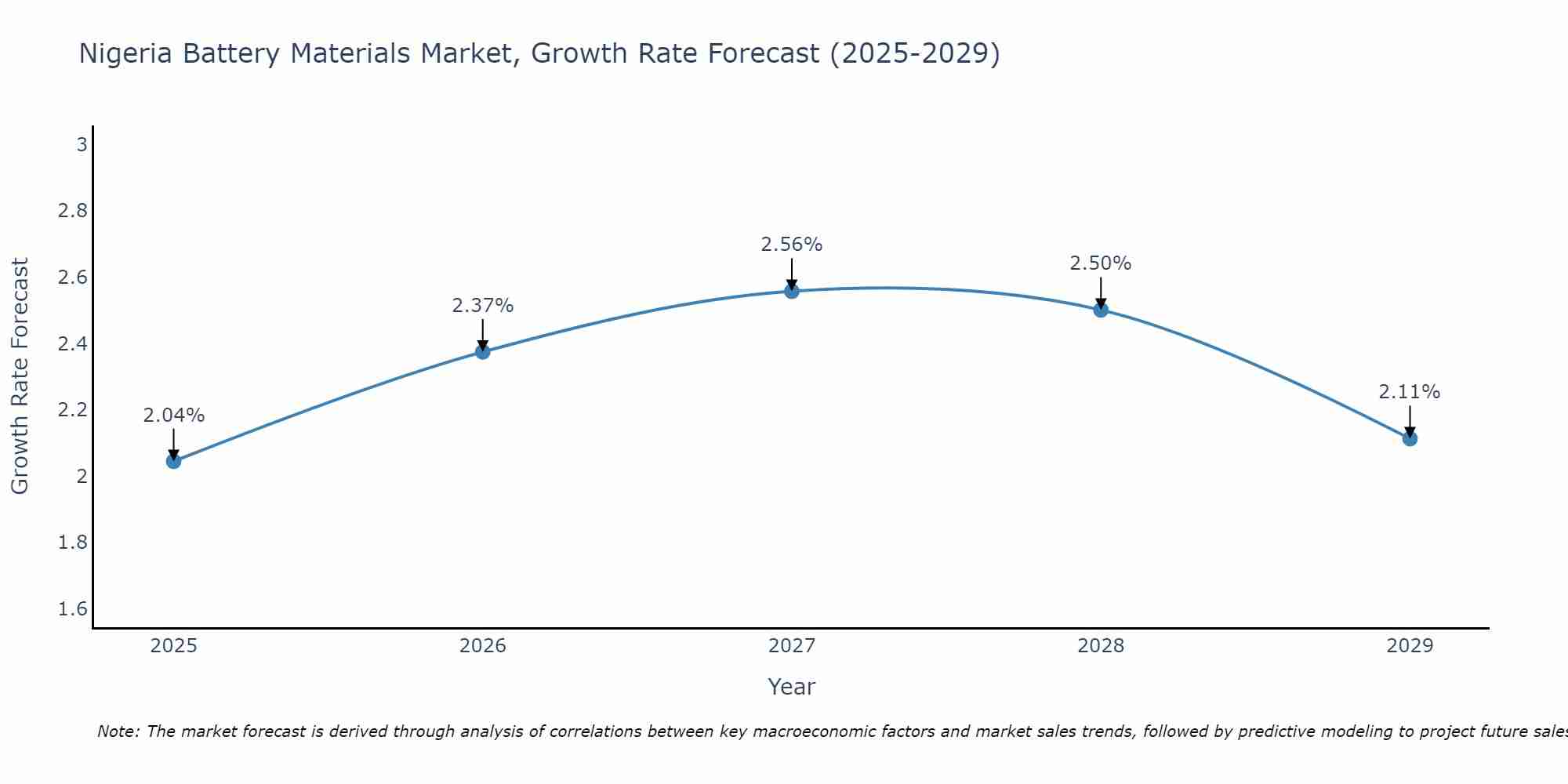
The Nigeria Battery Materials Market is projected to witness mixed growth rate patterns during 2025 to 2029. The growth rate begins at 2.04% in 2025, climbs to a high of 2.56% in 2027, and moderates to 2.11% by 2029.
Nigeria Battery Materials Market Overview
The Nigeria Battery Materials Market is experiencing steady growth driven by the increasing adoption of renewable energy storage solutions and the rising demand for electric vehicles (EVs) in the country. Key players in the market include battery manufacturers, raw material suppliers, and recycling companies. The market is primarily driven by the demand for lithium-ion batteries, which are used in various applications such as EVs, consumer electronics, and energy storage systems. Key challenges faced by the market include the high cost of raw materials, limited domestic production capacity, and the need for sustainable battery recycling practices. However, initiatives to promote local battery manufacturing and recycling capabilities are expected to drive further growth in the Nigeria Battery Materials Market in the coming years.
Nigeria Battery Materials Market Trends
The Nigeria Battery Materials Market is experiencing a growing demand for lithium-ion batteries due to the increasing adoption of electric vehicles and renewable energy storage solutions. This trend is driving the need for key battery materials such as lithium, cobalt, and nickel in the market. In addition, there is a growing focus on developing sustainable and environmentally friendly battery materials to meet the rising demand while reducing the environmental impact of battery production and disposal. Local sourcing and recycling of battery materials are also gaining traction in the market, driven by both regulatory requirements and industry initiatives to create a more sustainable battery supply chain in Nigeria. Overall, the Nigeria Battery Materials Market is witnessing a shift towards more efficient, sustainable, and locally sourced battery materials to support the country`s growing energy needs and environmental goals.
Nigeria Battery Materials Market Challenges
In the Nigeria Battery Materials Market, some of the key challenges faced include limited access to raw materials such as lithium and cobalt, which are crucial components for producing batteries. This reliance on imported materials can lead to supply chain disruptions and increased costs. Additionally, inadequate infrastructure and unreliable power supply in the country pose challenges for battery manufacturers in terms of production efficiency and reliability. Furthermore, the lack of local expertise and investment in research and development for battery technology hinders the industry`s growth and innovation potential. Addressing these challenges will be essential for the Nigeria Battery Materials Market to enhance its competitiveness and sustainability in the global market.
Nigeria Battery Materials Market Investment Opportunities
The Nigeria Battery Materials Market presents significant investment opportunities due to the country`s growing demand for batteries in various sectors such as automotive, renewable energy, and consumer electronics. Investing in battery materials like lithium, cobalt, nickel, and graphite could be lucrative as these materials are essential components of batteries. With the Nigerian government`s focus on promoting clean energy and electric vehicle adoption, the demand for batteries is expected to rise, creating a favorable market for battery materials investors. Additionally, investing in recycling technologies for battery materials could also be a promising opportunity considering the increasing need for sustainable and environmentally friendly practices in the battery industry. Overall, the Nigeria Battery Materials Market offers diverse investment prospects for those looking to capitalize on the country`s evolving energy landscape.
Nigeria Battery Materials Market Government Policy
The Nigerian government has implemented policies to promote the growth of the battery materials market in the country. These policies focus on supporting local production and reducing reliance on imports. The government has provided incentives such as tax breaks and subsidies to encourage investment in battery materials manufacturing facilities. Additionally, regulations have been put in place to ensure environmental sustainability and responsible sourcing of raw materials. The government is also working on developing partnerships with industry stakeholders to drive innovation and research in battery technology. Overall, these policies aim to strengthen the domestic battery materials market, create job opportunities, and enhance Nigeria`s position in the global renewable energy sector.
Nigeria Battery Materials Market Future Outlook
The Nigeria Battery Materials Market is poised for significant growth in the coming years, driven by the increasing demand for batteries in various sectors such as automotive, energy storage, and consumer electronics. The shift towards renewable energy sources and the adoption of electric vehicles are key factors fueling this growth. Additionally, government initiatives to promote clean energy solutions and the development of infrastructure for battery manufacturing are expected to further boost the market. However, challenges such as raw material sourcing, technological advancements, and regulatory uncertainties may impact the market`s growth trajectory. Overall, with the right investments and strategic partnerships, the Nigeria Battery Materials Market is likely to experience substantial expansion in the foreseeable future.
Key Highlights of the Report:
- Nigeria Battery Materials Market Outlook
- Market Size of Nigeria Battery Materials Market, 2024
- Forecast of Nigeria Battery Materials Market, 2031
- Historical Data and Forecast of Nigeria Battery Materials Revenues & Volume for the Period 2021 - 2031
- Nigeria Battery Materials Market Trend Evolution
- Nigeria Battery Materials Market Drivers and Challenges
- Nigeria Battery Materials Price Trends
- Nigeria Battery Materials Porter's Five Forces
- Nigeria Battery Materials Industry Life Cycle
- Historical Data and Forecast of Nigeria Battery Materials Market Revenues & Volume By Battery Type for the Period 2021 - 2031
- Historical Data and Forecast of Nigeria Battery Materials Market Revenues & Volume By Lithium-Ion for the Period 2021 - 2031
- Historical Data and Forecast of Nigeria Battery Materials Market Revenues & Volume By Lead Acid for the Period 2021 - 2031
- Historical Data and Forecast of Nigeria Battery Materials Market Revenues & Volume By Others for the Period 2021 - 2031
- Historical Data and Forecast of Nigeria Battery Materials Market Revenues & Volume By Material for the Period 2021 - 2031
- Historical Data and Forecast of Nigeria Battery Materials Market Revenues & Volume By Lithium-Ion for the Period 2021 - 2031
- Historical Data and Forecast of Nigeria Battery Materials Market Revenues & Volume By Lead Acid for the Period 2021 - 2031
- Nigeria Battery Materials Import Export Trade Statistics
- Market Opportunity Assessment By Battery Type
- Market Opportunity Assessment By Material
- Nigeria Battery Materials Top Companies Market Share
- Nigeria Battery Materials Competitive Benchmarking By Technical and Operational Parameters
- Nigeria Battery Materials Company Profiles
- Nigeria Battery Materials Key Strategic Recommendations






































