Nigeria Bottle Filling Machine Market Size, Share & Growth Rate
The Nigeria Bottle Filling Machine Market was estimated at USD 712 Million in 2025 and is projected to reach USD 1016 Million by 2032, growing at a CAGR of 5.2% from 2026 to 2032. This upward trajectory is fueled by a robust increase in consumer demand for packaged beverages, driven by rising disposable incomes and an expanding population. Additionally, the local manufacturing push, backed by government support, is enhancing the market landscape, enabling producers to meet growing requirements efficiently.
Nigeria Bottle Filling Machine Market Year-wise Growth Rate and Key Drivers
This graph highlights how the Nigeria Bottle Filling Machine Market has steadily grown over the years, supported by major growth factors.
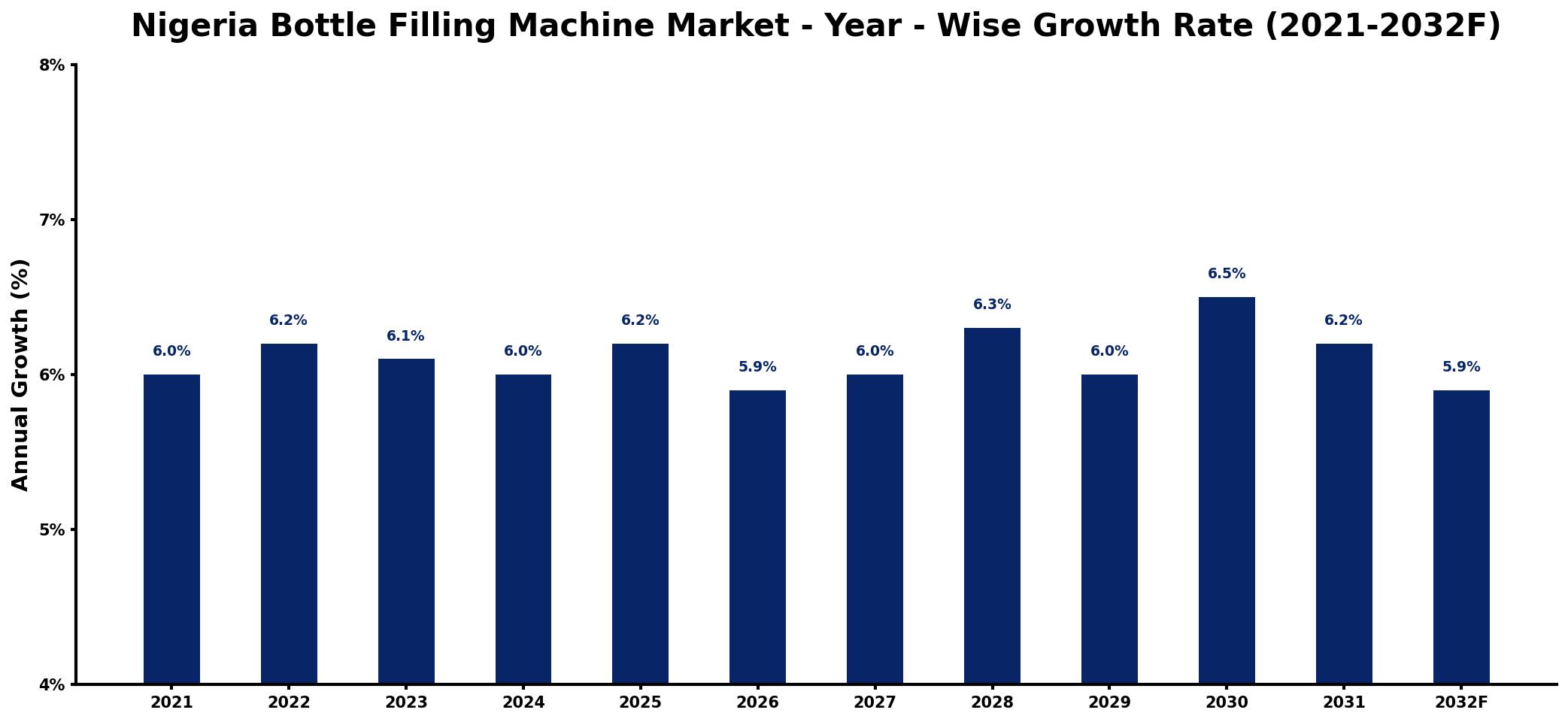
The table below presents the year‑wise growth rates along with the key drivers influencing the market
| Year | Growth Rate | Major Drivers |
| 2021 | 6.0% | increased beverage production capacity |
| 2022 | 6.2% | rising demand for packaged products |
| 2023 | 6.1% | growth in consumer goods sector |
| 2024 | 6.0% | expansion of food processing industry |
| 2025 | 6.2% | surge in export opportunities |
| 2026 | 5.9% | development of local manufacturing |
| 2027 | 6.0% | advancements in automation technology |
| 2028 | 6.3% | increased investment in infrastructure |
| 2029 | 6.0% | growing popularity of sustainable packaging |
| 2030 | 6.5% | enhanced distribution network efficiency |
| 2031 | 6.2% | rising urbanization and consumption |
| 2032 | 5.9% | strengthened regulatory compliance focus |
Note: Market size estimations and growth projections presented in this report are based on 6Wresearch's proprietary forecasting methodology, utilizing the latest available industry data, government publications, and primary research inputs.
Nigeria Bottle Filling Machine Market Synopsis
The Nigeria Bottle Filling Machine market is currently experiencing solid momentum, reflecting a dynamic landscape where both domestic and international manufacturers are vying for market share. However, as the sector evolves, there is a clear shift toward greater automation and sustainability, indicating a transformative phase in response to technological advancements and consumer preferences.
Moving forward, the market is expected to capitalize on increased production efficiency and innovation in filling machine technologies. This development aligns with the broader growth trends in the food and beverage sector, paving the way for greater opportunities and heightened competition among local players.
Nigeria Bottle Filling Machine Market Key Takeaways
- The market is witnessing rising demand for high-speed and automated bottle filling solutions.
- Technological advancements are driving the shift toward eco-friendly and energy-efficient machines.
- Local manufacturing initiatives are being supported by government policies aimed at reducing import dependency.
- Consumer preferences are evolving toward hygienic packaging, further stimulating market growth.
- Investment opportunities are increasing due to the overall expansion of the beverage industry.
Evaluation of Restraints in Nigeria Bottle Filling Machine Market
Despite its growth, the Nigeria Bottle Filling Machine market faces significant restraints. Chief among these is the unreliable power supply, which disrupts production processes and inflates operational costs for manufacturers. Additionally, high import tariffs on machinery and spare parts create financial barriers, making it challenging for businesses to invest in and maintain modern filling equipment. Inadequate infrastructure further complicates logistics, while limited access to financing options constrains the ability of small and medium enterprises to compete effectively in this evolving landscape.
Nigeria Bottle Filling Machine Market Trends
Several key trends are shaping the Nigeria Bottle Filling Machine market. There is a notable shift towards automated systems that enhance production efficiency and meet the escalating demand for bottled products. Furthermore, eco-friendly filling machines are gaining traction, as companies seek to align with sustainability goals. The increasing adoption of digital technologies, such as IoT and AI, is also becoming prominent, facilitating better automation and operational monitoring. Finally, manufacturers are focusing on developing versatile machines capable of handling a variety of bottle sizes to meet the diverse needs of the beverage sector.
Nigeria Bottle Filling Machine Market Opportunities
The Nigeria Bottle Filling Machine market presents several promising investment opportunities, particularly as the packaged beverage sector continues to expand. Entrepreneurs can explore avenues in manufacturing, distribution, and service provision for bottle filling technologies. Additionally, innovations in smart machinery and sustainable designs offer a competitive edge to investors looking to differentiate themselves. By capitalizing on these trends, stakeholders can significantly benefit from the modernization of the bottle filling processes across various industries.
Government Initiatives in the Nigeria Bottle Filling Machine Market
The Nigerian government has introduced several initiatives aimed at bolstering local manufacturing within the bottle filling machine market. Policies such as the National Automotive Industry Development Plan (NAIDP) incentivize the domestic production of machinery components. Moreover, programs like the Nigerian Export Expansion Program (NEEP) support the exportation of locally manufactured goods, including machinery. The Standards Organization of Nigeria (SON) plays a crucial role in ensuring that machinery adheres to quality and safety standards, which collectively enhance the market's integrity and competitiveness.
Future Insights of the Nigeria Bottle Filling Machine Market
Looking ahead, the Nigeria Bottle Filling Machine market is set to experience sustained growth through 2032, driven by increased demand for bottled beverages. The emphasis on efficiency and automation within the beverage industry will propel the adoption of advanced filling technologies. As manufacturers strive for enhanced productivity and operational excellence, the integration of innovative, eco-friendly designs will further shape the market landscape, ensuring its resilience amidst challenges such as high investment costs.
Nigeria Bottle Filling Machine Market Latest Developments (2025 - 2026)
Recent developments within the Nigeria Bottle Filling Machine market indicate a growing focus on automation and sustainable practices. Manufacturers are increasingly investing in research and development to innovate filling machines that cater to the rising demand for efficiency and environmental responsibility. Additionally, collaborations between local and international firms are enhancing technology transfer and fostering competition, thereby refining the overall manufacturing landscape.
Nigeria Bottle Filling Machine Market - Key Attractiveness of the Report
- 10 Years of Market Numbers
- Historical Data Starting from 2022 to 2025
- Base Year: 2025
- Forecast Data until 2032
- Key Performance Indicators Impacting the Market
- Major Upcoming Developments and Projects
Key Highlights of the Report:
- Nigeria Bottle Filling Machine Market Outlook
- Market Size of Nigeria Bottle Filling Machine Market, 2025
- Forecast of Nigeria Bottle Filling Machine Market, 2032
- Historical Data and Forecast of Nigeria Bottle Filling Machine Revenues & Volume for the Period 2022-2032F
- Nigeria Bottle Filling Machine Market Trend Evolution
- Nigeria Bottle Filling Machine Market Drivers and Challenges
- Nigeria Bottle Filling Machine Price Trends
- Nigeria Bottle Filling Machine Porter's Five Forces
- Nigeria Bottle Filling Machine Industry Life Cycle
- Historical Data and Forecast of Nigeria Bottle Filling Machine Market Revenues & Volume By Bottle Type for the Period 2022-2032F
- Historical Data and Forecast of Nigeria Bottle Filling Machine Market Revenues & Volume By PET Bottles for the Period 2022-2032F
- Historical Data and Forecast of Nigeria Bottle Filling Machine Market Revenues & Volume By Glass Bottles for the Period 2022-2032F
- Historical Data and Forecast of Nigeria Bottle Filling Machine Market Revenues & Volume By Others for the Period 2022-2032F
- Historical Data and Forecast of Nigeria Bottle Filling Machine Market Revenues & Volume By Application for the Period 2022-2032F
- Historical Data and Forecast of Nigeria Bottle Filling Machine Market Revenues & Volume By Food Products for the Period 2022-2032F
- Historical Data and Forecast of Nigeria Bottle Filling Machine Market Revenues & Volume By Beverages for the Period 2022-2032F
- Historical Data and Forecast of Nigeria Bottle Filling Machine Market Revenues & Volume By Chemicals & Pharmaceuticals for the Period 2022-2032F
- Historical Data and Forecast of Nigeria Bottle Filling Machine Market Revenues & Volume By Cosmetics for the Period 2022-2032F
- Nigeria Bottle Filling Machine Import Export Trade Statistics
- Market Opportunity Assessment By Bottle Type
- Market Opportunity Assessment By Application
- Nigeria Bottle Filling Machine Top Companies Market Share
- Nigeria Bottle Filling Machine Competitive Benchmarking By Technical and Operational Parameters
- Nigeria Bottle Filling Machine Company Profiles
- Nigeria Bottle Filling Machine Key Strategic Recommendations






































