Nigeria Buttermilk Market Top 5 Importing Countries and Market Competition (HHI) Analysis
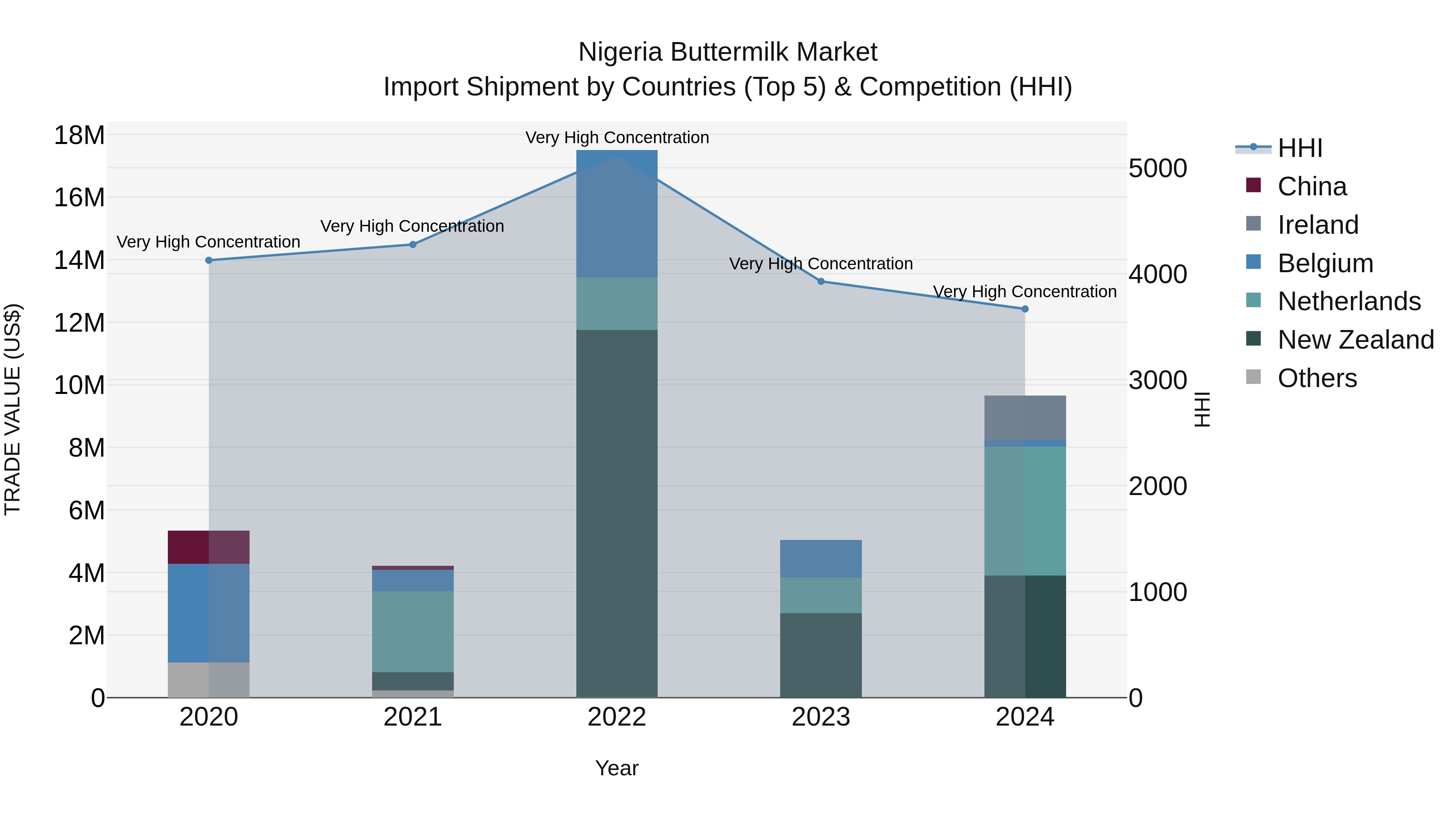
The Nigeria buttermilk import market saw significant growth in 2024, with top exporting countries being Netherlands, New Zealand, Ireland, Belgium, and Metropolitan France. The high Herfindahl-Hirschman Index (HHI) indicates a concentrated market, while the impressive Compound Annual Growth Rate (CAGR) of 15.96% from 2020-2024 reflects a strong upward trend. The exceptional growth rate of 91.4% in 2024 suggests a surge in demand for buttermilk in Nigeria, presenting opportunities for further market expansion and diversification in the coming years.
Nigeria Buttermilk Market Overview
The buttermilk market in Nigeria caters to the food and beverage industry, providing a key ingredient for various dairy products and culinary applications.
Drivers of the market
In Nigeria, the buttermilk market is influenced by factors such as changing dietary preferences, increasing awareness about the health benefits of dairy products, and the demand for ingredients in food processing and culinary applications.
Challenges of the market
Challenges in the Nigeria Buttermilk Market include limited consumer awareness and competition from alternative dairy products. Moreover, concerns over product shelf-life and distribution impact market growth.
Government Policy of the market
Quality standards and health regulations guide policies in the buttermilk market, ensuring product safety and nutritional value for consumers.
Key Highlights of the Report:
- Nigeria Buttermilk Market Outlook
- Market Size of Nigeria Buttermilk Market, 2024
- Forecast of Nigeria Buttermilk Market, 2031
- Historical Data and Forecast of Nigeria Buttermilk Revenues & Volume for the Period 2021-2031
- Nigeria Buttermilk Market Trend Evolution
- Nigeria Buttermilk Market Drivers and Challenges
- Nigeria Buttermilk Price Trends
- Nigeria Buttermilk Porter's Five Forces
- Nigeria Buttermilk Industry Life Cycle
- Historical Data and Forecast of Nigeria Buttermilk Market Revenues & Volume By Type for the Period 2021-2031
- Historical Data and Forecast of Nigeria Buttermilk Market Revenues & Volume By Powder for the Period 2021-2031
- Historical Data and Forecast of Nigeria Buttermilk Market Revenues & Volume By Liquid for the Period 2021-2031
- Historical Data and Forecast of Nigeria Buttermilk Market Revenues & Volume By End-use Industry for the Period 2021-2031
- Historical Data and Forecast of Nigeria Buttermilk Market Revenues & Volume By Food & Beverage Industry for the Period 2021-2031
- Historical Data and Forecast of Nigeria Buttermilk Market Revenues & Volume By Foodservice Industry for the Period 2021-2031
- Historical Data and Forecast of Nigeria Buttermilk Market Revenues & Volume By Processed Food Industry for the Period 2021-2031
- Historical Data and Forecast of Nigeria Buttermilk Market Revenues & Volume By Distribution Channel for the Period 2021-2031
- Historical Data and Forecast of Nigeria Buttermilk Market Revenues & Volume By Business to Business for the Period 2021-2031
- Historical Data and Forecast of Nigeria Buttermilk Market Revenues & Volume By Business to Consumer for the Period 2021-2031
- Nigeria Buttermilk Import Export Trade Statistics
- Market Opportunity Assessment By Type
- Market Opportunity Assessment By End-use Industry
- Market Opportunity Assessment By Distribution Channel
- Nigeria Buttermilk Top Companies Market Share
- Nigeria Buttermilk Competitive Benchmarking By Technical and Operational Parameters
- Nigeria Buttermilk Company Profiles
- Nigeria Buttermilk Key Strategic Recommendations






































