Nigeria Cognitive Analytics Market Size & Growth Rate (2026-2032)
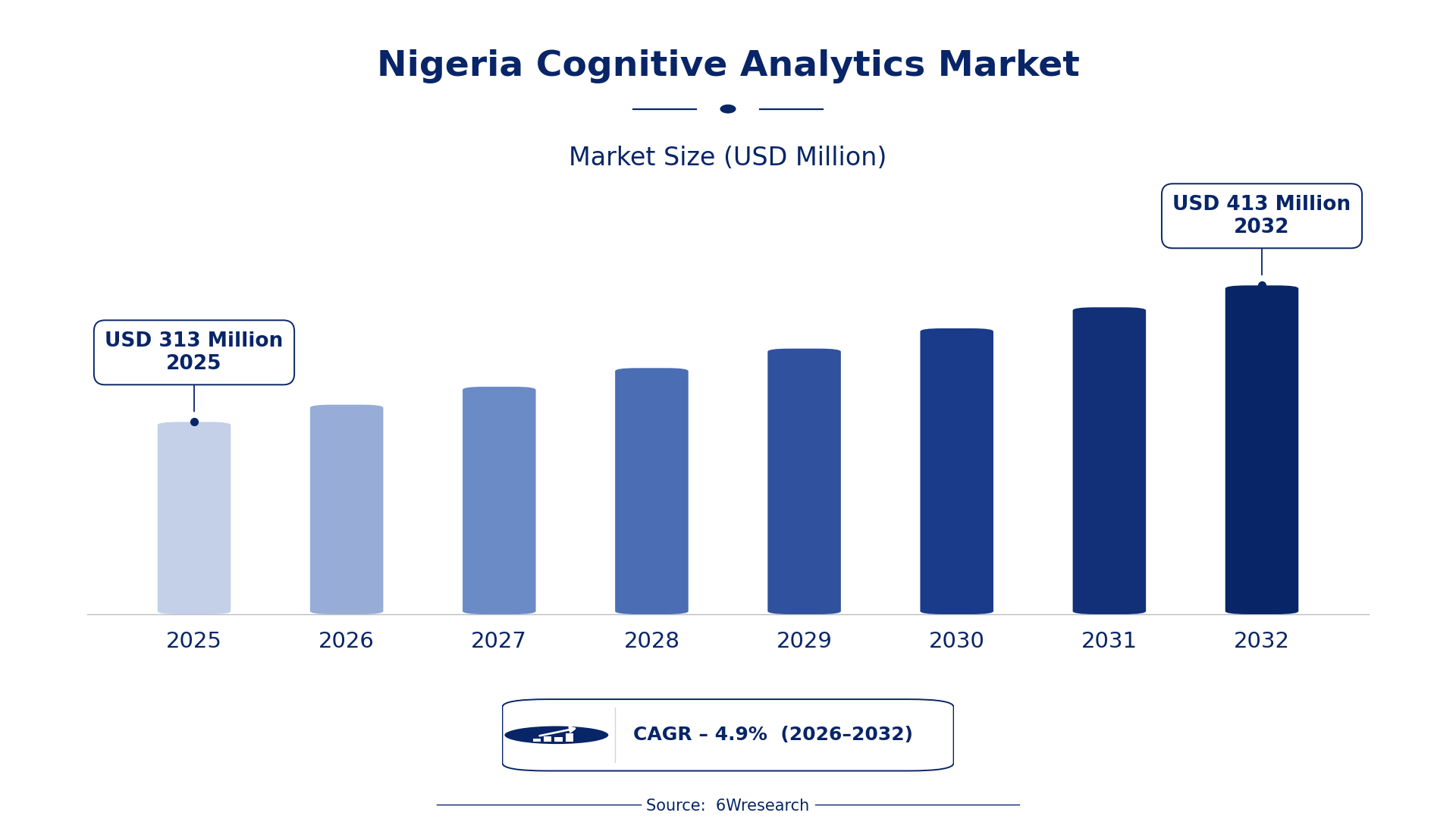
The Nigeria Cognitive Analytics Market was estimated at USD 313 Million in 2025 and is projected to reach USD 413 Million by 2032, growing at a CAGR of 4.9% from 2026 to 2032.
Nigeria Cognitive Analytics Market Synopsis
Cognitive analytics is gaining traction among Nigerian businesses as they increasingly seek to unlock the value hidden in their data. Organizations are turning to advanced analytics, machine learning, and artificial intelligence (AI) to enhance their decision-making capabilities and streamline operations.
The demand for cognitive analytics solutions is being propelled by the need for actionable insights that can improve customer experiences and operational efficiency. Companies are recognizing the importance of data-driven strategies, leading to a surge in investments in these technologies.
Nigeria Cognitive Analytics Market Year-wise Growth Rate and Key Drivers
This graph illustrates the annual growth rates of the Nigeria Cognitive Analytics Market from 2021 to 2032, highlighting a steady upward trajectory and projected expansion over the forecast period.
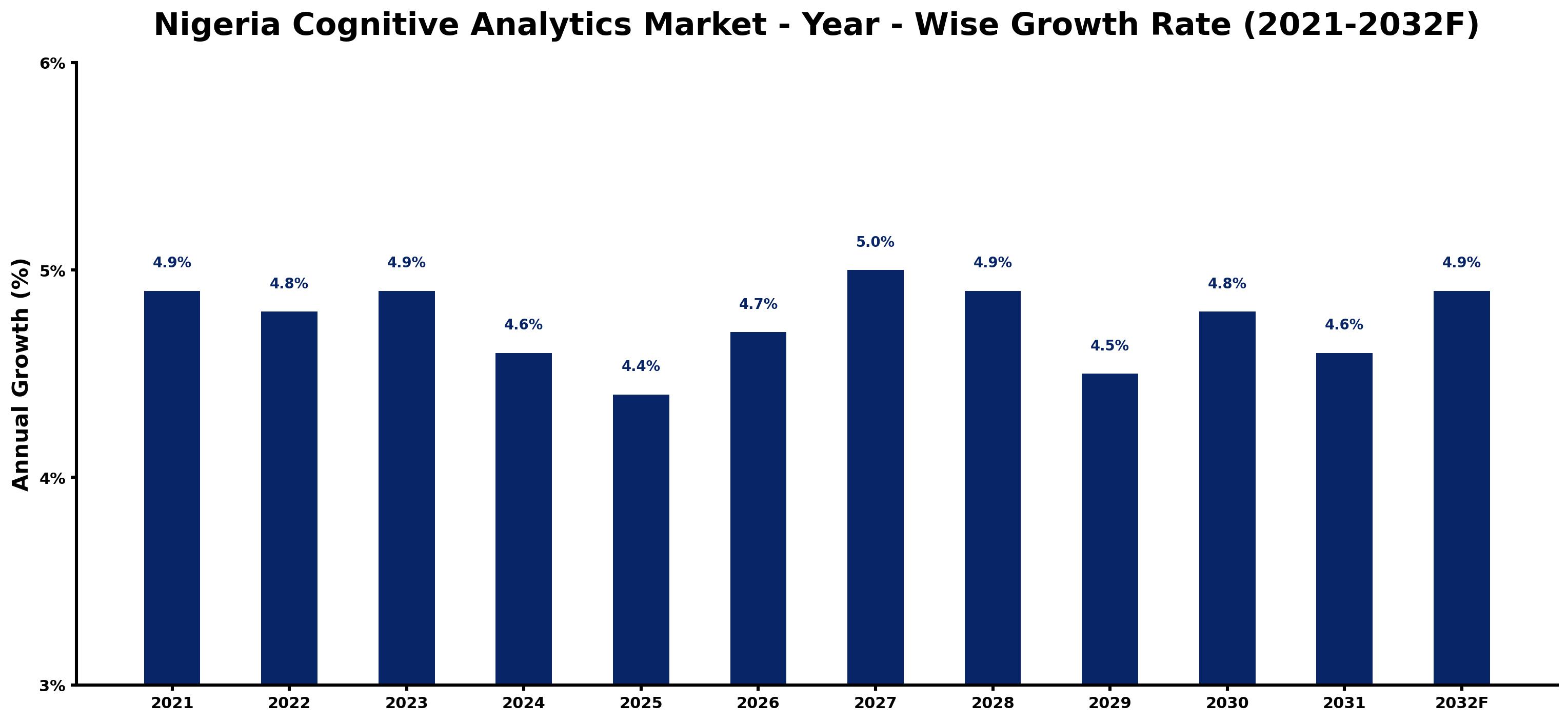
The table below presents the year‑wise growth rates along with the key drivers influencing the market
| Year | Growth Rate | Major Drivers |
| 2021 | 4.9% | National broadband policy enhancing digital skills training initiatives. |
| 2022 | 4.8% | Growing fintech sector driving demand for data insights. |
| 2023 | 4.9% | Increased investments in local AI research and development. |
| 2024 | 4.6% | Emergence of smart health initiatives requiring advanced analytics. |
| 2025 | 4.4% | Rising analytics usage in agriculture for yield optimization. |
| 2026 | 4.7% | Government support for tech startups boosting AI adoption. |
| 2027 | 5.0% | Adoption of biometric systems enhancing security analytics demands. |
| 2028 | 4.9% | Educational reforms emphasizing STEM increasing data literacy. |
| 2029 | 4.5% | Boost in mobile penetration improving access to analytics tools. |
| 2030 | 4.8% | Cybersecurity threats increasing need for cognitive risk assessments. |
| 2031 | 4.6% | Public health data integration driving analytics in health sector. |
| 2032 | 4.9% | Local enterprises adopting data-driven strategies for competitiveness. |
Note: Market size estimations and growth projections presented in this report are based on 6Wresearch's proprietary forecasting methodology, utilizing the latest available industry data, government publications, and primary research inputs.
Nigeria Cognitive Analytics Market Key Takeaways
Below are some of the specific key takeaways from the market, including:
- Growing adoption of AI and machine learning technologies for enhanced data insights.
- Increased focus on optimizing operations through cognitive analytics solutions.
- Challenges regarding data privacy and algorithmic biases impacting market growth.
- Government policies shaping the regulatory environment for data analytics.
- Emerging opportunities for businesses to invest in advanced analytics capabilities.
Evaluation of Restraints in Nigeria Cognitive Analytics Market
Despite the positive outlook, several constraints hinder market growth. Data privacy concerns are paramount, as organizations grapple with compliance to regulations that safeguard consumer information. Many businesses also face challenges related to biases inherent in data algorithms, which can skew insights and decision-making.
Integrating cognitive analytics with existing IT infrastructure remains a hurdle for many firms. Additionally, the scarcity of skilled professionals in advanced analytics poses a significant barrier, as organizations struggle to find talent capable of effectively harnessing cognitive insights.
Nigeria Cognitive Analytics Market Trends
A noticeable trend is the increasing investment in AI technologies, which are becoming fundamental to cognitive analytics. Businesses are prioritizing the integration of AI to enhance their analytical capabilities, focusing on real-time data processing and predictive analytics.
on top of that, the shift towards cloud-based solutions is reshaping the market. Companies are adopting cloud analytics to improve scalability and access to advanced tools, facilitating data-driven strategies without the burden of extensive on-premises infrastructure.
Nigeria Cognitive Analytics Market Opportunities
Opportunities abound in sectors such as finance, healthcare, and retail where cognitive analytics can drive significant improvements. The finance sector, for instance, can utilize these technologies for fraud detection and risk assessment, while healthcare can benefit from enhanced patient data analysis.
on top of that, as businesses increasingly prioritize customer experience, cognitive analytics presents a chance to personalize services and products based on detailed consumer insights. Investments in education and training for analytics professionals can also yield long-term benefits for the market.
Government Initiatives in the Nigeria Cognitive Analytics Market
Government policy is critical in shaping the Nigeria Cognitive Analytics Market, as regulations around data privacy and ethical AI are evolving. The Nigerian government is taking steps to establish a regulatory framework that encourages responsible use of analytics while ensuring consumer protection.
- A national data protection regulation introduced in 2025 aims to enhance data privacy and promote trust in analytics solutions.
- Current efforts focus on a national digital infrastructure upgrade program, enhancing connectivity and data accessibility for businesses.
- Planned initiatives include public-private partnerships set to launch in 2027, aimed at fostering innovation in AI and cognitive analytics.
- Ongoing workshops and training programs aim to develop local talent in analytics and AI technologies.
- Collaborative frameworks with international organizations are being established to promote best practices in data ethics.
Future Insights of the Nigeria Cognitive Analytics Market
Looking ahead to 2026-2032, the Nigeria Cognitive Analytics Market is expected to experience steady growth, driven by technological advancements and increasing data volumes. The emphasis on data-driven decision-making will continue to rise, particularly as organizations strive for greater efficiency and competitiveness.
As AI technologies mature, the integration of advanced analytics into everyday business processes will become standard practice. Organizations that embrace these changes early will likely gain a competitive edge, positioning themselves for success in a data-centric future.
Nigeria Cognitive Analytics Market Latest Developments
Over the past year, the Nigeria Cognitive Analytics Market has seen a flurry of activity as businesses and governments ramp up their focus on advanced analytics. Companies are increasingly investing in AI-driven solutions to harness the power of big data, while regulatory bodies are finalizing guidelines to ensure ethical practices.
- A major technology vendor launched a new AI-powered analytics platform in Q2 2025, aimed at SMEs looking to enhance data utilization.
- An initiative that began in early 2025 focuses on establishing AI research hubs across major cities to promote innovation and collaboration.
- In Q4 2025, a public-private partnership was announced to enhance digital literacy in analytics among youth, targeting educational institutions.
- Currently underway is a project aimed at integrating cognitive analytics into government services to improve public sector efficiency.
- A rollout expected to begin in early 2026 will focus on developing a national framework for ethical AI use in analytics.
Nigeria Cognitive Analytics Market - Key Attractiveness of the Report
- 10 Years of Market Numbers
- Historical Data Starting from 2022 to 2025
- Base Year: 2025
- Forecast Data until 2032
- Key Performance Indicators Impacting the Market
- Major Upcoming Developments and Projects
Key Highlights of the Report:
- Nigeria Cognitive Analytics Market Outlook
- Market Size of Nigeria Cognitive Analytics Market, 2025
- Forecast of Nigeria Cognitive Analytics Market, 2032
- Historical Data and Forecast of Nigeria Cognitive Analytics Revenues & Volume for the Period 2022-2032F
- Nigeria Cognitive Analytics Market Trend Evolution
- Nigeria Cognitive Analytics Market Drivers and Challenges
- Nigeria Cognitive Analytics Price Trends
- Nigeria Cognitive Analytics Porter's Five Forces
- Nigeria Cognitive Analytics Industry Life Cycle
- Historical Data and Forecast of Nigeria Cognitive Analytics Market Revenues & Volume By Application for the Period 2022-2032F
- Historical Data and Forecast of Nigeria Cognitive Analytics Market Revenues & Volume By Automation for the Period 2022-2032F
- Historical Data and Forecast of Nigeria Cognitive Analytics Market Revenues & Volume By Intelligent Virtual Assistants for the Period 2022-2032F
- Historical Data and Forecast of Nigeria Cognitive Analytics Market Revenues & Volume By Behavioral Analysis for the Period 2022-2032F
- Historical Data and Forecast of Nigeria Cognitive Analytics Market Revenues & Volume By Biometrics for the Period 2022-2032F
- Historical Data and Forecast of Nigeria Cognitive Analytics Market Revenues & Volume By Others for the Period 2022-2032F
- Historical Data and Forecast of Nigeria Cognitive Analytics Market Revenues & Volume By Component for the Period 2022-2032F
- Historical Data and Forecast of Nigeria Cognitive Analytics Market Revenues & Volume By Platform for the Period 2022-2032F
- Historical Data and Forecast of Nigeria Cognitive Analytics Market Revenues & Volume By Service for the Period 2022-2032F
- Historical Data and Forecast of Nigeria Cognitive Analytics Market Revenues & Volume By Technology for the Period 2022-2032F
- Historical Data and Forecast of Nigeria Cognitive Analytics Market Revenues & Volume By Machine Learning (ML) for the Period 2022-2032F
- Historical Data and Forecast of Nigeria Cognitive Analytics Market Revenues & Volume By Human Computer Interaction for the Period 2022-2032F
- Historical Data and Forecast of Nigeria Cognitive Analytics Market Revenues & Volume By Natural Language Processing (NLP) for the Period 2022-2032F
- Historical Data and Forecast of Nigeria Cognitive Analytics Market Revenues & Volume By Deep Learning for the Period 2022-2032F
- Historical Data and Forecast of Nigeria Cognitive Analytics Market Revenues & Volume By Deployment Mode for the Period 2022-2032F
- Historical Data and Forecast of Nigeria Cognitive Analytics Market Revenues & Volume By On-premise for the Period 2022-2032F
- Historical Data and Forecast of Nigeria Cognitive Analytics Market Revenues & Volume By Cloud for the Period 2022-2032F
- Historical Data and Forecast of Nigeria Cognitive Analytics Market Revenues & Volume By Hybrid for the Period 2022-2032F
- Historical Data and Forecast of Nigeria Cognitive Analytics Market Revenues & Volume By Industry for the Period 2022-2032F
- Historical Data and Forecast of Nigeria Cognitive Analytics Market Revenues & Volume By BFSI for the Period 2022-2032F
- Historical Data and Forecast of Nigeria Cognitive Analytics Market Revenues & Volume By Retail and eCommerce for the Period 2022-2032F
- Historical Data and Forecast of Nigeria Cognitive Analytics Market Revenues & Volume By Telecommunication and IT for the Period 2022-2032F
- Historical Data and Forecast of Nigeria Cognitive Analytics Market Revenues & Volume By Healthcare and Life Sciences for the Period 2022-2032F
- Historical Data and Forecast of Nigeria Cognitive Analytics Market Revenues & Volume By Manufacturing for the Period 2022-2032F
- Historical Data and Forecast of Nigeria Cognitive Analytics Market Revenues & Volume By Government and Defense for the Period 2022-2032F
- Historical Data and Forecast of Nigeria Cognitive Analytics Market Revenues & Volume By Media and Entertainment for the Period 2022-2032F
- Historical Data and Forecast of Nigeria Cognitive Analytics Market Revenues & Volume By Organization Size for the Period 2022-2032F
- Historical Data and Forecast of Nigeria Cognitive Analytics Market Revenues & Volume By Large Enterprises for the Period 2022-2032F
- Historical Data and Forecast of Nigeria Cognitive Analytics Market Revenues & Volume By Small and Medium-Sized Enterprises (SMEs) for the Period 2022-2032F
- Nigeria Cognitive Analytics Import Export Trade Statistics
- Market Opportunity Assessment By Application
- Market Opportunity Assessment By Component
- Market Opportunity Assessment By Technology
- Market Opportunity Assessment By Deployment Mode
- Market Opportunity Assessment By Industry
- Market Opportunity Assessment By Organization Size
- Nigeria Cognitive Analytics Top Companies Market Share
- Nigeria Cognitive Analytics Competitive Benchmarking By Technical and Operational Parameters
- Nigeria Cognitive Analytics Company Profiles
- Nigeria Cognitive Analytics Key Strategic Recommendations






































