Nigeria Cold Chain Market Size, Share & Growth Rate
The Nigeria Cold Chain Market was estimated at USD 1098 Million in 2025 and is projected to reach USD 2042 Million by 2032, growing at a CAGR of 9.3% from 2026 to 2032. This growth trajectory is largely driven by the escalating demand for perishable goods, ranging from fresh produce to pharmaceuticals. As consumer awareness around food safety and quality deepens, investments in infrastructure and technology are increasingly seen as essential to meet these rising standards.
Nigeria Cold Chain Market Year-wise Growth Rate and Key Drivers
This graph highlights how the Nigeria Cold Chain Market has steadily grown over the years, supported by major growth factors.
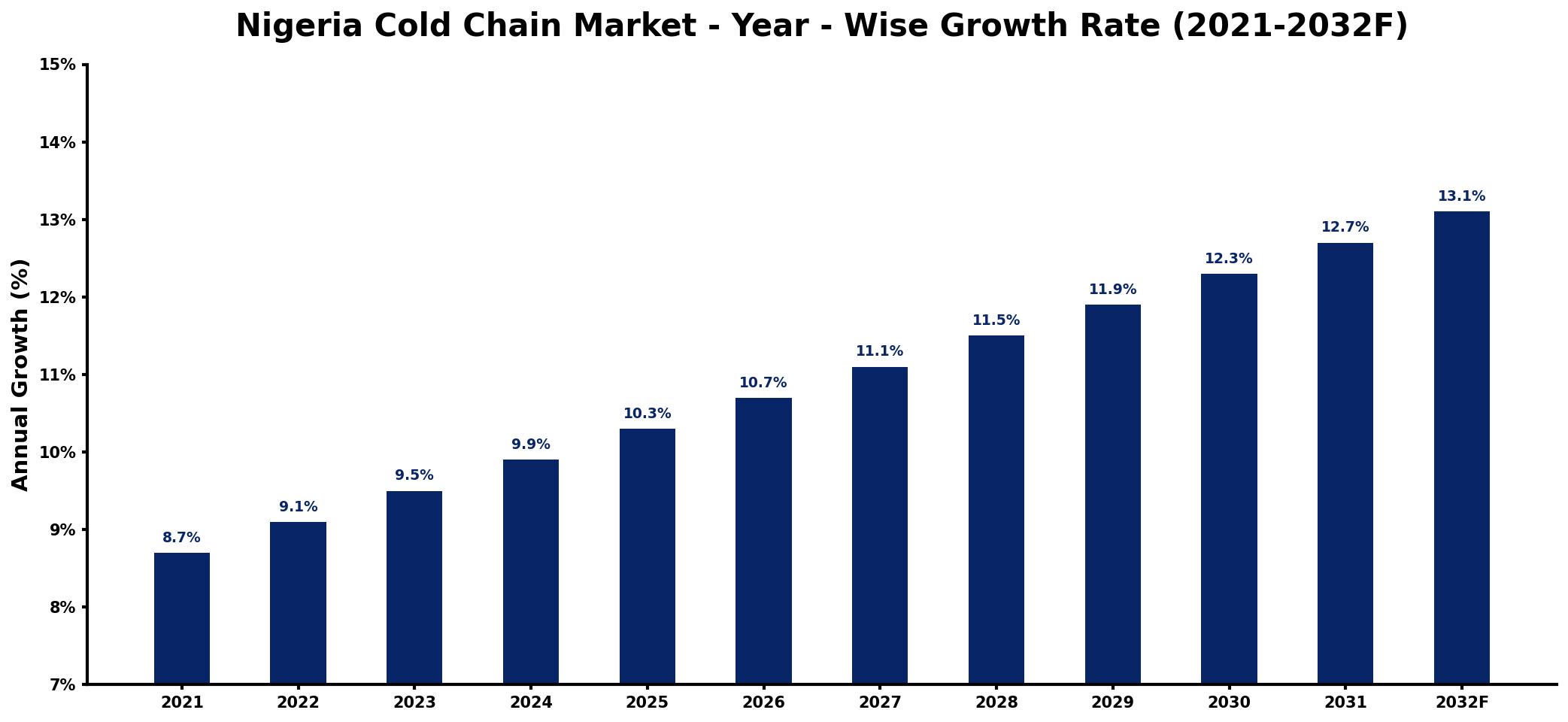
The table below presents the year‑wise growth rates along with the key drivers influencing the market
| Year | Growth Rate | Major Drivers |
| 2021 | 8.7% | Rising demand for perishable goods |
| 2022 | 9.1% | Expansion of pharmaceutical logistics sector |
| 2023 | 9.5% | Increased investments in infrastructure |
| 2024 | 9.9% | Growing e-commerce food deliveries |
| 2025 | 10.3% | Surge in food safety regulations |
| 2026 | 10.7% | Enhanced consumer awareness on quality |
| 2027 | 11.1% | Development of urban distribution networks |
| 2028 | 11.5% | growing regional consumption patterns |
| 2029 | 11.9% | Technological advancements in logistics |
| 2030 | 12.3% | Strengthening of local food production |
| 2031 | 12.7% | Increase in regional trade agreements |
| 2032 | 13.1% | Rising popularity of convenience foods |
Note: Market size estimations and growth projections presented in this report are based on 6Wresearch's proprietary forecasting methodology, utilizing the latest available industry data, government publications, and primary research inputs.
Nigeria Cold Chain Market Synopsis
The Nigeria Cold Chain Market is undergoing transformative growth as the need for efficient logistics and storage solutions for temperature-sensitive products becomes paramount. This sector's expansion is fueled by the country's burgeoning middle class, which is changing consumption patterns and increasing the demand for high-quality perishable goods.
Recent years have witnessed a significant uptick in awareness regarding the importance of maintaining product quality throughout the supply chain. Consequently, key stakeholders are prioritizing investments in state-of-the-art technology and infrastructure to enhance cold storage capabilities and transportation logistics across Nigeria.
Nigeria Cold Chain Market Key Takeaways
- The market is anticipated to grow at a CAGR of 9.3% between 2026 and 2032, highlighting a robust demand for cold chain solutions.
- Advancements in technology, including IoT-based monitoring systems, are streamlining cold chain operations.
- Government initiatives aimed at enhancing agricultural productivity are contributing to the growth of the cold chain sector.
- Challenges in infrastructure and power supply continue to be critical considerations for market stakeholders.
- Increased consumer demand for pharmaceuticals and fresh food is reshaping logistics and storage requirements.
Evaluation of Restraints in Nigeria Cold Chain Market
While the Nigeria Cold Chain Market presents exciting opportunities, it is hindered by significant challenges. Chief among these is the inadequate infrastructure, which limits the efficient transport and storage of perishable goods. Frequent power outages create hurdles in maintaining optimal temperature conditions, resulting in product spoilage and increased operational costs. Additionally, the scarcity of modern storage facilities in rural areas compounds these issues. To effectively address these limitations, investments in reliable infrastructure and power supply are imperative, ensuring that the cold chain can operate efficiently across all regions of Nigeria.
Nigeria Cold Chain Market Trends
Several pivotal trends are shaping the Nigeria Cold Chain Market. Notably, the increasing consumption of temperature-sensitive products, such as processed foods and pharmaceuticals, is pushing stakeholders to adopt more robust cold chain logistics solutions. Enhanced technological capabilities, including advanced temperature monitoring systems and data analytics, are improving operational efficiency. Additionally, sustainability considerations are gaining traction, with companies seeking energy-efficient solutions that reduce both environmental impact and costs. This holistic approach to cold chain management is set to become a fundamental aspect of market dynamics.
Nigeria Cold Chain Market Opportunities
The Nigeria Cold Chain Market is ripe for investment, driven by the surging demand for effective cold storage and transportation solutions. Opportunities abound in upgrading existing facilities and establishing new cold storage units to cater to the evolving needs of the food and healthcare sectors. The rise in e-commerce and online food delivery services also presents a promising avenue for innovative cold chain logistics. Additionally, leveraging government initiatives aimed at reducing post-harvest losses in agriculture can yield substantial returns for investors committed to enhancing cold chain infrastructure.
Government Initiatives in the Nigeria Cold Chain Market
The Nigerian government has put forth a series of policies to foster the cold chain market, focusing on improving food safety and public health outcomes. Key initiatives include the National Cold Chain Policy and Strategy, which provides essential guidelines for infrastructure development. Programs such as the Growth Enhancement Support Scheme (GESS) further emphasize the importance of cold chain technologies in distributing agricultural products efficiently. These government efforts underscore a strong commitment to developing the cold chain sector as a catalyst for economic growth.
Future Insights of the Nigeria Cold Chain Market
Looking ahead to the years between 2026 and 2032, the Nigeria Cold Chain Market is poised for sustained growth. The expanding food and beverage industry, combined with increasing healthcare expenditures, are set to elevate the demand for temperature-sensitive products. As stakeholders continue to invest in better infrastructure and innovative technologies, the market will increasingly adapt to meet consumer expectations for safety and quality. However, attention to operational costs and infrastructure improvements will be essential to fully realize this potential.
Nigeria Cold Chain Market Latest Developments (2025 - 2026)
Recent developments in the Nigeria Cold Chain Market indicate a trend toward enhanced investment in storage facilities and transportation networks. Industry stakeholders are increasingly adopting advanced technologies to improve the tracking and monitoring of perishable goods. Collaborative initiatives between public and private sectors are emerging, aiming to bolster cold chain infrastructure, particularly in underserved regions. These strategic moves highlight a proactive approach to meeting the growing demands of consumers and businesses alike.
Nigeria Cold Chain Market - Key Attractiveness of the Report
- 10 Years of Market Numbers
- Historical Data Starting from 2022 to 2025
- Base Year: 2025
- Forecast Data until 2032
- Key Performance Indicators Impacting the Market
- Major Upcoming Developments and Projects
Key Highlights of the Report:
- Nigeria Cold Chain Market Outlook
- Market Size of Nigeria Cold Chain Market, 2025
- Forecast of Nigeria Cold Chain Market, 2032
- Historical Data and Forecast of Nigeria Cold Chain Revenues & Volume for the Period 2022-2032F
- Nigeria Cold Chain Market Trend Evolution
- Nigeria Cold Chain Market Drivers and Challenges
- Nigeria Cold Chain Price Trends
- Nigeria Cold Chain Porter's Five Forces
- Nigeria Cold Chain Industry Life Cycle
- Historical Data and Forecast of Nigeria Cold Chain Market Revenues & Volume By Temperature Type for the Period 2022-2032F
- Historical Data and Forecast of Nigeria Cold Chain Market Revenues & Volume By Frozen for the Period 2022-2032F
- Historical Data and Forecast of Nigeria Cold Chain Market Revenues & Volume By Chilled for the Period 2022-2032F
- Historical Data and Forecast of Nigeria Cold Chain Market Revenues & Volume By Type for the Period 2022-2032F
- Historical Data and Forecast of Nigeria Cold Chain Market Revenues & Volume By Refrigerated warehousing for the Period 2022-2032F
- Historical Data and Forecast of Nigeria Cold Chain Market Revenues & Volume By Refrigerated transport for the Period 2022-2032F
- Historical Data and Forecast of Nigeria Cold Chain Market Revenues & Volume By Application for the Period 2022-2032F
- Historical Data and Forecast of Nigeria Cold Chain Market Revenues & Volume By Dairy & frozen desserts for the Period 2022-2032F
- Historical Data and Forecast of Nigeria Cold Chain Market Revenues & Volume By Fish, meat, and seafood products for the Period 2022-2032F
- Historical Data and Forecast of Nigeria Cold Chain Market Revenues & Volume By Bakery & confectionery products for the Period 2022-2032F
- Historical Data and Forecast of Nigeria Cold Chain Market Revenues & Volume By Fruits & vegetables for the Period 2022-2032F
- Historical Data and Forecast of Nigeria Cold Chain Market Revenues & Volume By Others for the Period 2022-2032F
- Nigeria Cold Chain Import Export Trade Statistics
- Market Opportunity Assessment By Temperature Type
- Market Opportunity Assessment By Type
- Market Opportunity Assessment By Application
- Nigeria Cold Chain Top Companies Market Share
- Nigeria Cold Chain Competitive Benchmarking By Technical and Operational Parameters
- Nigeria Cold Chain Company Profiles
- Nigeria Cold Chain Key Strategic Recommendations






































