Nigeria Contactless Payment Market Size & Growth Rate (2026-2032)
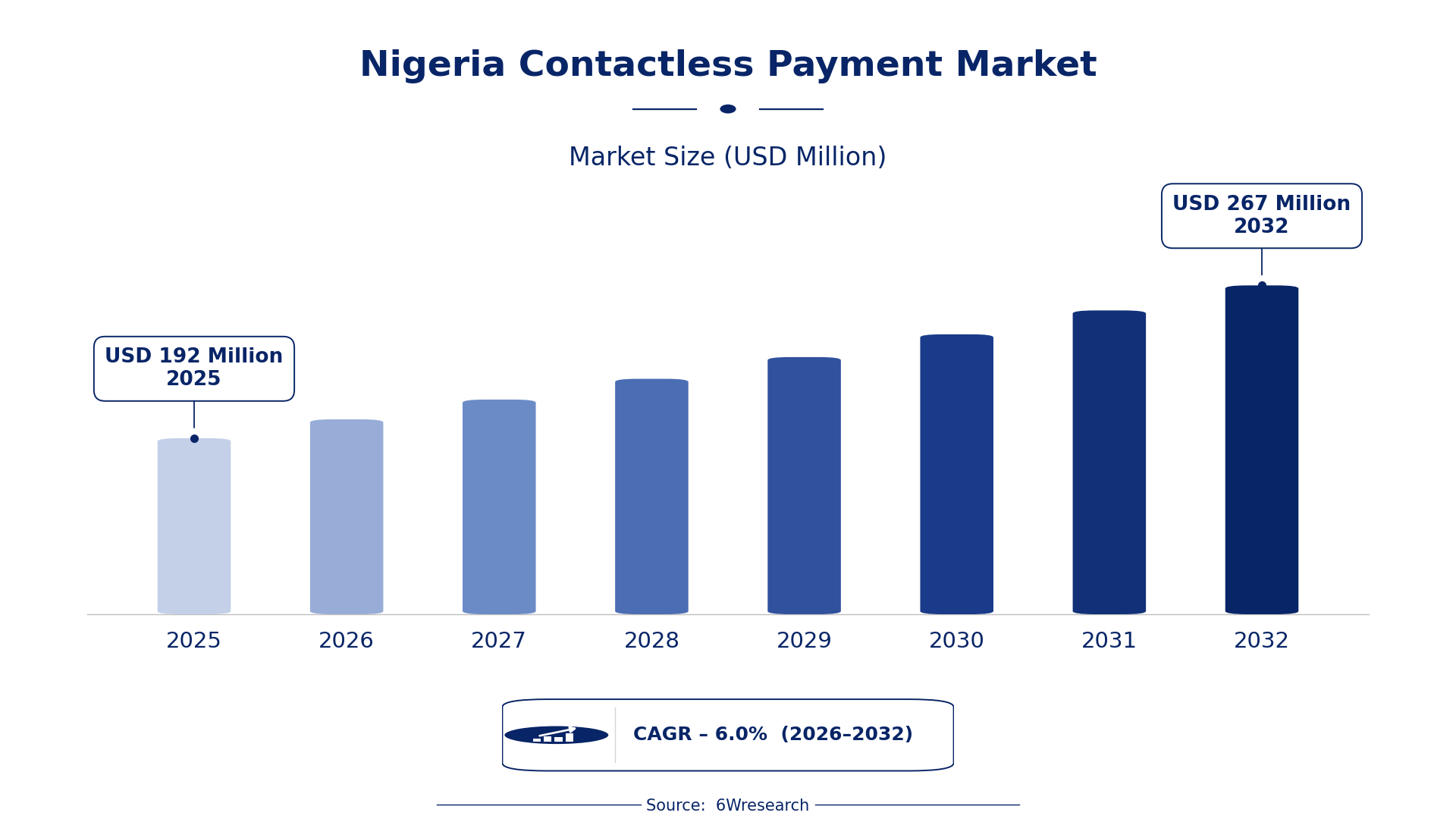
The Nigeria Contactless Payment Market was estimated at USD 192 Million in 2025 and is projected to reach USD 267 Million by 2032, growing at a CAGR of 6.0% from 2026 to 2032.
Nigeria Contactless Payment Market Synopsis
The surge in digital transactions in Nigeria is pushing the adoption of contactless payment solutions across various sectors. With the growing emphasis on speed and hygiene, consumers and businesses alike are gravitating toward technologies that facilitate quick and secure transactions.
Currently, contactless payment methods, which utilize NFC and RFID technologies, are becoming increasingly popular in retail, transit, and hospitality. These solutions not only enhance customer experience but also address the rising demand for cashless transactions, particularly in urban areas.
Nigeria Contactless Payment Market Year-wise Growth Rate and Key Drivers
This graph illustrates the annual growth rates of the Nigeria Contactless Payment Market from 2021 to 2032, highlighting a steady upward trajectory and projected expansion over the forecast period.
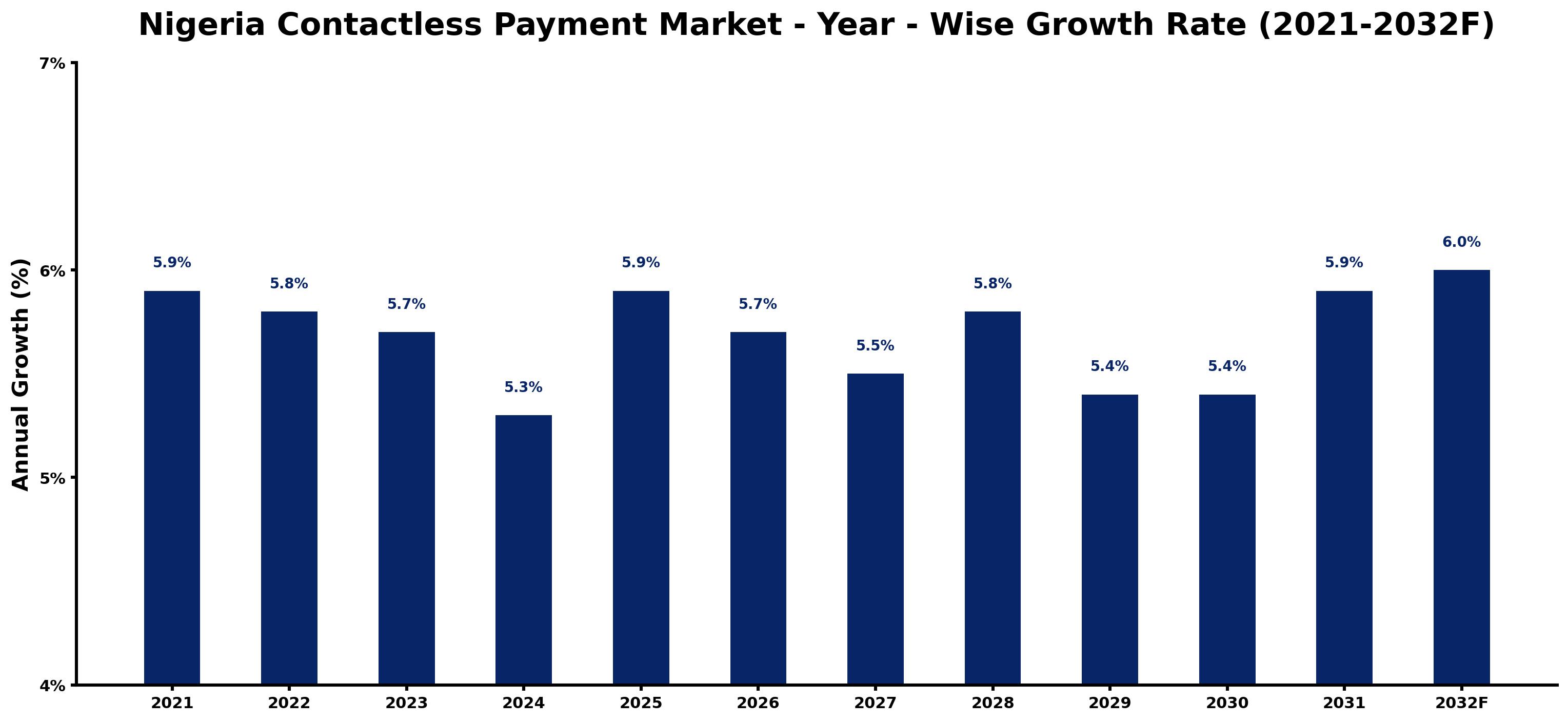
The table below presents the year‑wise growth rates along with the key drivers influencing the market
| Year | Growth Rate | Major Drivers |
| 2021 | 5.9% | Central Bank's cashless Nigeria policy driving technology adoption. |
| 2022 | 5.8% | Increased smartphone penetration enabling mobile payment usage. |
| 2023 | 5.7% | Fintech startups enhancing accessibility of contactless solutions. |
| 2024 | 5.3% | Regional trade agreements boosting cross-border digital payments. |
| 2025 | 5.9% | Rising remittances fueling demand for contactless transactions. |
| 2026 | 5.7% | Government partnerships with fintechs promoting secure payment systems. |
| 2027 | 5.5% | E-commerce growth driving demand for quick payment solutions. |
| 2028 | 5.8% | Youth demographic leading demand for modern payment methods. |
| 2029 | 5.4% | COVID-19 recovery increasing preference for touchless transactions. |
| 2030 | 5.4% | Local banks launching innovative contactless payment products. |
| 2031 | 5.9% | Urbanization promoting cashless transactions in metropolitan areas. |
| 2032 | 6.0% | Adoption of biometric authentication enhancing payment security. |
Note: Market size estimations and growth projections presented in this report are based on 6Wresearch's proprietary forecasting methodology, utilizing the latest available industry data, government publications, and primary research inputs.
Nigeria Contactless Payment Market Key Takeaways
Below are some of the specific key takeaways from the market, including:
- Contactless payment methods are gaining traction due to consumer preferences for speed and convenience.
- The market is supported by advancements in digital payment technologies and infrastructure investments.
- Regulatory frameworks are evolving to support secure digital transactions.
- Challenges such as limited infrastructure and consumer awareness hinder broader adoption.
- Innovative solutions are emerging, catering to the increasing demand for contactless transactions.
Evaluation of Restraints in Nigeria Contactless Payment Market
Despite the optimistic outlook, several factors limit the growth of the contactless payment market in Nigeria. High costs associated with implementing contactless systems deter some businesses from adopting these solutions. on top of that, consumer awareness remains relatively low, which affects the overall uptake of contactless payments. The existing regulatory environment, while improving, still presents challenges that need addressing, particularly in terms of security and compliance. Lastly, inadequate infrastructure and a lack of technical expertise can hinder the smooth operation of contactless payment systems, limiting their reach.
Nigeria Contactless Payment Market Trends
Several key trends are shaping the Nigeria Contactless Payment Market. The shift toward cashless transactions is accelerating, driven by increased smartphone penetration and the proliferation of mobile wallets. Retailers are increasingly integrating contactless payment options to enhance customer experience and streamline operations. Additionally, there's a notable focus on payment security, with businesses investing in advanced technologies to protect consumer data. The rise of e-commerce is also prompting retailers to adopt contactless solutions, catering to the changing shopping habits of consumers.
Nigeria Contactless Payment Market Opportunities
The market presents numerous growth opportunities, particularly in urban centers where digital payment adoption is high. Investments in infrastructure are vital for expanding the reach of contactless payment systems. Collaborations between financial institutions and technology providers can lead to innovative solutions that meet diverse consumer needs. There is also potential for contactless payment applications to penetrate sectors like healthcare and transportation, where speed and convenience are paramount.
Government Initiatives in the Nigeria Contactless Payment Market
Government policies play a crucial role in shaping the Nigeria Contactless Payment Market. Recent efforts have focused on enhancing digital payment infrastructure and establishing regulatory frameworks that promote secure transactions. The Nigerian government is increasingly prioritizing financial inclusion and technological advancement, which directly impacts the growth of contactless payment solutions.
- A national digital infrastructure upgrade programme was launched in early 2023 to improve connectivity for digital transactions.
- A regulatory framework introduced in mid-2024 mandates enhanced security standards for contactless payment systems.
- Ongoing initiatives aim to increase public awareness about digital payment options, with campaigns scheduled throughout 2025.
- Upcoming plans for a public-private partnership expected to expand contactless payment acceptance in rural areas by 2026.
Future Insights of the Nigeria Contactless Payment Market
Looking ahead to 2026-2032, the Nigeria Contactless Payment Market is set to experience substantial growth. As consumer confidence in digital payment methods increases, the market will likely see further integration of contactless solutions across various sectors. Technological advancements will continue to enhance security and user experience, driving wider adoption. The government's commitment to improving digital infrastructure and regulatory frameworks will further support market expansion, making contactless payments a staple of everyday transactions.
Nigeria Contactless Payment Market Latest Developments
In the past year, the Nigeria Contactless Payment Market has witnessed notable developments that signal a robust shift towards digital transactions. The emphasis on contactless solutions has spurred various initiatives aimed at enhancing consumer experience and security in financial transactions.
- A major technology vendor launched a new mobile wallet solution in Q2 2023, enabling consumers to make contactless payments with their smartphones.
- An initiative began in early 2023 to enhance the security of contactless transactions through advanced encryption techniques, and it is currently underway.
- Retailers are currently upgrading their point-of-sale systems to support contactless payments, with significant rollouts expected by late 2025.
- Plans for a nationwide consumer awareness campaign were announced in mid-2023 to promote the benefits of contactless payments, set to launch in early 2024.
Nigeria Contactless Payment Market - Key Attractiveness of the Report
- 10 Years of Market Numbers
- Historical Data Starting from 2022 to 2025
- Base Year: 2025
- Forecast Data until 2032
- Key Performance Indicators Impacting the Market
- Major Upcoming Developments and Projects
Key Highlights of the Report:
- Nigeria Contactless Payment Market Outlook
- Market Size of Nigeria Contactless Payment Market, 2025
- Forecast of Nigeria Contactless Payment Market, 2032
- Historical Data and Forecast of Nigeria Contactless Payment Revenues & Volume for the Period 2022-2032F
- Nigeria Contactless Payment Market Trend Evolution
- Nigeria Contactless Payment Market Drivers and Challenges
- Nigeria Contactless Payment Price Trends
- Nigeria Contactless Payment Porter's Five Forces
- Nigeria Contactless Payment Industry Life Cycle
- Historical Data and Forecast of Nigeria Contactless Payment Market Revenues & Volume By Component for the Period 2022-2032F
- Historical Data and Forecast of Nigeria Contactless Payment Market Revenues & Volume By Hardware for the Period 2022-2032F
- Historical Data and Forecast of Nigeria Contactless Payment Market Revenues & Volume By Solutions for the Period 2022-2032F
- Historical Data and Forecast of Nigeria Contactless Payment Market Revenues & Volume By Services for the Period 2022-2032F
- Historical Data and Forecast of Nigeria Contactless Payment Market Revenues & Volume By Vertical for the Period 2022-2032F
- Historical Data and Forecast of Nigeria Contactless Payment Market Revenues & Volume By Retail for the Period 2022-2032F
- Historical Data and Forecast of Nigeria Contactless Payment Market Revenues & Volume By Hospitality for the Period 2022-2032F
- Historical Data and Forecast of Nigeria Contactless Payment Market Revenues & Volume By Healthcare for the Period 2022-2032F
- Historical Data and Forecast of Nigeria Contactless Payment Market Revenues & Volume By Energy and Utilities for the Period 2022-2032F
- Historical Data and Forecast of Nigeria Contactless Payment Market Revenues & Volume By Transportation and Logistics for the Period 2022-2032F
- Historical Data and Forecast of Nigeria Contactless Payment Market Revenues & Volume By BFSI for the Period 2022-2032F
- Historical Data and Forecast of Nigeria Contactless Payment Market Revenues & Volume By Others (Government, telecommunications, and education) for the Period 2022-2032F
- Nigeria Contactless Payment Import Export Trade Statistics
- Market Opportunity Assessment By Component
- Market Opportunity Assessment By Vertical
- Nigeria Contactless Payment Top Companies Market Share
- Nigeria Contactless Payment Competitive Benchmarking By Technical and Operational Parameters
- Nigeria Contactless Payment Company Profiles
- Nigeria Contactless Payment Key Strategic Recommendations






































