Nigeria Cutting Equipment Market Size, Share & Growth Rate
The Nigeria Cutting Equipment Market was estimated at USD 345 Million in 2025 and is projected to reach USD 485 Million by 2032, growing at a CAGR of 5.0% from 2026 to 2032. This growth is driven primarily by a robust expansion in Nigeria's manufacturing and construction sectors, which are increasingly utilizing advanced cutting technologies to enhance productivity and efficiency. As urbanization accelerates and infrastructure projects proliferate, the demand for cutting equipment is poised to gain momentum across various applications.
Nigeria Cutting Equipment Market Year-wise Growth Rate and Key Drivers
This graph highlights how the Nigeria Cutting Equipment Market has steadily grown over the years, supported by major growth factors.
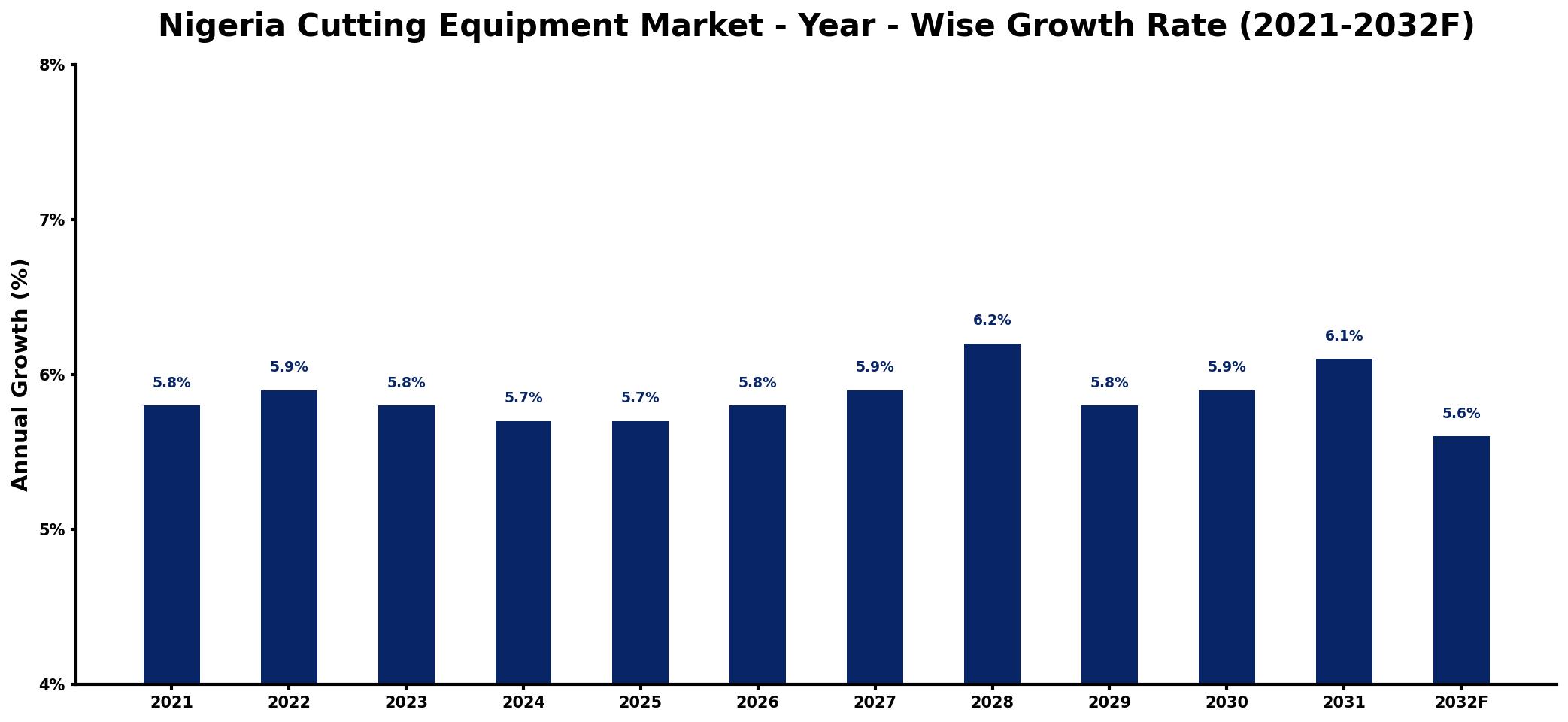
The table below presents the year‑wise growth rates along with the key drivers influencing the market
| Year | Growth Rate | Major Drivers |
| 2021 | 5.8% | Rising construction sector investments |
| 2022 | 5.9% | Increased manufacturing capacity utilization |
| 2023 | 5.8% | Expansion of renewable energy projects |
| 2024 | 5.7% | Growth in automotive production rates |
| 2025 | 5.7% | Advancements in industrial automation |
| 2026 | 5.8% | Surge in infrastructure development projects |
| 2027 | 5.9% | Increased demand from packaging industry |
| 2028 | 6.2% | Technological innovations driving efficiency |
| 2029 | 5.8% | Growing emphasis on safety regulations |
| 2030 | 5.9% | Boost in export opportunities available |
| 2031 | 6.1% | Rising urbanization and population growth |
| 2032 | 5.6% | Increased focus on sustainability initiatives |
Note: Market size estimations and growth projections presented in this report are based on 6Wresearch's proprietary forecasting methodology, utilizing the latest available industry data, government publications, and primary research inputs.
Nigeria Cutting Equipment Market Synopsis
The Nigerian cutting equipment market is witnessing a significant transformation, fueled by the country's ongoing industrialization efforts. Recent investments in construction and manufacturing are spurring a surge in demand for cutting tools and machinery, reflecting the market's dynamic nature.
However, the market is not without challenges. High costs associated with advanced equipment, along with stiff competition from imported alternatives, create a complex environment for local manufacturers. Furthermore, limited local production capabilities and a lack of skilled labor can hinder the sector's potential.
Nigeria Cutting Equipment Market Key Takeaways
- Rapid growth driven by industrialization in construction and manufacturing.
- Market constrained by high import costs and limited local production.
- Regulatory frameworks shaping operational standards and equipment safety.
- Emerging trends towards automation and advanced technology integration.
- Government initiatives supporting infrastructure development and local production.
Evaluation of Restraints in Nigeria Cutting Equipment Market
The Nigeria cutting equipment market faces several significant restraints that curtail its potential for growth. The high costs of cutting equipment remain a persistent barrier, as many manufacturers are reluctant to invest in imported machinery that can impact their operating margins. Additionally, limited local production capabilities contribute to a reliance on foreign imports, further exacerbating cost issues. Infrastructural deficiencies, particularly in transportation and power supply, impede the efficient distribution and operation of cutting equipment. The workforce's lack of technical expertise also presents a challenge, as businesses seek skilled labor to effectively utilize advanced cutting technologies.
Nigeria Cutting Equipment Market Trends
Several trends are shaping the Nigeria cutting equipment market. A notable shift towards automation is enhancing operational efficiency and accuracy in manufacturing processes. Companies are increasingly adopting smart technologies that integrate cutting equipment with digital platforms, enabling better resource management and data analytics. Moreover, the growing emphasis on sustainability is driving innovations in cutting technologies that reduce waste and energy consumption, aligning with global environmental goals.
Nigeria Cutting Equipment Market Opportunities
There are substantial growth and investment opportunities within the Nigeria cutting equipment market, particularly as the government continues to focus on infrastructure development and industrial growth. Expanding sectors such as renewable energy and advanced manufacturing offer pathways for cutting equipment innovations. Furthermore, fostering local production capabilities through partnerships and investments in technical training could significantly enhance market competitiveness. By leveraging local resources and expertise, manufacturers can develop tailored solutions that address unique market demands.
Government Initiatives in the Nigeria Cutting Equipment Market
The Nigerian government is implementing various policies and initiatives aimed at enhancing the industrial sector, which indirectly benefits the cutting equipment market. Measures such as industrial machinery safety regulations and equipment standards are being put in place to ensure compliance and promote the use of safe, efficient technologies. Additionally, public spending on infrastructure and housing projects creates a favorable environment for cutting equipment manufacturers, signaling the government's commitment to stimulating economic growth in these sectors.
Future Insights of the Nigeria Cutting Equipment Market
Looking ahead to 2026-2032, the Nigeria cutting equipment market is likely to experience steady growth driven by an ongoing emphasis on industrialization and modernization. As more industries embrace advanced manufacturing techniques, the demand for sophisticated cutting solutions is expected to rise. Innovations in product design and technology, combined with supportive government policies, will play a crucial role in shaping the market landscape. Furthermore, as local production capabilities improve, we anticipate a shift towards more competitive pricing and increased market participation from domestic manufacturers.
Nigeria Cutting Equipment Market Latest Developments (2025 - 2026)
Recent developments in the Nigeria cutting equipment market indicate a growing emphasis on local manufacturing capabilities. Increased government funding for infrastructure projects is likely to stimulate demand for cutting equipment. Additionally, industry stakeholders are exploring collaborations to enhance technical training for workers, aiming to bridge the skills gap in the market. These initiatives suggest a proactive approach to fostering a robust industrial sector that can effectively utilize advanced cutting technologies.
Nigeria Cutting Equipment Market - Key Attractiveness of the Report
- 10 Years of Market Numbers
- Historical Data Starting from 2022 to 2025
- Base Year: 2025
- Forecast Data until 2032
- Key Performance Indicators Impacting the Market
- Major Upcoming Developments and Projects
Key Highlights of the Report:
- Nigeria Cutting Equipment Market Outlook
- Market Size of Nigeria Cutting Equipment Market, 2025
- Forecast of Nigeria Cutting Equipment Market, 2032
- Historical Data and Forecast of Nigeria Cutting Equipment Revenues & Volume for the Period 2022-2032F
- Nigeria Cutting Equipment Market Trend Evolution
- Nigeria Cutting Equipment Market Drivers and Challenges
- Nigeria Cutting Equipment Price Trends
- Nigeria Cutting Equipment Porter's Five Forces
- Nigeria Cutting Equipment Industry Life Cycle
- Historical Data and Forecast of Nigeria Cutting Equipment Market Revenues & Volume By Equipment Type for the Period 2022-2032F
- Historical Data and Forecast of Nigeria Cutting Equipment Market Revenues & Volume By Manual for the Period 2022-2032F
- Historical Data and Forecast of Nigeria Cutting Equipment Market Revenues & Volume By Mechanized for the Period 2022-2032F
- Historical Data and Forecast of Nigeria Cutting Equipment Market Revenues & Volume By Cutting Technology for the Period 2022-2032F
- Historical Data and Forecast of Nigeria Cutting Equipment Market Revenues & Volume By Plasma cutting for the Period 2022-2032F
- Historical Data and Forecast of Nigeria Cutting Equipment Market Revenues & Volume By Oxy-fuel cutting for the Period 2022-2032F
- Historical Data and Forecast of Nigeria Cutting Equipment Market Revenues & Volume By Laser cutting for the Period 2022-2032F
- Historical Data and Forecast of Nigeria Cutting Equipment Market Revenues & Volume By Waterjet cutting for the Period 2022-2032F
- Historical Data and Forecast of Nigeria Cutting Equipment Market Revenues & Volume By Carbon arc cutting for the Period 2022-2032F
- Historical Data and Forecast of Nigeria Cutting Equipment Market Revenues & Volume By End Use Industry for the Period 2022-2032F
- Historical Data and Forecast of Nigeria Cutting Equipment Market Revenues & Volume By Construction for the Period 2022-2032F
- Historical Data and Forecast of Nigeria Cutting Equipment Market Revenues & Volume By Heavy metal fabrication for the Period 2022-2032F
- Historical Data and Forecast of Nigeria Cutting Equipment Market Revenues & Volume By Shipbuilding & offshore for the Period 2022-2032F
- Historical Data and Forecast of Nigeria Cutting Equipment Market Revenues & Volume By Automotive for the Period 2022-2032F
- Historical Data and Forecast of Nigeria Cutting Equipment Market Revenues & Volume By Others for the Period 2022-2032F
- Historical Data and Forecast of Nigeria Cutting Equipment Market Revenues & Volume By Type for the Period 2022-2032F
- Historical Data and Forecast of Nigeria Cutting Equipment Market Revenues & Volume By Equipment for the Period 2022-2032F
- Historical Data and Forecast of Nigeria Cutting Equipment Market Revenues & Volume By Consumables/Accessories for the Period 2022-2032F
- Nigeria Cutting Equipment Import Export Trade Statistics
- Market Opportunity Assessment By Equipment Type
- Market Opportunity Assessment By Cutting Technology
- Market Opportunity Assessment By End Use Industry
- Market Opportunity Assessment By Type
- Nigeria Cutting Equipment Top Companies Market Share
- Nigeria Cutting Equipment Competitive Benchmarking By Technical and Operational Parameters
- Nigeria Cutting Equipment Company Profiles
- Nigeria Cutting Equipment Key Strategic Recommendations






































