Nigeria Data Prep Market Size & Growth Rate (2026-2032)
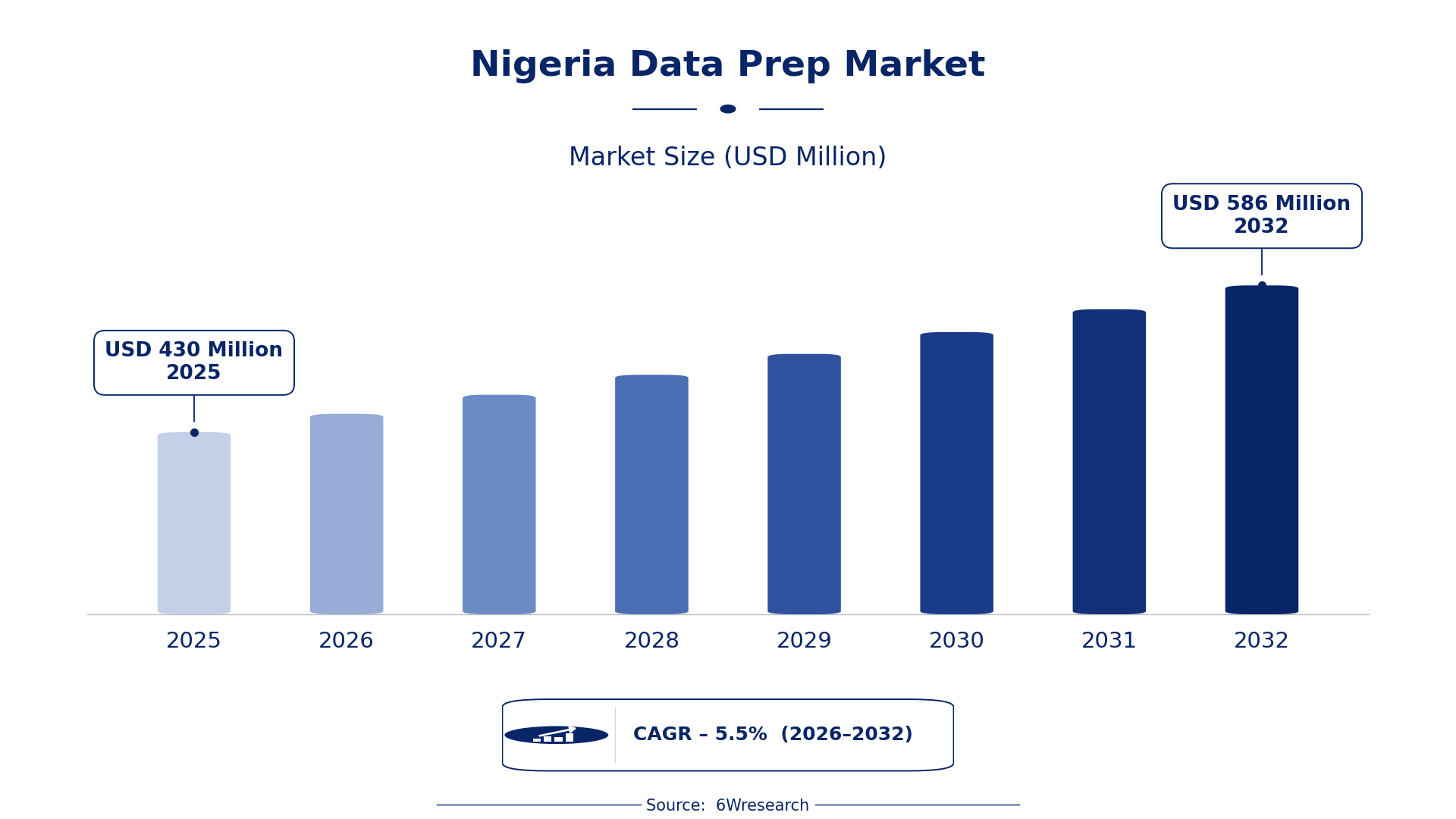
The Nigeria Data Prep Market was estimated at USD 430 Million in 2025 and is projected to reach USD 586 Million by 2032, growing at a CAGR of 5.5% from 2026 to 2032.
Nigeria Data Prep Market Synopsis
The surge in data generation across Nigerian enterprises is a key driver behind the rapid expansion of the data preparation market. Organizations increasingly recognize that effective data preparation is essential for accurate analysis, regulatory compliance, and informed decision-making.
As businesses pivot towards data-centric strategies, the demand for sophisticated data preparation tools is on the rise. Companies are prioritizing solutions that simplify the complexities of data manipulation, ensuring that even non-technical users can access and utilize critical insights.
Nigeria Data Prep Market Year-wise Growth Rate and Key Drivers
This graph illustrates the annual growth rates of the Nigeria Data Prep Market from 2021 to 2032, highlighting a steady upward trajectory and projected expansion over the forecast period.
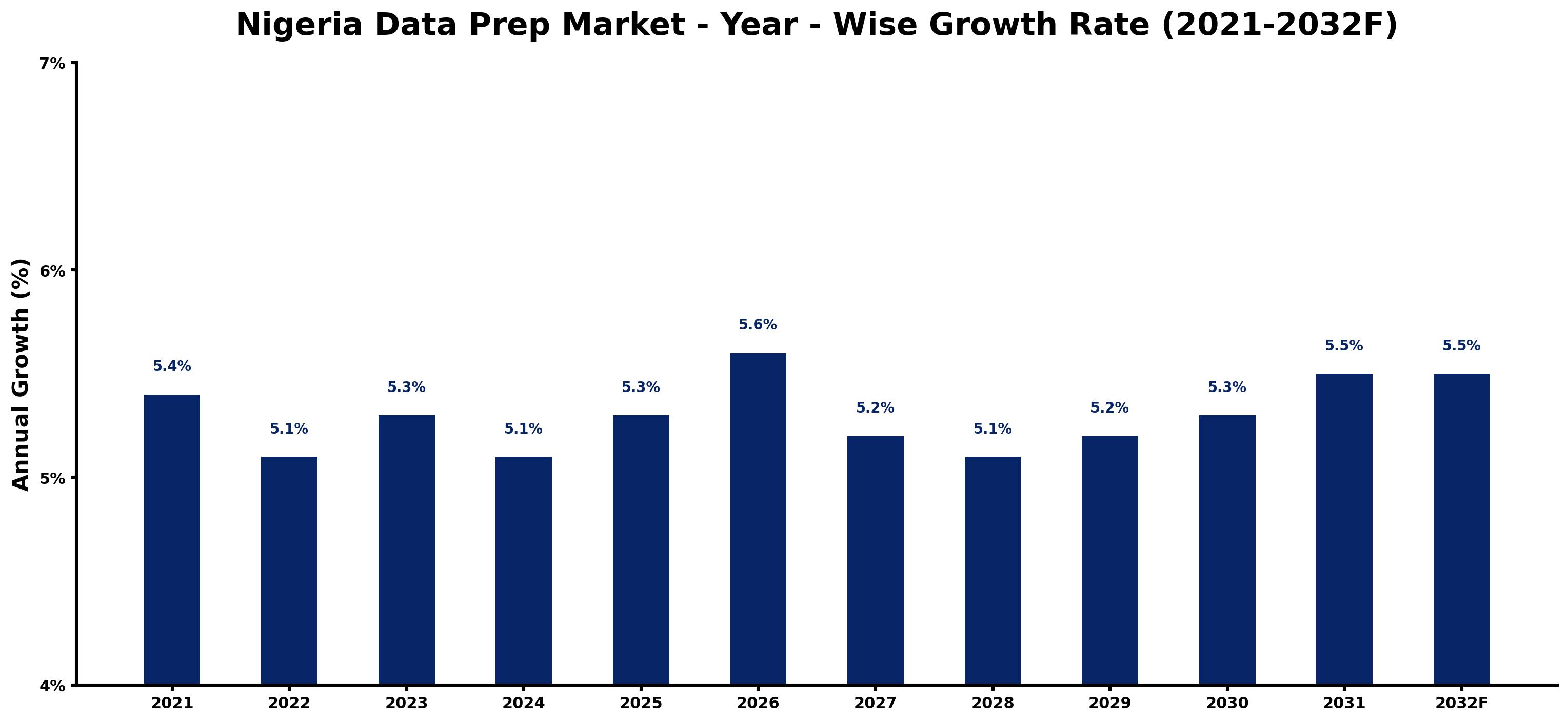
The table below presents the year‑wise growth rates along with the key drivers influencing the market
| Year | Growth Rate | Major Drivers |
| 2021 | 5.4% | NITDA's initiatives boosting data literacy in Nigeria. |
| 2022 | 5.1% | Government funding for digitization drives data preparation needs. |
| 2023 | 5.3% | Growing need for data-driven decisions in Nigerian agriculture. |
| 2024 | 5.1% | Rise of e-commerce platforms enhances data management demand. |
| 2025 | 5.3% | Increased smartphone penetration improves data access capabilities. |
| 2026 | 5.6% | Nigerian telecom sector expansion fuels data processing growth. |
| 2027 | 5.2% | Emerging remote work trends heighten need for data solutions. |
| 2028 | 5.1% | Local interest in AI applications boosts data preparation demand. |
| 2029 | 5.2% | Partnerships between banks and tech firms enhance data strategies. |
| 2030 | 5.3% | Focus on economic diversification increases demand for data analytics. |
| 2031 | 5.5% | Public sector digitization programs drive adoption of data tools. |
| 2032 | 5.5% | Nigerian youth's tech-savvy nature stimulates data industry growth. |
Note: Market size estimations and growth projections presented in this report are based on 6Wresearch's proprietary forecasting methodology, utilizing the latest available industry data, government publications, and primary research inputs.
Nigeria Data Prep Market Key Takeaways
Below are some of the specific key takeaways from the market, including:
- The market is witnessing a shift towards self-service data preparation solutions.
- Cloud-based data preparation tools are gaining traction among organizations for their scalability.
- Artificial intelligence is becoming a crucial component in the development of automated data preparation tools.
- Data quality and regulatory compliance are primary considerations driving market demand.
- Investment in training and skilled workforce development is critical to address the skills gap.
Evaluation of Restraints in Nigeria Data Prep Market
Despite the growth potential, the Nigeria Data Prep Market faces several constraints. A notable limitation is the shortage of skilled professionals who can effectively handle complex data preparation tasks. This gap not only hampers operational efficiency but also introduces risks of inaccuracies in data processing. Compounding this issue is the rapid increase in data sources and formats, which makes consistent data accuracy a persistent challenge. on top of that, evolving data security regulations add another layer of complexity, necessitating ongoing investments in compliance and governance frameworks.
Nigeria Data Prep Market Trends
Several trends are shaping the Nigeria Data Prep Market. Self-service data preparation is empowering users without technical backgrounds to take charge of their data. This democratization of data handling is crucial as organizations seek to streamline operations and enhance decision-making speed.
The emergence of cloud-based solutions continues to disrupt traditional models, allowing businesses to scale their data management capabilities without hefty upfront investments. on top of that, as organizations increasingly adopt AI and machine learning, the development of automated data preparation tools is set to redefine efficiency standards.
Nigeria Data Prep Market Opportunities
The Nigeria Data Prep Market holds several opportunities for growth and investment. The demand for user-friendly, cloud-based solutions presents a chance for vendors to innovate and capture market share. As businesses seek to harness the power of data analytics, opportunities abound in developing specialized tools that cater to unique industry needs.
Additionally, the integration of AI capabilities into data preparation processes can enhance operational efficiencies, making it an attractive avenue for investment. Companies that prioritize these innovations are likely to gain a competitive edge in the marketplace.
Government Initiatives in the Nigeria Data Prep Market
The Nigerian government plays a vital role in shaping the data prep market through various policies and initiatives. The focus on enhancing digital infrastructure and ensuring data protection is critical for fostering a supportive environment for businesses engaged in data preparation. Recent regulations highlight the importance of compliance and security, driving organizations to adopt better practices in data management.
- A national digital infrastructure upgrade programme aimed at improving connectivity and data access across the country is currently underway.
- The National Information Technology Development Agency (NITDA) introduced guidelines in 2025 to enhance data protection and privacy compliance.
- Planned initiatives include a public-private partnership expected to boost data literacy and skill development in the workforce by 2028.
- Ongoing efforts to implement the National Broadband Plan are enhancing the capacity for data-driven businesses.
- The government is currently working on a regulatory framework to streamline data processing standards across industries.
Future Insights of the Nigeria Data Prep Market
Looking ahead, the Nigeria Data Prep Market is set to experience transformative growth fueled by technological advancements and an expanding data ecosystem. As more organizations prioritize data analytics, the demand for efficient preparation tools will intensify. The push for improved data governance and quality assurance will also drive innovation, leading to new solutions that align with the evolving needs of businesses.
By 2032, we anticipate that the market will not only expand but also diversify, with a proliferation of offerings tailored to specific industries and business requirements. Companies that adapt to these changes will position themselves favorably in a competitive landscape.
Nigeria Data Prep Market Latest Developments
In recent months, the Nigeria Data Prep Market has seen notable developments that reflect the growing importance of data management solutions. As businesses increasingly turn to advanced analytics, the demand for reliable data preparation tools has surged. Industry players are responding with innovative offerings designed to meet specific market needs.
- A major technology vendor launched a cloud-based data preparation platform in early 2025, catering to small and medium enterprises.
- Ongoing partnerships between local firms and international tech companies aim to enhance data processing capabilities in the region.
- A new training initiative, started in Q1 2025, focuses on developing data literacy among Nigerian professionals to address the skills gap.
- Expected in late 2025, a collaborative project involving multiple stakeholders aims to create an open-source data prep tool tailored to local businesses.
- A leading analytics firm is currently expanding its service offerings to include AI-driven data preparation solutions, expected to launch by mid-2026.
Nigeria Data Prep Market - Key Attractiveness of the Report
- 10 Years of Market Numbers
- Historical Data Starting from 2022 to 2025
- Base Year: 2025
- Forecast Data until 2032
- Key Performance Indicators Impacting the Market
- Major Upcoming Developments and Projects
Key Highlights of the Report:
- Nigeria Data Prep Market Outlook
- Market Size of Nigeria Data Prep Market, 2025
- Forecast of Nigeria Data Prep Market, 2032
- Historical Data and Forecast of Nigeria Data Prep Revenues & Volume for the Period 2022-2032F
- Nigeria Data Prep Market Trend Evolution
- Nigeria Data Prep Market Drivers and Challenges
- Nigeria Data Prep Price Trends
- Nigeria Data Prep Porter's Five Forces
- Nigeria Data Prep Industry Life Cycle
- Historical Data and Forecast of Nigeria Data Prep Market Revenues & Volume By Platform for the Period 2022-2032F
- Historical Data and Forecast of Nigeria Data Prep Market Revenues & Volume By Self-service data prep for the Period 2022-2032F
- Historical Data and Forecast of Nigeria Data Prep Market Revenues & Volume By Data integration for the Period 2022-2032F
- Historical Data and Forecast of Nigeria Data Prep Market Revenues & Volume By Tool for the Period 2022-2032F
- Historical Data and Forecast of Nigeria Data Prep Market Revenues & Volume By Data curation for the Period 2022-2032F
- Historical Data and Forecast of Nigeria Data Prep Market Revenues & Volume By Data cataloging for the Period 2022-2032F
- Historical Data and Forecast of Nigeria Data Prep Market Revenues & Volume By Data quality for the Period 2022-2032F
- Historical Data and Forecast of Nigeria Data Prep Market Revenues & Volume By Data ingestion for the Period 2022-2032F
- Historical Data and Forecast of Nigeria Data Prep Market Revenues & Volume By Data governance for the Period 2022-2032F
- Historical Data and Forecast of Nigeria Data Prep Market Revenues & Volume By Deployment for the Period 2022-2032F
- Historical Data and Forecast of Nigeria Data Prep Market Revenues & Volume By On-premises for the Period 2022-2032F
- Historical Data and Forecast of Nigeria Data Prep Market Revenues & Volume By Hosted/On-cloud for the Period 2022-2032F
- Historical Data and Forecast of Nigeria Data Prep Market Revenues & Volume By Vertical for the Period 2022-2032F
- Historical Data and Forecast of Nigeria Data Prep Market Revenues & Volume By Banking, Financial Services, and Insurance (BFSI) for the Period 2022-2032F
- Historical Data and Forecast of Nigeria Data Prep Market Revenues & Volume By Government for the Period 2022-2032F
- Historical Data and Forecast of Nigeria Data Prep Market Revenues & Volume By Healthcare for the Period 2022-2032F
- Historical Data and Forecast of Nigeria Data Prep Market Revenues & Volume By Retail and eCommerce for the Period 2022-2032F
- Historical Data and Forecast of Nigeria Data Prep Market Revenues & Volume By Manufacturing for the Period 2022-2032F
- Historical Data and Forecast of Nigeria Data Prep Market Revenues & Volume By Energy and utilities for the Period 2022-2032F
- Historical Data and Forecast of Nigeria Data Prep Market Revenues & Volume By Transportation for the Period 2022-2032F
- Historical Data and Forecast of Nigeria Data Prep Market Revenues & Volume By Others for the Period 2022-2032F
- Nigeria Data Prep Import Export Trade Statistics
- Market Opportunity Assessment By Platform
- Market Opportunity Assessment By Tool
- Market Opportunity Assessment By Deployment
- Market Opportunity Assessment By Vertical
- Nigeria Data Prep Top Companies Market Share
- Nigeria Data Prep Competitive Benchmarking By Technical and Operational Parameters
- Nigeria Data Prep Company Profiles
- Nigeria Data Prep Key Strategic Recommendations






































