Nigeria Decorative Laminates Market Top 5 Importing Countries and Market Competition (HHI) Analysis
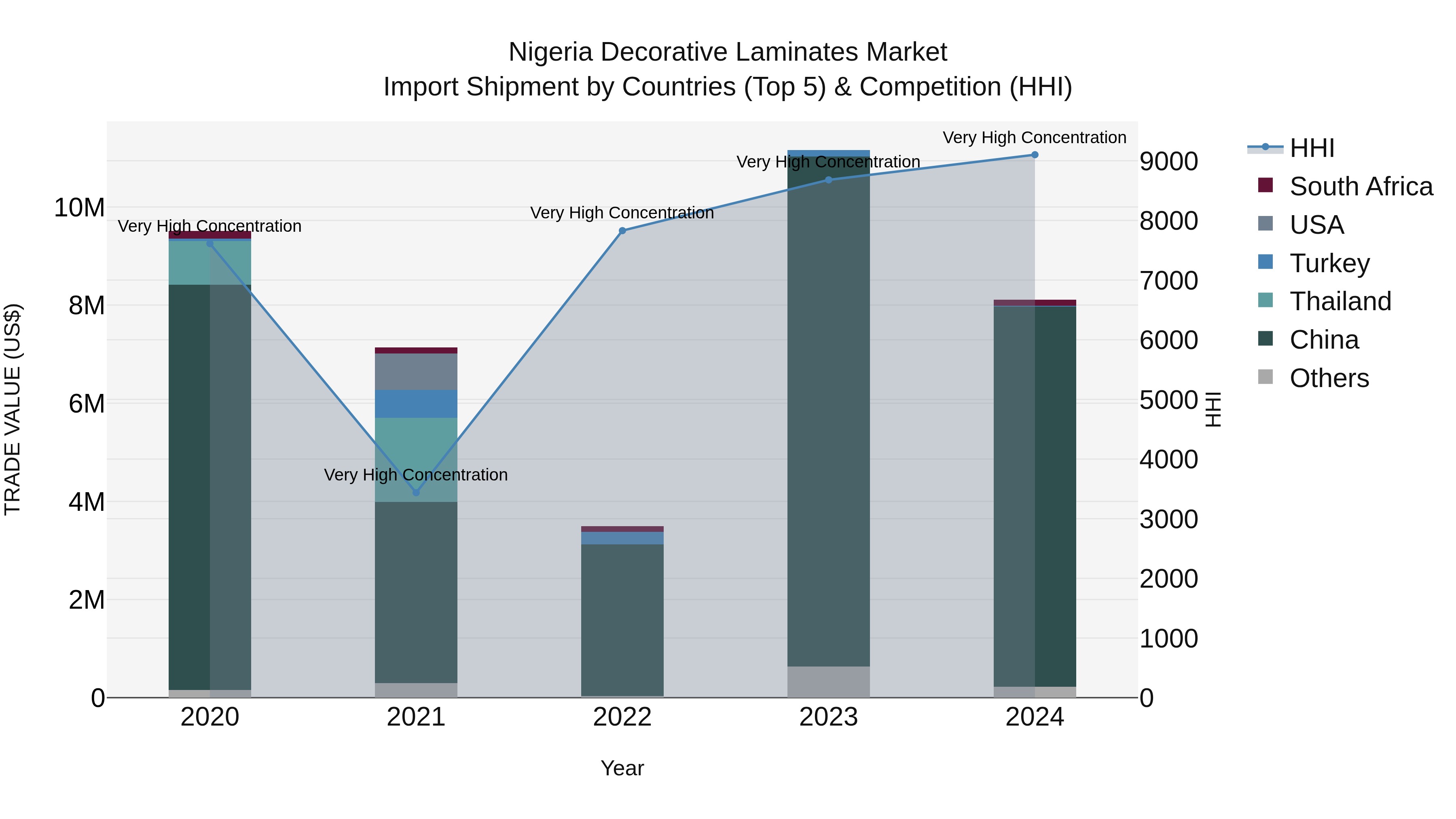
In 2024, Nigeria continued to be a key destination for decorative laminates imports, with top suppliers being China, South Africa, Gabon, Bulgaria, and Greece. Despite a high Herfindahl-Hirschman Index (HHI) indicating market concentration, the industry experienced a decline with a negative Compound Annual Growth Rate (CAGR) of -3.92% from 2020 to 2024. The growth rate in 2024 plummeted by -27.32%, reflecting challenges faced by the sector. Nigeria`s decorative laminates import market may require strategic interventions to stimulate growth and enhance competitiveness in the coming years.
Nigeria Decorative Laminates Market Overview
The decorative laminates market in Nigeria is expanding as consumer preferences shift towards aesthetically pleasing and durable surfacing materials. Decorative laminates are used in residential and commercial applications to enhance the appearance of furniture, walls, and floors. The market growth is driven by the increasing demand for interior design solutions, the rise in construction activities, and advancements in laminate manufacturing technologies. Companies in the furniture and construction sectors are adopting decorative laminates to meet the growing demand for stylish and functional surfaces.
Drivers of the market
The Nigeria Decorative Laminates market is driven by the growing demand for aesthetically appealing and durable interior decor solutions. Decorative laminates offer versatility, ease of maintenance, and cost-effectiveness, making them a preferred choice for residential and commercial applications, thereby driving market growth.
Challenges of the market
The Nigeria decorative laminates market encounters challenges such as the fluctuating cost of raw materials, competition from alternative surfacing materials, and the impact of economic downturns on consumer spending. Additionally, concerns about product quality and durability may affect consumer perceptions and purchasing decisions.
Government Policy of the market
The Nigeria government supports the decorative laminates market through policies that encourage sustainable development and innovation. Regulatory frameworks provide guidelines for the manufacture and use of decorative laminates, ensuring compliance with environmental and safety standards. Moreover, the government promotes investment in infrastructure and technology upgrades to support the growth of the decorative laminates industry. This includes fostering partnerships between manufacturers, designers, and consumers to promote creativity and quality in decorative laminate products. Additionally, the government supports capacity-building initiatives to enhance local expertise and skills in decorative laminate production and design.
Key Highlights of the Report:
- Nigeria Decorative Laminates Market Outlook
- Market Size of Nigeria Decorative Laminates Market, 2024
- Forecast of Nigeria Decorative Laminates Market, 2031
- Historical Data and Forecast of Nigeria Decorative Laminates Revenues & Volume for the Period 2021-2031
- Nigeria Decorative Laminates Market Trend Evolution
- Nigeria Decorative Laminates Market Drivers and Challenges
- Nigeria Decorative Laminates Price Trends
- Nigeria Decorative Laminates Porter's Five Forces
- Nigeria Decorative Laminates Industry Life Cycle
- Historical Data and Forecast of Nigeria Decorative Laminates Market Revenues & Volume By Raw Material for the Period 2021-2031
- Historical Data and Forecast of Nigeria Decorative Laminates Market Revenues & Volume By Plastic resins for the Period 2021-2031
- Historical Data and Forecast of Nigeria Decorative Laminates Market Revenues & Volume By Overlays for the Period 2021-2031
- Historical Data and Forecast of Nigeria Decorative Laminates Market Revenues & Volume By Adhesives for the Period 2021-2031
- Historical Data and Forecast of Nigeria Decorative Laminates Market Revenues & Volume By Wood substrate for the Period 2021-2031
- Historical Data and Forecast of Nigeria Decorative Laminates Market Revenues & Volume By Type for the Period 2021-2031
- Historical Data and Forecast of Nigeria Decorative Laminates Market Revenues & Volume By General Purpose for the Period 2021-2031
- Historical Data and Forecast of Nigeria Decorative Laminates Market Revenues & Volume By Postforming for the Period 2021-2031
- Historical Data and Forecast of Nigeria Decorative Laminates Market Revenues & Volume By Special Products for the Period 2021-2031
- Historical Data and Forecast of Nigeria Decorative Laminates Market Revenues & Volume By Backer for the Period 2021-2031
- Historical Data and Forecast of Nigeria Decorative Laminates Market Revenues & Volume By Application for the Period 2021-2031
- Historical Data and Forecast of Nigeria Decorative Laminates Market Revenues & Volume By Cabinets for the Period 2021-2031
- Historical Data and Forecast of Nigeria Decorative Laminates Market Revenues & Volume By Furniture for the Period 2021-2031
- Historical Data and Forecast of Nigeria Decorative Laminates Market Revenues & Volume By Flooring for the Period 2021-2031
- Historical Data and Forecast of Nigeria Decorative Laminates Market Revenues & Volume By Table Top for the Period 2021-2031
- Historical Data and Forecast of Nigeria Decorative Laminates Market Revenues & Volume By Counter Top for the Period 2021-2031
- Historical Data and Forecast of Nigeria Decorative Laminates Market Revenues & Volume By Wall Panels for the Period 2021-2031
- Historical Data and Forecast of Nigeria Decorative Laminates Market Revenues & Volume By End-Use for the Period 2021-2031
- Historical Data and Forecast of Nigeria Decorative Laminates Market Revenues & Volume By Residential for the Period 2021-2031
- Historical Data and Forecast of Nigeria Decorative Laminates Market Revenues & Volume By Non-residential for the Period 2021-2031
- Historical Data and Forecast of Nigeria Decorative Laminates Market Revenues & Volume By Transportation for the Period 2021-2031
- Nigeria Decorative Laminates Import Export Trade Statistics
- Market Opportunity Assessment By Raw Material
- Market Opportunity Assessment By Type
- Market Opportunity Assessment By Application
- Market Opportunity Assessment By End-Use
- Nigeria Decorative Laminates Top Companies Market Share
- Nigeria Decorative Laminates Competitive Benchmarking By Technical and Operational Parameters
- Nigeria Decorative Laminates Company Profiles
- Nigeria Decorative Laminates Key Strategic Recommendations






































