Nigeria Digital Education Market Size & Growth Rate (2026-2032)
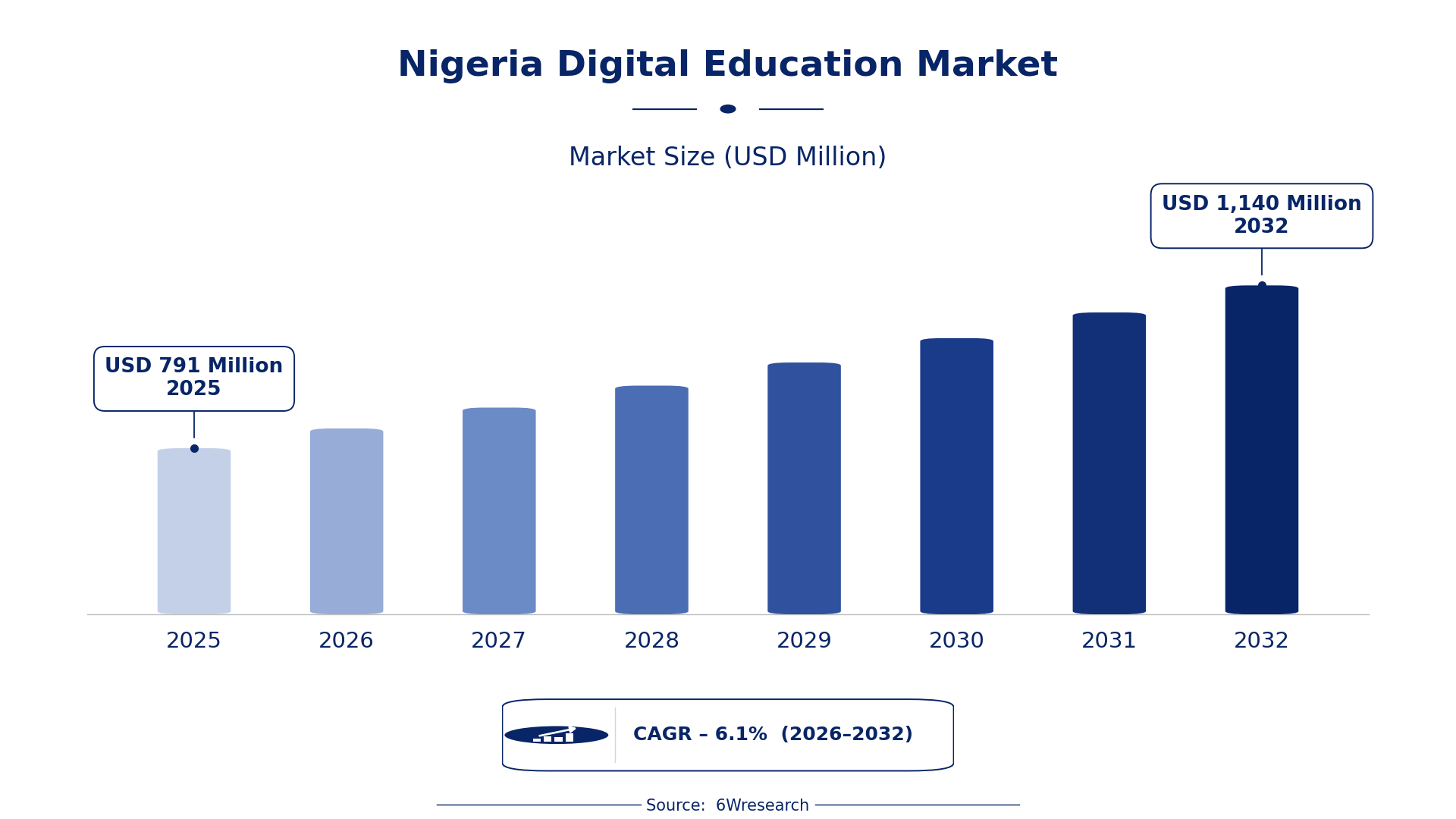
The Nigeria Digital Education Market was estimated at USD 791 Million in 2025 and is projected to reach USD 1140 Million by 2032, growing at a CAGR of 6.1% from 2026 to 2032.
Nigeria Digital Education Market Synopsis
The surge in demand for accessible and flexible educational solutions is the most significant driver of the Nigeria Digital Education Market. The COVID-19 pandemic acted as a catalyst, pushing educational institutions to rapidly adopt online platforms and digital content.
Government support through various initiatives and investments in educational technology is further enhancing the market's growth potential. As mobile device usage and internet access continue to rise, more students are able to engage with digital learning resources.
Nigeria Digital Education Market Year-wise Growth Rate and Key Drivers
This graph illustrates the annual growth rates of the Nigeria Digital Education Market from 2021 to 2032, highlighting a steady upward trajectory and projected expansion over the forecast period.
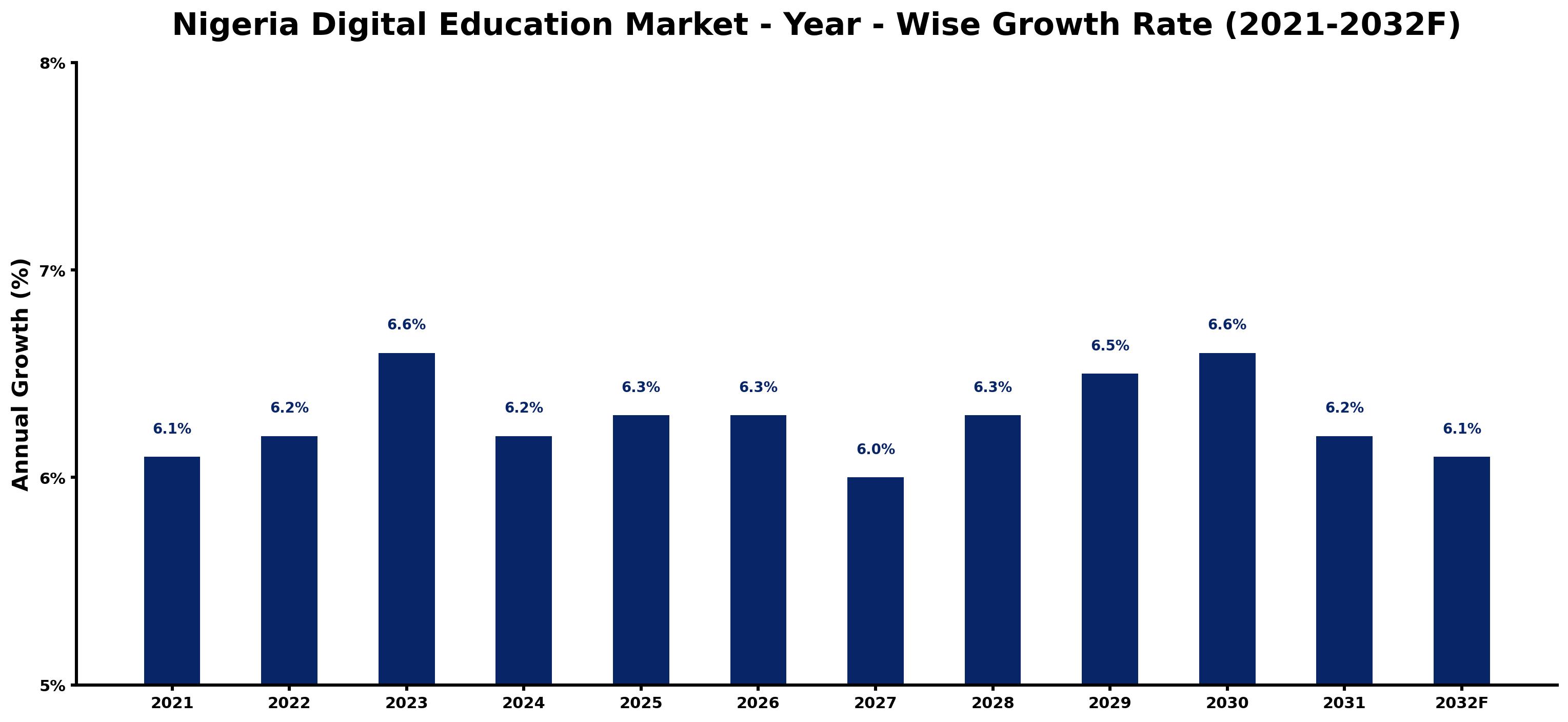
The table below presents the year‑wise growth rates along with the key drivers influencing the market
| Year | Growth Rate | Major Drivers |
| 2021 | 6.1% | Increased mobile penetration among Nigerian youth populations. |
| 2022 | 6.2% | Government's strategic focus on digital learning initiatives. |
| 2023 | 6.6% | Rise in online courses due to pandemic-driven changes. |
| 2024 | 6.2% | Local startups developing tailored e-learning platforms. |
| 2025 | 6.3% | Partnerships between schools and tech companies expanding access. |
| 2026 | 6.3% | Growing urbanization driving demand for digital education solutions. |
| 2027 | 6.0% | Continued investment in internet infrastructure by providers. |
| 2028 | 6.3% | Educational reforms promoting technology integration in classrooms. |
| 2029 | 6.5% | Increased availability of affordable smartphones among students. |
| 2030 | 6.6% | Government funding for digital literacy programs in schools. |
| 2031 | 6.2% | Emerging online certification programs attracting adult learners. |
| 2032 | 6.1% | Enhanced focus on STEM education through digital platforms. |
Note: Market size estimations and growth projections presented in this report are based on 6Wresearch's proprietary forecasting methodology, utilizing the latest available industry data, government publications, and primary research inputs.
Nigeria Digital Education Market Key Takeaways
Below are some of the specific key takeaways from the market, including:
- Digital education is increasingly viewed as a necessary alternative to traditional learning methods.
- Government policies are actively facilitating the integration of technology in educational settings.
- Mobile accessibility is transforming how students and educators interact with educational content.
- Adoption of personalized and adaptive learning technologies is on the rise.
- Challenges such as inadequate infrastructure still pose risks to market expansion.
Evaluation of Restraints in Nigeria Digital Education Market
Despite the promising growth trajectory, the Nigeria Digital Education Market faces substantial hurdles. Inadequate infrastructure, particularly unreliable internet connectivity and frequent power outages, significantly impede access to digital education. High costs associated with digital devices and software create barriers for many students. Additionally, there is a noticeable gap in trained educators who are proficient in digital teaching methods, compounded by cultural resistance to embracing new educational technologies. These challenges must be addressed to unlock the market's full potential.
Nigeria Digital Education Market Trends
The rise of mobile learning is a prominent trend, as students increasingly utilize smartphones and tablets for educational purposes. Virtual classrooms and online courses are becoming mainstream, with many educational institutions developing tailored content for remote learning. on top of that, the incorporation of gamification and interactive content is enhancing student engagement. There’s also a growing focus on personalized learning experiences, driven by data analytics and artificial intelligence, which are being integrated into educational platforms.
Nigeria Digital Education Market Opportunities
Investors and stakeholders should look towards opportunities in developing localized content and platforms tailored to Nigerian students. The expansion of public-private partnerships can also facilitate advancements in educational technology. With an increasing emphasis on digital literacy, initiatives aimed at training educators in digital teaching methods present a fertile ground for growth. The push for improved digital infrastructure will also create pathways for new investments.
Government Initiatives in the Nigeria Digital Education Market
The Nigerian government is actively shaping the digital education sector through various strategic initiatives. Public policy focuses on integrating technology in educational settings and improving digital literacy among students and teachers. This regulatory environment is crucial as it aims to bridge the digital divide and enhance access to quality education.
- A national digital infrastructure upgrade program launched in early 2023 aims to improve internet connectivity in educational institutions.
- The implementation of the National Policy on Information and Communication Technology (ICT) in Education is currently underway, focusing on integrating digital tools into the curriculum.
- A public-private partnership initiative planned for 2025 seeks to expand access to affordable digital devices for students.
- Ongoing training programs for educators to enhance their proficiency in digital teaching methods are being executed across various regions.
- A regulatory framework to incentivize tech companies to develop educational solutions is anticipated to be introduced by 2026.
Future Insights of the Nigeria Digital Education Market
From 2026 to 2032, the Nigeria Digital Education Market is expected to evolve significantly. As technological advancements continue, there will be a greater emphasis on personalized learning experiences that cater to individual student needs. Investment in digital infrastructure and governmental support will play critical roles in driving market expansion. Additionally, the growing trend of lifelong learning is likely to encourage more adults to engage with digital education platforms, further broadening the market base.
Nigeria Digital Education Market Latest Developments
Recent activities in the Nigeria Digital Education Market reflect a focused push towards enhancing educational technology and accessibility. Over the past year, several initiatives have emerged to bolster the market's infrastructure and offerings.
- A major technology vendor launched an interactive e-learning platform in Q3 2023 aimed at primary and secondary school students.
- An initiative that began in mid-2023, focused on providing training workshops for teachers on digital tools, is currently ongoing.
- A rollout of affordable tablet devices for students, expected to begin in early 2024, aims to enhance access to digital learning resources.
- A collaboration between educational institutions and tech companies to develop localized content was initiated in late 2023.
- A pilot program for online vocational training courses, set to launch by mid-2024, is designed to enhance skill development among youths.
Nigeria Digital Education Market - Key Attractiveness of the Report
- 10 Years of Market Numbers
- Historical Data Starting from 2022 to 2025
- Base Year: 2025
- Forecast Data until 2032
- Key Performance Indicators Impacting the Market
- Major Upcoming Developments and Projects
Key Highlights of the Report:
- Nigeria Digital Education Market Outlook
- Market Size of Nigeria Digital Education Market, 2025
- Forecast of Nigeria Digital Education Market, 2032
- Historical Data and Forecast of Nigeria Digital Education Revenues & Volume for the Period 2022-2032F
- Nigeria Digital Education Market Trend Evolution
- Nigeria Digital Education Market Drivers and Challenges
- Nigeria Digital Education Price Trends
- Nigeria Digital Education Porter's Five Forces
- Nigeria Digital Education Industry Life Cycle
- Historical Data and Forecast of Nigeria Digital Education Market Revenues & Volume By End User for the Period 2022-2032F
- Historical Data and Forecast of Nigeria Digital Education Market Revenues & Volume By Academic Institutions for the Period 2022-2032F
- Historical Data and Forecast of Nigeria Digital Education Market Revenues & Volume By Enterprises and Public Sector for the Period 2022-2032F
- Historical Data and Forecast of Nigeria Digital Education Market Revenues & Volume By Learning Type for the Period 2022-2032F
- Historical Data and Forecast of Nigeria Digital Education Market Revenues & Volume By Self-paced Online Education for the Period 2022-2032F
- Historical Data and Forecast of Nigeria Digital Education Market Revenues & Volume By Instructor-led Online Education for the Period 2022-2032F
- Historical Data and Forecast of Nigeria Digital Education Market Revenues & Volume By Course Type for the Period 2022-2032F
- Historical Data and Forecast of Nigeria Digital Education Market Revenues & Volume By Science and Technology Courses for the Period 2022-2032F
- Historical Data and Forecast of Nigeria Digital Education Market Revenues & Volume By Entrepreneurship and Business Management Courses for the Period 2022-2032F
- Historical Data and Forecast of Nigeria Digital Education Market Revenues & Volume By Other Courses for the Period 2022-2032F
- Nigeria Digital Education Import Export Trade Statistics
- Market Opportunity Assessment By End User
- Market Opportunity Assessment By Learning Type
- Market Opportunity Assessment By Course Type
- Nigeria Digital Education Top Companies Market Share
- Nigeria Digital Education Competitive Benchmarking By Technical and Operational Parameters
- Nigeria Digital Education Company Profiles
- Nigeria Digital Education Key Strategic Recommendations






































