Nigeria EdTech and Smart Classrooms Market Size & Growth Rate (2026-2032)
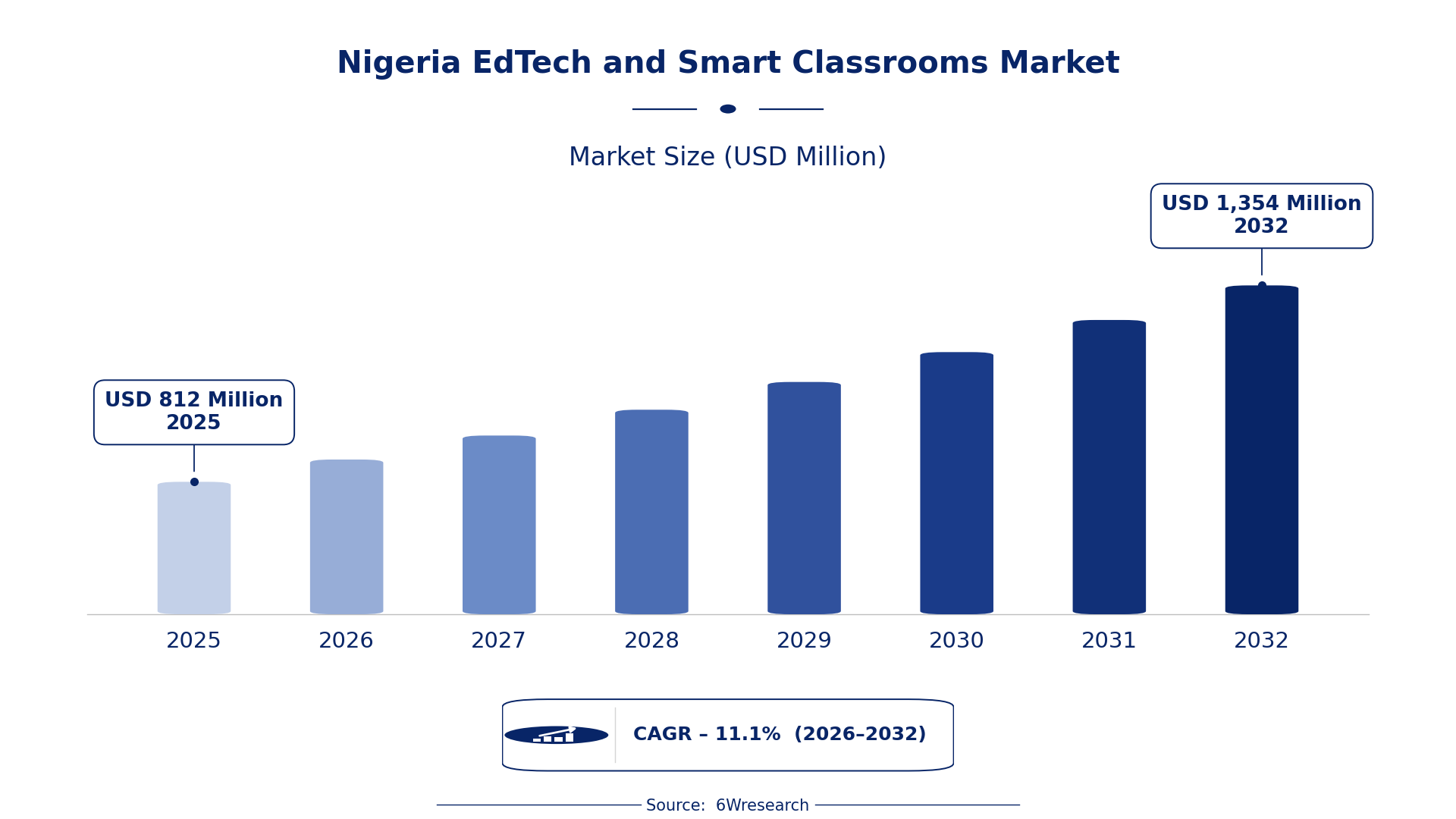
The Nigeria EdTech and Smart Classrooms Market was estimated at USD 812 Million in 2025 and is projected to reach USD 1354 Million by 2032, growing at a CAGR of 11.1% from 2026 to 2032.
Nigeria EdTech and Smart Classrooms Market Synopsis
The Nigeria EdTech and Smart Classrooms Market is witnessing an extraordinary transformation, fueled by increasing digital learning adoption. The drive for modern educational tools is amplified by government policies that advocate for technology integration in schools, creating a fertile ground for innovation.
As smartphones and internet connectivity become ubiquitous, both students and educators are increasingly embracing online platforms and interactive content. This shift not only enhances learning experiences but also poses unique challenges, particularly concerning infrastructure and equitable access to technology.
Nigeria EdTech and Smart Classrooms Market Year-wise Growth Rate and Key Drivers
This graph illustrates the annual growth rates of the Nigeria EdTech and Smart Classrooms Market from 2021 to 2032, highlighting a steady upward trajectory and projected expansion over the forecast period.
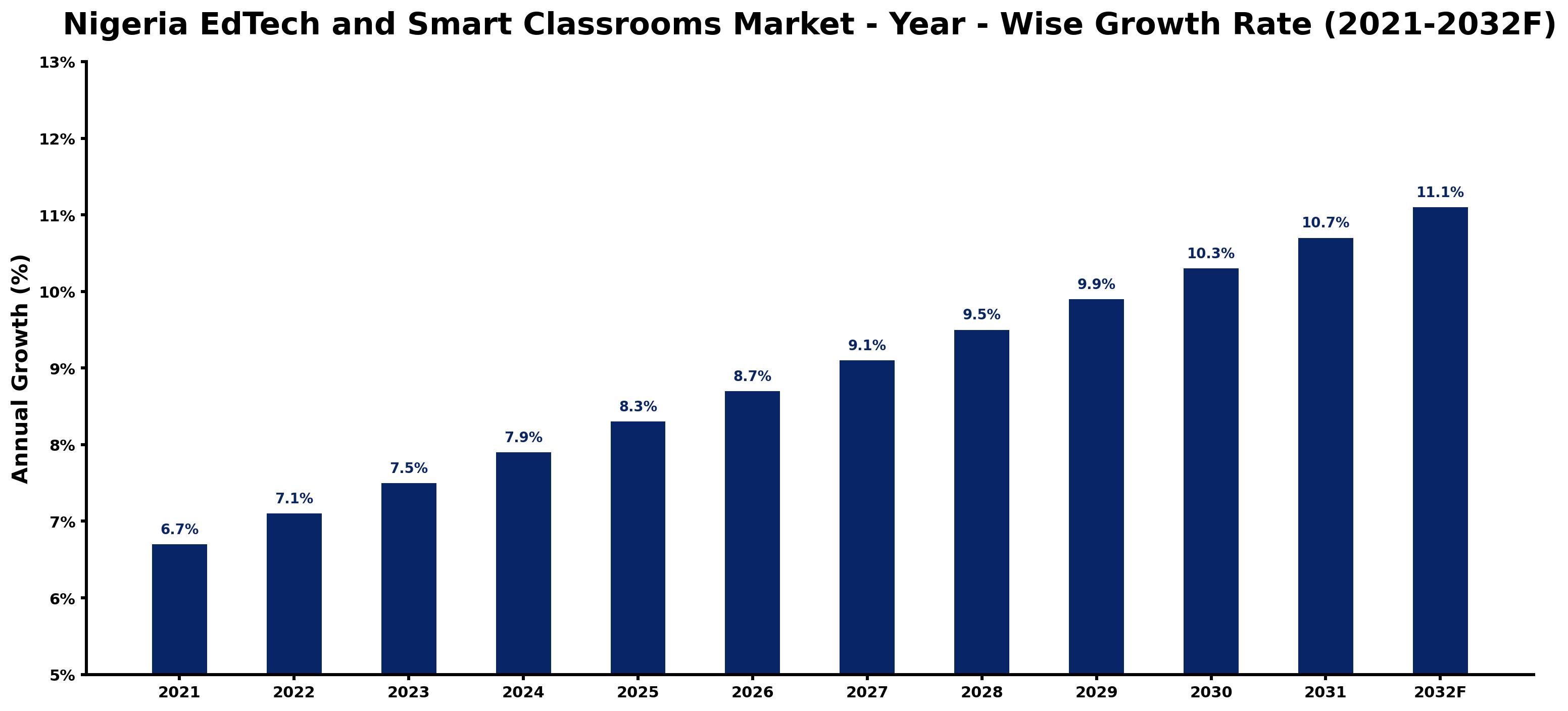
The table below presents the year‑wise growth rates along with the key drivers influencing the market
| Year | Growth Rate | Major Drivers |
| 2021 | 6.7% | Nigerian schools adopting online learning platforms rapidly. |
| 2022 | 7.1% | Growing youth population enhances demand for tech education. |
| 2023 | 7.5% | Local universities integrating smart technology in classrooms. |
| 2024 | 7.9% | National policy promoting technology in remote learning. |
| 2025 | 8.3% | Increased mobile internet penetration facilitates EdTech accessibility. |
| 2026 | 8.7% | Government grants incentivizing digital classroom equipment purchases. |
| 2027 | 9.1% | Rising corporate sponsorships for educational technology initiatives. |
| 2028 | 9.5% | Inclusion of digital literacy in national curriculum reforms. |
| 2029 | 9.9% | Partnerships with local tech firms advancing classroom innovation. |
| 2030 | 10.3% | Increased public awareness of digital learning benefits. |
| 2031 | 10.7% | Investment in sustainable energy powering smart classroom tools. |
| 2032 | 11.1% | Nigerian NGOs supporting digital education initiatives nationwide. |
Note: Market size estimations and growth projections presented in this report are based on 6Wresearch's proprietary forecasting methodology, utilizing the latest available industry data, government publications, and primary research inputs.
Nigeria EdTech and Smart Classrooms Market Key Takeaways
Below are some of the specific key takeaways from the market, including:
- The market is experiencing rapid growth, driven by government initiatives and increasing internet penetration.
- Innovative technologies such as AI and gamification are changing how education is delivered.
- Investment in infrastructure and teacher training remains critical for future success.
- Collaborations between EdTech firms and educational institutions are on the rise.
- The demand for upskilling and reskilling programs is creating new opportunities for EdTech solutions.
Evaluation of Restraints in Nigeria EdTech and Smart Classrooms Market
Despite its promising trajectory, the Nigeria EdTech and Smart Classrooms Market faces several restraints that hinder its full potential. Limited access to technology in rural areas remains a significant barrier, making it difficult for many students to benefit from digital learning tools. Inadequate funding for educational infrastructure exacerbates this issue, leaving many schools ill-equipped to implement modern teaching methodologies.
Resistance to change from traditional educational practices further complicates matters, as both educators and institutions grapple with the transition. There’s also a pressing need for comprehensive teacher training programs to ensure effective utilization of EdTech solutions. Addressing these challenges is essential for unlocking the market’s full capabilities.
Nigeria EdTech and Smart Classrooms Market Trends
Several trends are shaping the Nigeria EdTech and Smart Classrooms Market. The surge in internet usage, particularly among younger demographics, has prompted a shift towards online learning platforms. Innovative approaches, including personalized learning through AI, are gaining traction, allowing educators to cater to diverse learning styles.
on top of that, the pandemic has accelerated the adoption of virtual classrooms, with many institutions exploring hybrid models of education. As these trends continue to evolve, they will play a crucial role in redefining educational delivery in Nigeria.
Nigeria EdTech and Smart Classrooms Market Opportunities
Numerous opportunities exist within the Nigeria EdTech and Smart Classrooms Market. Partnerships between EdTech companies and educational institutions can lead to the development of localized content that resonates with Nigerian students. Additionally, investments in digital infrastructure are critical to bridging the technology gap, particularly in underserved areas.
The increasing demand for upskilling and reskilling programs also opens avenues for EdTech firms to provide targeted solutions that prepare students for the evolving job market. These opportunities highlight the potential for growth and innovation in the sector.
Government Initiatives in the Nigeria EdTech and Smart Classrooms Market
The Nigerian government is actively shaping the EdTech and Smart Classrooms Market through various initiatives aimed at integrating technology into education. With a clear focus on enhancing digital literacy and educational outcomes, these policies are crucial for fostering collaboration among stakeholders in the sector.
- A recently launched Smart School Initiative aims to integrate technology into the education system, enhancing learning environments.
- The ICT for Change program is currently underway, focusing on improving digital infrastructure in schools across Nigeria.
- A planned national digital skills development strategy is set to roll out by 2026, targeting both students and educators.
- Tax incentives for EdTech companies were introduced to encourage innovation and investment in educational technologies.
- The National Policy on Education emphasizes the importance of technology integration, guiding future educational reforms.
Future Insights of the Nigeria EdTech and Smart Classrooms Market
Looking ahead to 2026-2032, the Nigeria EdTech and Smart Classrooms Market is well-positioned for substantial growth. As internet connectivity improves and digital literacy initiatives take root, more educational institutions will adopt technology-driven solutions. The increasing focus on personalized learning experiences and interactive content will likely dominate the educational paradigm.
With a young, tech-savvy population eager for quality education, the potential for EdTech innovations to meet evolving educational needs is enormous. Stakeholders who recognize these trends and invest accordingly will be best positioned to capitalize on the market's growth trajectory.
Nigeria EdTech and Smart Classrooms Market Latest Developments
Recent activity in the Nigeria EdTech and Smart Classrooms Market indicates a vigorous push towards modernization and technological integration in education. Over the past year, various initiatives and partnerships have emerged, reflecting a strong commitment to enhancing educational outcomes through technology.
- A major technology vendor launched a new virtual classroom platform in early 2025, aimed at enhancing remote learning experiences.
- In Q3 2025, a collaborative initiative between local universities and EdTech firms began, focusing on developing tailored digital content for Nigerian students.
- An ongoing project to upgrade digital infrastructure in schools was initiated in mid-2025, with significant progress reported.
- A planned nationwide teacher training program is set to commence in early 2026, aimed at equipping educators with essential EdTech skills.
- By late 2025, a leading regional operator is expected to roll out a mobile learning application designed for underserved communities.
Nigeria EdTech and Smart Classrooms Market - Key Attractiveness of the Report
- 10 Years of Market Numbers
- Historical Data Starting from 2022 to 2025
- Base Year: 2025
- Forecast Data until 2032
- Key Performance Indicators Impacting the Market
- Major Upcoming Developments and Projects
Key Highlights of the Report:
- Nigeria EdTech and Smart Classrooms Market Outlook
- Market Size of Nigeria EdTech and Smart Classrooms Market, 2025
- Forecast of Nigeria EdTech and Smart Classrooms Market, 2032
- Historical Data and Forecast of Nigeria EdTech and Smart Classrooms Revenues & Volume for the Period 2022-2032F
- Nigeria EdTech and Smart Classrooms Market Trend Evolution
- Nigeria EdTech and Smart Classrooms Market Drivers and Challenges
- Nigeria EdTech and Smart Classrooms Price Trends
- Nigeria EdTech and Smart Classrooms Porter's Five Forces
- Nigeria EdTech and Smart Classrooms Industry Life Cycle
- Historical Data and Forecast of Nigeria EdTech and Smart Classrooms Market Revenues & Volume By Hardware for the Period 2022-2032F
- Historical Data and Forecast of Nigeria EdTech and Smart Classrooms Market Revenues & Volume By Interactive Displays for the Period 2022-2032F
- Historical Data and Forecast of Nigeria EdTech and Smart Classrooms Market Revenues & Volume By Interactive Projectors for the Period 2022-2032F
- Historical Data and Forecast of Nigeria EdTech and Smart Classrooms Market Revenues & Volume By Education System Solution for the Period 2022-2032F
- Historical Data and Forecast of Nigeria EdTech and Smart Classrooms Market Revenues & Volume By Learning Management System for the Period 2022-2032F
- Historical Data and Forecast of Nigeria EdTech and Smart Classrooms Market Revenues & Volume By Student Information and Administration System for the Period 2022-2032F
- Historical Data and Forecast of Nigeria EdTech and Smart Classrooms Market Revenues & Volume By Student Collaboration System for the Period 2022-2032F
- Historical Data and Forecast of Nigeria EdTech and Smart Classrooms Market Revenues & Volume By Student Response System for the Period 2022-2032F
- Historical Data and Forecast of Nigeria EdTech and Smart Classrooms Market Revenues & Volume By Learning and Gamification for the Period 2022-2032F
- Historical Data and Forecast of Nigeria EdTech and Smart Classrooms Market Revenues & Volume By Test Preparation for the Period 2022-2032F
- Historical Data and Forecast of Nigeria EdTech and Smart Classrooms Market Revenues & Volume By Classroom Management System for the Period 2022-2032F
- Historical Data and Forecast of Nigeria EdTech and Smart Classrooms Market Revenues & Volume By Document Management System for the Period 2022-2032F
- Historical Data and Forecast of Nigeria EdTech and Smart Classrooms Market Revenues & Volume By Deployment Type for the Period 2022-2032F
- Historical Data and Forecast of Nigeria EdTech and Smart Classrooms Market Revenues & Volume By Cloud for the Period 2022-2032F
- Historical Data and Forecast of Nigeria EdTech and Smart Classrooms Market Revenues & Volume By On-Premises for the Period 2022-2032F
- Historical Data and Forecast of Nigeria EdTech and Smart Classrooms Market Revenues & Volume By End User for the Period 2022-2032F
- Historical Data and Forecast of Nigeria EdTech and Smart Classrooms Market Revenues & Volume By K-12 for the Period 2022-2032F
- Historical Data and Forecast of Nigeria EdTech and Smart Classrooms Market Revenues & Volume By Higher Education for the Period 2022-2032F
- Nigeria EdTech and Smart Classrooms Import Export Trade Statistics
- Market Opportunity Assessment By Hardware
- Market Opportunity Assessment By Education System Solution
- Market Opportunity Assessment By Deployment Type
- Market Opportunity Assessment By End User
- Nigeria EdTech and Smart Classrooms Top Companies Market Share
- Nigeria EdTech and Smart Classrooms Competitive Benchmarking By Technical and Operational Parameters
- Nigeria EdTech and Smart Classrooms Company Profiles
- Nigeria EdTech and Smart Classrooms Key Strategic Recommendations






































