Nigeria Educational Toys Market Size, Share & Growth Rate
The Nigeria Educational Toys Market was estimated at USD 1341 Million in 2025 and is projected to reach USD 1958 Million by 2032, growing at a CAGR of 5.6% from 2026 to 2032. This growth can be attributed to a notable shift in parental attitudes towards education, where the emphasis on cognitive development from an early age is gaining momentum. The increasing availability of diverse educational toy options, driven by both local and international manufacturers, is further enhancing market prospects.
Nigeria Educational Toys Market Year-wise Growth Rate and Key Drivers
This graph highlights how the Nigeria Educational Toys Market has steadily grown over the years, supported by major growth factors.
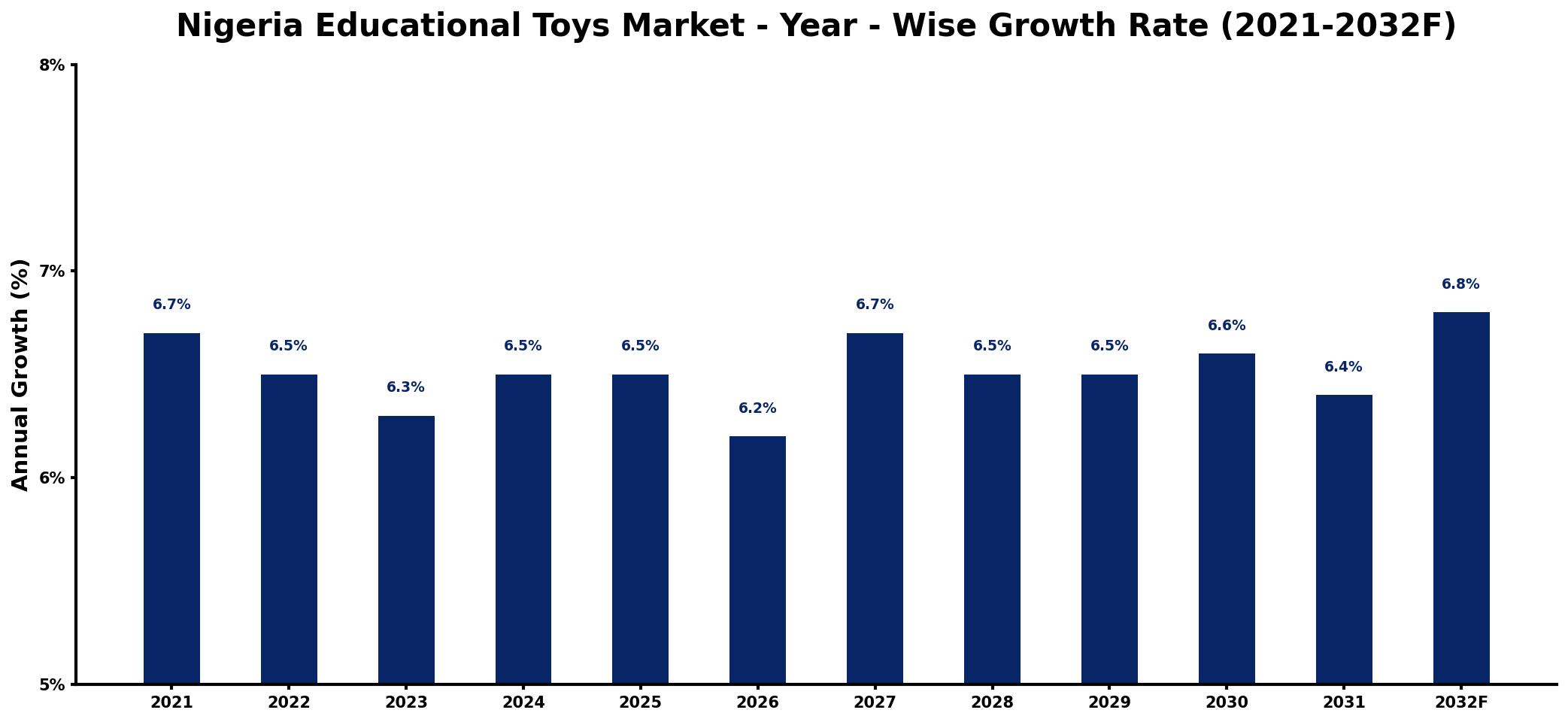
The table below presents the year‑wise growth rates along with the key drivers influencing the market
| Year | Growth Rate | Major Drivers |
| 2021 | 6.7% | Rising consumer awareness trends |
| 2022 | 6.5% | Increased investment in education |
| 2023 | 6.3% | Growing parental spending habits |
| 2024 | 6.5% | Expansion of online retail platforms |
| 2025 | 6.5% | Enhanced focus on child development |
| 2026 | 6.2% | Emerging markets driving demand |
| 2027 | 6.7% | Innovations in learning methodologies |
| 2028 | 6.5% | increased pharmaceutical industry usage |
| 2029 | 6.5% | Strengthening local manufacturing capabilities |
| 2030 | 6.6% | Adoption of sustainable materials |
| 2031 | 6.4% | Diversification of product offerings |
| 2032 | 6.8% | Integration of technology in learning |
Note: Market size estimations and growth projections presented in this report are based on 6Wresearch's proprietary forecasting methodology, utilizing the latest available industry data, government publications, and primary research inputs.
Nigeria Educational Toys Market Synopsis
The landscape of the Nigeria Educational Toys Market is rapidly evolving, with parents actively seeking toys that foster their childrens educational growth. A noticeable trend is the rising interest in toys that merge learning with play, particularly those that promote STEM skills.
Innovative products such as interactive robotics and coding kits are becoming staples in households as parents are increasingly aware of the benefits these tools can provide. This awareness is driven not only by personal convictions but also by educational initiatives and advocacy in schools across the nation.
Nigeria Educational Toys Market Key Takeaways
- The market is witnessing a steady increase in demand for educational toys that prioritize cognitive and creative skill development.
- Growth in online retail channels is making educational toys more accessible to consumers throughout Nigeria.
- Interactive and STEM-focused toys are leading the charge in popularity among parents.
- Awareness of eco-friendly and sustainable products is prompting manufacturers to adapt their offerings.
- Government regulations aimed at product safety are fostering consumer trust in the market.
Evaluation of Restraints in Nigeria Educational Toys Market
Despite the positive trends, the Nigeria Educational Toys Market faces significant constraints. One of the primary challenges is the affordability of educational toys, as the high prices can deter a large segment of the population from making purchases. Furthermore, the limited awareness surrounding the developmental benefits of educational toys often results in hesitant buying behavior. Distribution challenges, coupled with logistical inefficiencies, hinder the ability to reach diverse consumer bases across the nation effectively. Additionally, the prevalence of counterfeit products raises concerns about quality and safety, damaging consumer confidence in legitimate offerings.
Nigeria Educational Toys Market Trends
The demand for educational toys in Nigeria is increasingly driven by trends favoring interactive and technology-based products. Toys that promote STEM learning are particularly popular, as parents recognize the importance of equipping children with relevant skills for the future. There is also a marked increase in the production of eco-friendly toys, reflecting broader societal shifts towards environmental sustainability. This eco-conscious trend aligns with growing parental concern about climate change and promoting responsible consumption habits among children.
Nigeria Educational Toys Market Opportunities
Investment opportunities within the Nigeria Educational Toys Market are robust, fueled by the rising demand for educational resources that cater to developmental needs. There is a strong inclination towards the introduction of innovative and interactive toys that engage children and stimulate learning. E-commerce platforms present an attractive outlet for businesses, allowing them to reach broader demographics, particularly in urban areas. Furthermore, initiatives that enhance educational infrastructure signify an expanding market ripe for companies willing to invest in the future of children's education.
Government Initiatives in the Nigeria Educational Toys Market
In Nigeria, governmental policies are primarily focused on the safety and quality of childrens toys, which includes educational products. The Standards Organization of Nigeria (SON) plays a crucial role in establishing standards that ensure toys meet necessary safety protocols. Similarly, the National Agency for Food and Drug Administration and Control (NAFDAC) oversees the registration and importation of toys to guarantee compliance with health standards. These initiatives aim to cultivate a safe environment for children and enhance consumer trust in educational toys.
Future Insights of the Nigeria Educational Toys Market
Looking ahead to the period from 2026 to 2032, the Nigeria Educational Toys Market is positioned for substantial growth. Increasing disposable incomes and a heightened focus on early childhood education will likely drive demand further. Digital learning tools and resources are on the rise, prompting manufacturers to innovate continually. The youthful demographic in Nigeria presents a promising market segment, paving the way for both local and international players to capitalize on emerging educational needs.
Nigeria Educational Toys Market Latest Developments (2025 - 2026)
In recent months, the Nigeria Educational Toys Market has witnessed significant developments as manufacturers expand their product lines to include more interactive and technologically advanced options. The emphasis on sustainable practices is becoming more prevalent, with brands actively promoting eco-friendly materials. Furthermore, there has been a noticeable uptick in collaborations between educational institutions and toy manufacturers, aimed at creating products that align with curriculum standards. This synergy is enhancing the credibility of educational toys and fostering an environment of trust among consumers.
Nigeria Educational Toys Market - Key Attractiveness of the Report
- 10 Years of Market Numbers
- Historical Data Starting from 2022 to 2025
- Base Year: 2025
- Forecast Data until 2032
- Key Performance Indicators Impacting the Market
- Major Upcoming Developments and Projects
Key Highlights of the Report:
- Nigeria Educational Toys Market Outlook
- Market Size of Nigeria Educational Toys Market, 2025
- Forecast of Nigeria Educational Toys Market, 2032
- Historical Data and Forecast of Nigeria Educational Toys Revenues & Volume for the Period 2022-2032F
- Nigeria Educational Toys Market Trend Evolution
- Nigeria Educational Toys Market Drivers and Challenges
- Nigeria Educational Toys Price Trends
- Nigeria Educational Toys Porter's Five Forces
- Nigeria Educational Toys Industry Life Cycle
- Historical Data and Forecast of Nigeria Educational Toys Market Revenues & Volume By Product Type for the Period 2022-2032F
- Historical Data and Forecast of Nigeria Educational Toys Market Revenues & Volume By Academic toys for the Period 2022-2032F
- Historical Data and Forecast of Nigeria Educational Toys Market Revenues & Volume By Cognitive toys for the Period 2022-2032F
- Historical Data and Forecast of Nigeria Educational Toys Market Revenues & Volume By Motor skills toys for the Period 2022-2032F
- Historical Data and Forecast of Nigeria Educational Toys Market Revenues & Volume By Others for the Period 2022-2032F
- Historical Data and Forecast of Nigeria Educational Toys Market Revenues & Volume By Age Group for the Period 2022-2032F
- Historical Data and Forecast of Nigeria Educational Toys Market Revenues & Volume By 1 ?? 4 years for the Period 2022-2032F
- Historical Data and Forecast of Nigeria Educational Toys Market Revenues & Volume By 4 ?? 8 years for the Period 2022-2032F
- Historical Data and Forecast of Nigeria Educational Toys Market Revenues & Volume By Above 8 years for the Period 2022-2032F
- Historical Data and Forecast of Nigeria Educational Toys Market Revenues & Volume By Others for the Period 2022-2032F
- Historical Data and Forecast of Nigeria Educational Toys Market Revenues & Volume By End-Users for the Period 2022-2032F
- Historical Data and Forecast of Nigeria Educational Toys Market Revenues & Volume By Residential for the Period 2022-2032F
- Historical Data and Forecast of Nigeria Educational Toys Market Revenues & Volume By Commercial for the Period 2022-2032F
- Nigeria Educational Toys Import Export Trade Statistics
- Market Opportunity Assessment By Product Type
- Market Opportunity Assessment By Age Group
- Market Opportunity Assessment By End-Users
- Nigeria Educational Toys Top Companies Market Share
- Nigeria Educational Toys Competitive Benchmarking By Technical and Operational Parameters
- Nigeria Educational Toys Company Profiles
- Nigeria Educational Toys Key Strategic Recommendations






































