Nigeria Enterprise Data Management Market Size & Growth Rate (2026-2032)
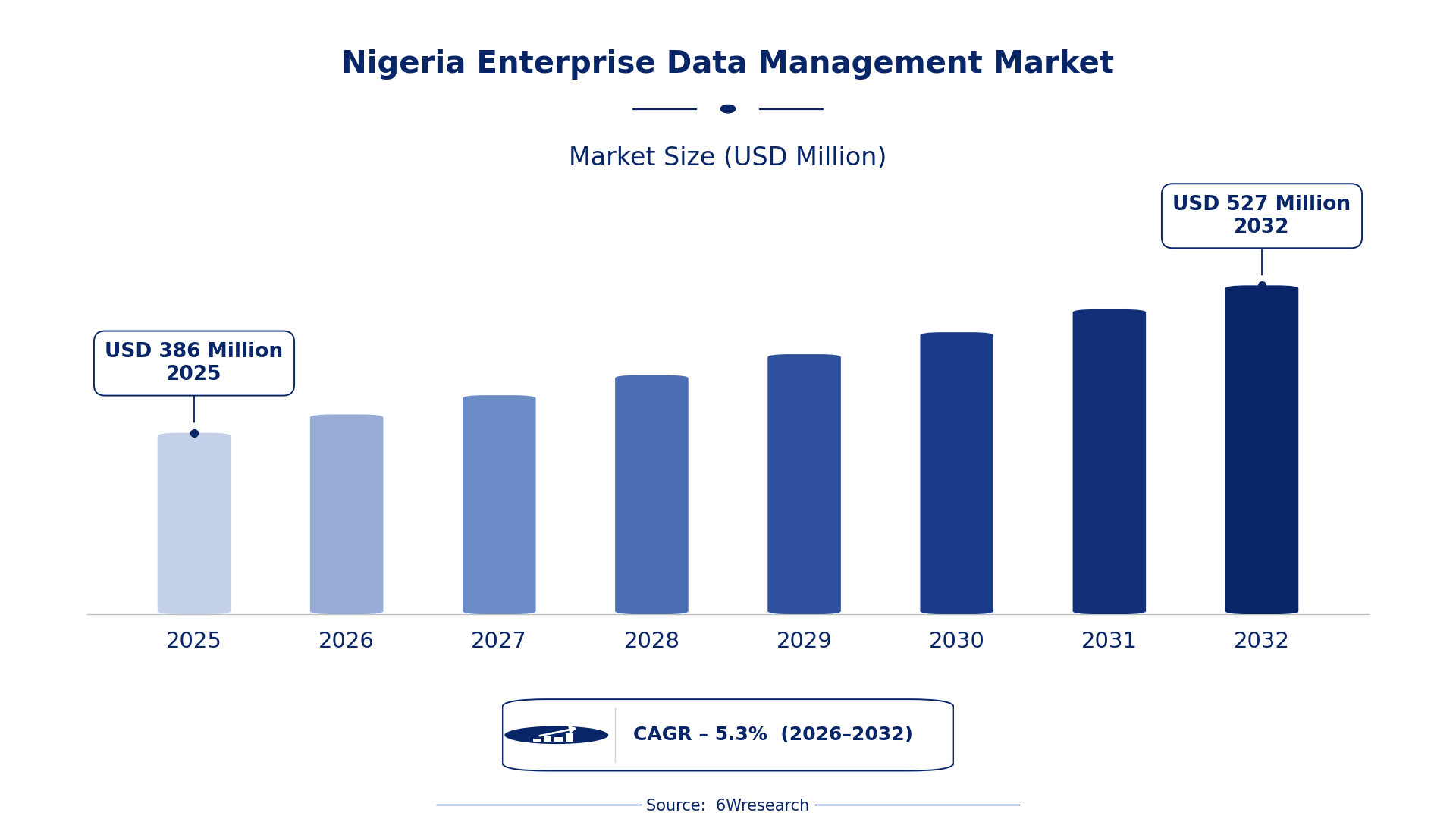
The Nigeria Enterprise Data Management Market was estimated at USD 386 Million in 2025 and is projected to reach USD 527 Million by 2032, growing at a CAGR of 5.3% from 2026 to 2032.
Nigeria Enterprise Data Management Market Synopsis
In Nigeria, the demand for enterprise data management solutions is rapidly increasing as organizations recognize the critical role of data in driving operational efficiency. Companies across various sectors are increasingly turning to advanced data management tools to harness the value of their data assets, particularly in the face of rising competition and consumer expectations.
The shift toward cloud-based solutions is particularly noteworthy, as Nigerian firms seek flexible and scalable options to manage their growing data volumes. With an emphasis on data security and compliance, organizations are more inclined to invest in comprehensive data management frameworks that not only enhance data quality but also support regulatory adherence.
Nigeria Enterprise Data Management Market Year-wise Growth Rate and Key Drivers
This graph illustrates the annual growth rates of the Nigeria Enterprise Data Management Market from 2021 to 2032, highlighting a steady upward trajectory and projected expansion over the forecast period.
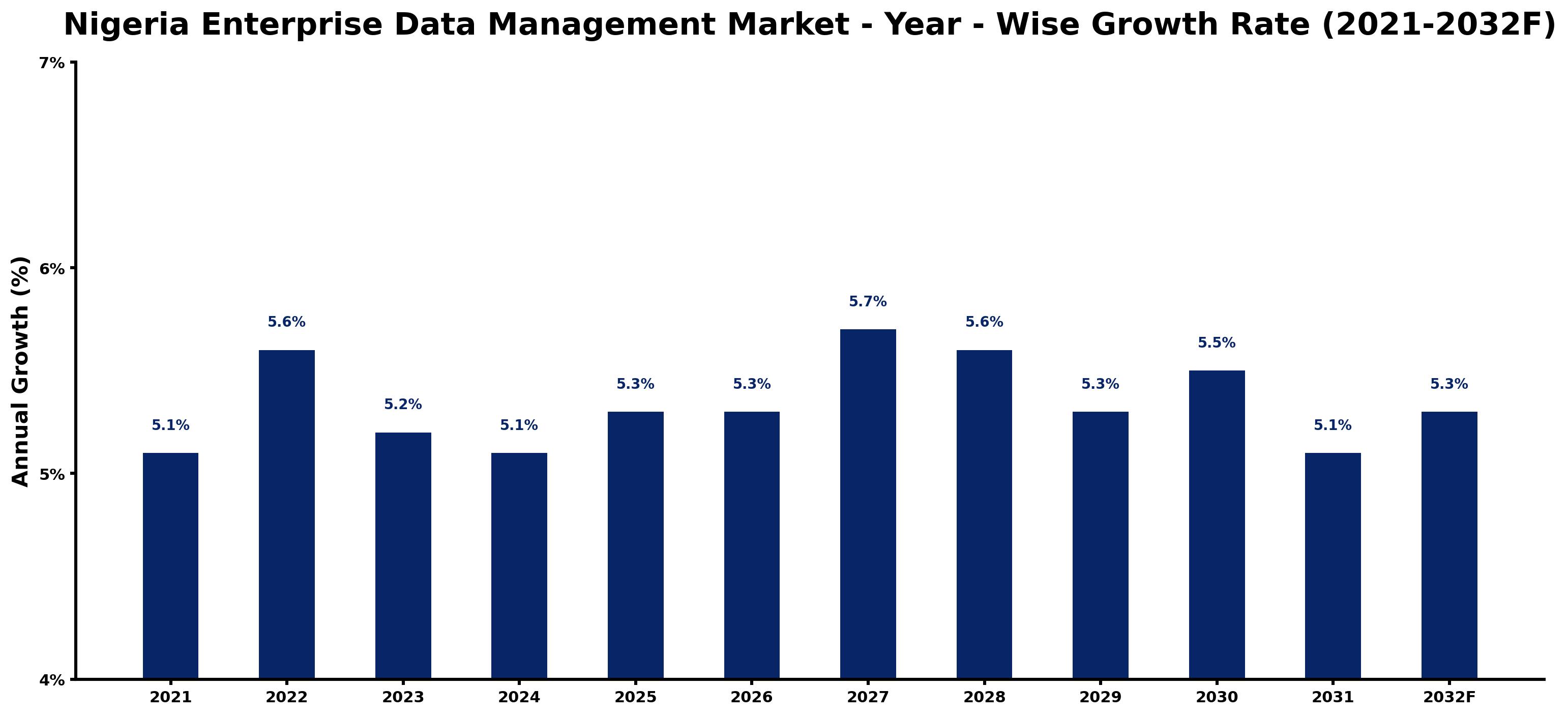
The table below presents the year‑wise growth rates along with the key drivers influencing the market
| Year | Growth Rate | Major Drivers |
| 2021 | 5.1% | Increased mobile penetration driving data management solutions. |
| 2022 | 5.6% | Growth of fintech sector enhancing data governance needs. |
| 2023 | 5.2% | Surge in cloud adoption among Nigerian enterprises. |
| 2024 | 5.1% | Emergence of AI-driven analytics improving data utilization. |
| 2025 | 5.3% | Local startups prioritizing data security and integrity. |
| 2026 | 5.3% | Government initiatives promoting digital transformation projects. |
| 2027 | 5.7% | Corporate focus on data-driven decision-making in Nigeria. |
| 2028 | 5.6% | Increasing investment in IT infrastructure by multinationals. |
| 2029 | 5.3% | Enhanced cybersecurity threats boosting data management demand. |
| 2030 | 5.5% | Public sector digitization requiring efficient data solutions. |
| 2031 | 5.1% | Adoption of IoT devices generating vast data needs. |
| 2032 | 5.3% | Cross-border trade demands stricter data management practices. |
Note: Market size estimations and growth projections presented in this report are based on 6Wresearch's proprietary forecasting methodology, utilizing the latest available industry data, government publications, and primary research inputs.
Nigeria Enterprise Data Management Market Key Takeaways
Below are some of the specific key takeaways from the market, including:
- The market is driven by the rising adoption of digital transformation initiatives across various industries.
- Cloud-based data management solutions are becoming increasingly popular, offering scalability and flexibility.
- Data security and compliance are top priorities for organizations investing in data management systems.
- There is a significant opportunity for tailored data management solutions specific to sectors like banking and healthcare.
- Advanced analytics is gaining traction as organizations seek data-driven insights for strategic decision-making.
Evaluation of Restraints in Nigeria Enterprise Data Management Market
Despite the promising growth potential, several factors are hindering the Nigeria Enterprise Data Management Market. A major challenge is the limited awareness among organizations regarding the importance of effective data management practices, leading to underinvestment in necessary technologies. This lack of understanding is compounded by a shortage of skilled professionals in the data management domain, which affects the successful implementation and upkeep of data systems.
on top of that, growing concerns around data security and privacy, exacerbated by rising cyber threats, create further obstacles. The absence of a comprehensive data governance framework and inconsistent data quality standards across organizations complicate efforts to enhance data management practices. Addressing these challenges requires a concerted effort in education, investment, and the establishment of best practices.
Nigeria Enterprise Data Management Market Trends
Key trends influencing the Nigeria Enterprise Data Management Market include an increasing reliance on cloud technologies, which provide organizations with the agility to manage data efficiently. There is also a marked shift towards advanced analytics, empowering businesses to extract actionable insights from their data, thereby enhancing decision-making processes.
on top of that, compliance with data governance regulations is becoming crucial, pushing firms to adopt more structured data management strategies. Organizations are also prioritizing data quality to ensure accuracy and reliability, recognizing that poor data quality can lead to detrimental business outcomes.
Nigeria Enterprise Data Management Market Opportunities
Opportunities abound for data management providers in Nigeria, particularly in offering specialized solutions tailored to specific industries such as healthcare, finance, and retail. As organizations continue to generate massive amounts of data, the demand for customized solutions that address unique challenges is growing.
Additionally, as regulatory frameworks become stricter, there is a strong market for services focusing on data security and privacy compliance. Businesses are increasingly aware that investing in effective data management not only enhances operational efficiency but also provides a competitive edge in an increasingly data-driven environment.
Government Initiatives in the Nigeria Enterprise Data Management Market
The Nigerian government is actively shaping the enterprise data management sector through various policies aimed at enhancing data security, privacy, and utilization. With a clear focus on regulatory compliance and the promotion of responsible data practices, these initiatives are crucial for organizations navigating the complexities of data management.
- A recently completed initiative by the National Information Technology Development Agency (NITDA) implemented the Nigeria Data Protection Regulation (NDPR) to safeguard personal data.
- Currently ongoing is a public awareness campaign led by NITDA to educate businesses on the importance of data management and compliance.
- A planned public-private partnership is expected to enhance data governance practices across various sectors by 2026.
- The Nigerian Communications Commission (NCC) has introduced guidelines for data security in the telecommunications sector that impact enterprise data management practices.
- Future initiatives are being discussed to standardize data quality measures across industries, enhancing overall data integrity.
Future Insights of the Nigeria Enterprise Data Management Market
Looking ahead to 2026-2032, the Nigeria Enterprise Data Management Market is on a trajectory of substantial growth, fueled by the increasing recognition of data as a critical asset. As businesses continue to undergo digital transformation, the demand for sophisticated data management solutions will only intensify.
Key developments in cloud technologies and analytics will play a pivotal role in shaping the market. Organizations that can adapt to the changing landscape and meet the evolving needs of data management will find themselves well-positioned to capitalize on emerging opportunities.
Nigeria Enterprise Data Management Market Latest Developments
In the past year, the Nigeria Enterprise Data Management Market has seen a flurry of activity, highlighting the sector's dynamism and potential for growth. Companies are increasingly focusing on integrating advanced technologies to improve data management practices, reflecting the broader trend towards digital transformation.
- A major technology vendor launched a new cloud-based data management platform in early 2025, designed specifically for the Nigerian market.
- An ongoing initiative by a leading regional operator is enhancing data analytics capabilities across various sectors, aiming for completion by mid-2026.
- A partnership between technology providers and local enterprises is expected to improve data governance frameworks, with discussions ongoing since Q3 2025.
- A planned rollout of a data quality improvement program is set to begin in late 2026, targeting industries with high data volume challenges.
- A recent upgrade to data security measures by telecommunications firms is currently underway, focusing on compliance with newly established guidelines.
Nigeria Enterprise Data Management Market - Key Attractiveness of the Report
- 10 Years of Market Numbers
- Historical Data Starting from 2022 to 2025
- Base Year: 2025
- Forecast Data until 2032
- Key Performance Indicators Impacting the Market
- Major Upcoming Developments and Projects
Key Highlights of the Report:
- Nigeria Enterprise Data Management Market Outlook
- Market Size of Nigeria Enterprise Data Management Market, 2025
- Forecast of Nigeria Enterprise Data Management Market, 2032
- Historical Data and Forecast of Nigeria Enterprise Data Management Revenues & Volume for the Period 2022-2032F
- Nigeria Enterprise Data Management Market Trend Evolution
- Nigeria Enterprise Data Management Market Drivers and Challenges
- Nigeria Enterprise Data Management Price Trends
- Nigeria Enterprise Data Management Porter's Five Forces
- Nigeria Enterprise Data Management Industry Life Cycle
- Historical Data and Forecast of Nigeria Enterprise Data Management Market Revenues & Volume By Component for the Period 2022-2032F
- Historical Data and Forecast of Nigeria Enterprise Data Management Market Revenues & Volume By Software for the Period 2022-2032F
- Historical Data and Forecast of Nigeria Enterprise Data Management Market Revenues & Volume By Services for the Period 2022-2032F
- Historical Data and Forecast of Nigeria Enterprise Data Management Market Revenues & Volume By Professional Services for the Period 2022-2032F
- Historical Data and Forecast of Nigeria Enterprise Data Management Market Revenues & Volume By Consulting for the Period 2022-2032F
- Historical Data and Forecast of Nigeria Enterprise Data Management Market Revenues & Volume By Deployment and Integration for the Period 2022-2032F
- Historical Data and Forecast of Nigeria Enterprise Data Management Market Revenues & Volume By Support and Maintenance for the Period 2022-2032F
- Historical Data and Forecast of Nigeria Enterprise Data Management Market Revenues & Volume By Industry Vertical for the Period 2022-2032F
- Historical Data and Forecast of Nigeria Enterprise Data Management Market Revenues & Volume By Healthcare and Life science for the Period 2022-2032F
- Historical Data and Forecast of Nigeria Enterprise Data Management Market Revenues & Volume By Banking, Financial Services and Insurance (BFSI) for the Period 2022-2032F
- Historical Data and Forecast of Nigeria Enterprise Data Management Market Revenues & Volume By Telecom and Information Technology (IT) for the Period 2022-2032F
- Historical Data and Forecast of Nigeria Enterprise Data Management Market Revenues & Volume By Retail and Consumer goods for the Period 2022-2032F
- Historical Data and Forecast of Nigeria Enterprise Data Management Market Revenues & Volume By Media and Entertainment for the Period 2022-2032F
- Historical Data and Forecast of Nigeria Enterprise Data Management Market Revenues & Volume By Manufacturing for the Period 2022-2032F
- Historical Data and Forecast of Nigeria Enterprise Data Management Market Revenues & Volume By Energy and Utilities for the Period 2022-2032F
- Historical Data and Forecast of Nigeria Enterprise Data Management Market Revenues & Volume By Transportation and Logistics for the Period 2022-2032F
- Historical Data and Forecast of Nigeria Enterprise Data Management Market Revenues & Volume By Organization Size for the Period 2022-2032F
- Historical Data and Forecast of Nigeria Enterprise Data Management Market Revenues & Volume By Small and Medium-sized Enterprises for the Period 2022-2032F
- Historical Data and Forecast of Nigeria Enterprise Data Management Market Revenues & Volume By Large enterprises for the Period 2022-2032F
- Historical Data and Forecast of Nigeria Enterprise Data Management Market Revenues & Volume By Deployment Mode for the Period 2022-2032F
- Historical Data and Forecast of Nigeria Enterprise Data Management Market Revenues & Volume By Cloud for the Period 2022-2032F
- Historical Data and Forecast of Nigeria Enterprise Data Management Market Revenues & Volume By On-premises for the Period 2022-2032F
- Nigeria Enterprise Data Management Import Export Trade Statistics
- Market Opportunity Assessment By Component
- Market Opportunity Assessment By Industry Vertical
- Market Opportunity Assessment By Organization Size
- Market Opportunity Assessment By Deployment Mode
- Nigeria Enterprise Data Management Top Companies Market Share
- Nigeria Enterprise Data Management Competitive Benchmarking By Technical and Operational Parameters
- Nigeria Enterprise Data Management Company Profiles
- Nigeria Enterprise Data Management Key Strategic Recommendations






































