Nigeria Ethyl Alcohol Market Top 5 Importing Countries and Market Competition (HHI) Analysis
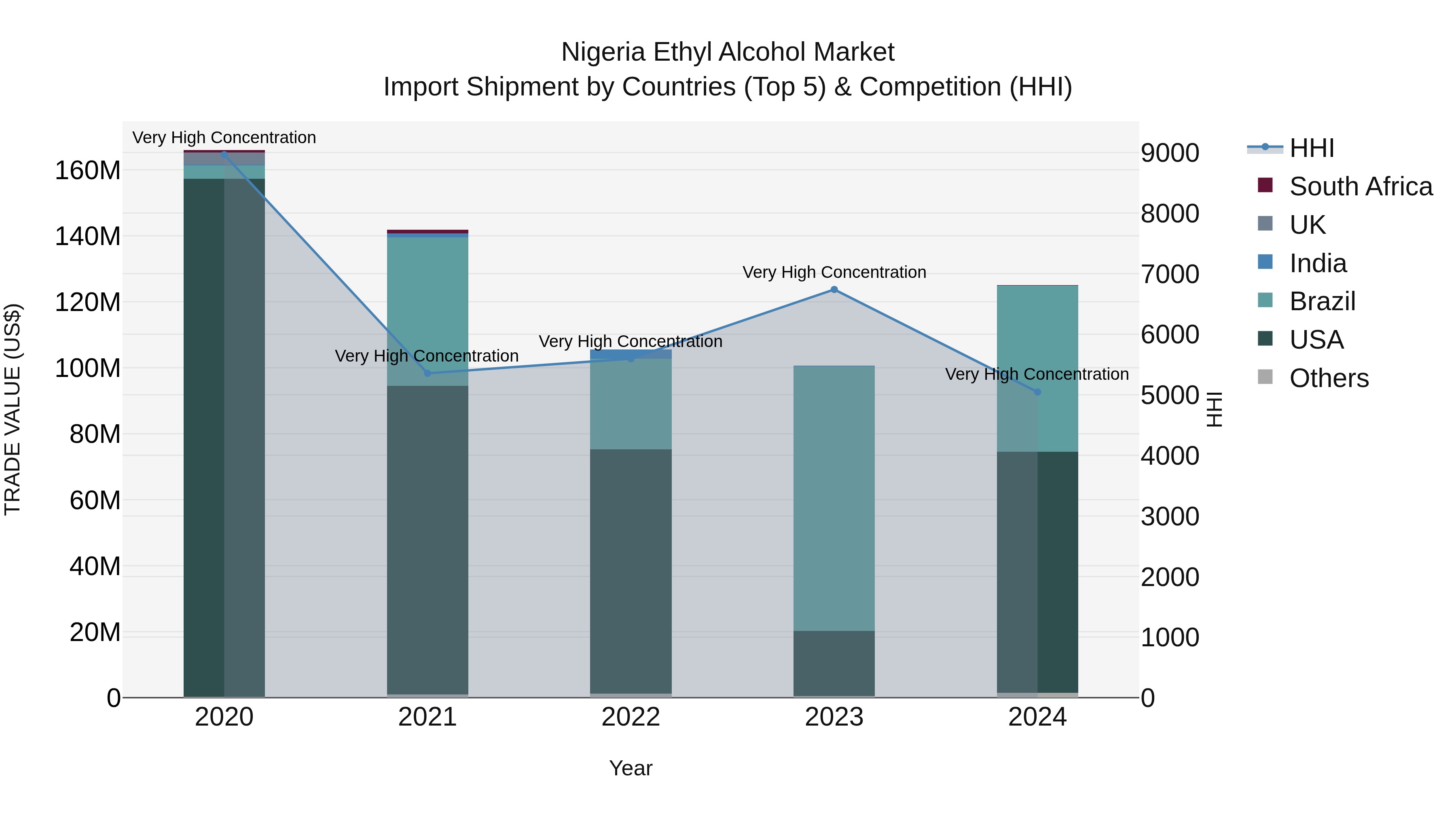
In 2024, Nigeria`s ethyl alcohol import market continued to showcase high concentration, with the top exporting countries being the USA, Brazil, Metropolitan France, Netherlands, and Germany. The market experienced a significant growth rate of 24.28% in 2024, following a negative Compound Annual Growth Rate (CAGR) of -6.84% from 2020 to 2024. This data suggests dynamic shifts in the import landscape, potentially influenced by changing consumer preferences, economic factors, or regulatory changes impacting the ethyl alcohol industry in Nigeria.
Nigeria Ethyl Alcohol Market Overview
The Nigeria Ethyl Alcohol market is experiencing steady growth driven by increasing demand from various industries such as pharmaceuticals, food and beverage, and cosmetics. The market is witnessing a rise in the consumption of ethyl alcohol due to its versatile applications in these sectors. The pharmaceutical industry, in particular, is a significant contributor to the market growth, as ethyl alcohol is widely used in the production of medicines and sanitizers. The market is also benefiting from the growing trend of using ethyl alcohol in the food and beverage industry for flavoring and preservation purposes. Additionally, the rise in disposable income and changing consumer preferences towards premium skincare and cosmetic products are further fueling the demand for ethyl alcohol in the country.
Nigeria Ethyl Alcohol Market Trends
The Nigeria Ethyl Alcohol Market is experiencing several key trends. Firstly, there is a growing demand for ethyl alcohol in various industries such as pharmaceuticals, food and beverages, and cosmetics. This is driven by the increasing disposable income of the population and the expansion of these industries. Secondly, there is a shift towards the use of ethyl alcohol as a cleaner and disinfectant, especially in the wake of the COVID-19 pandemic. Additionally, the government`s policies promoting the use of ethanol in fuel blends are also contributing to the growth of the market. Overall, the Nigeria Ethyl Alcohol Market is expected to continue expanding as the demand for ethyl alcohol across various sectors remains strong.
Nigeria Ethyl Alcohol Market Challenges
One of the key challenges faced in the Nigeria Ethyl Alcohol Market is the prevalence of counterfeit and unregulated products. The market is plagued by the presence of illicit alcohol products that not only pose health risks to consumers but also undercut legitimate businesses. This issue not only impacts the reputation of established brands but also hampers efforts to ensure product quality and safety standards. Additionally, the lack of stringent regulatory measures and enforcement mechanisms further exacerbate the problem, making it difficult for legitimate players to compete on a level playing field. Addressing these challenges requires collaborative efforts between industry stakeholders, government authorities, and regulatory bodies to crack down on illicit trade practices, improve quality control measures, and enhance consumer awareness regarding the risks associated with counterfeit alcohol products.
Nigeria Ethyl Alcohol Market Investment Opportunities
Investment opportunities in the Nigeria Ethyl Alcohol Market include the production and distribution of ethanol for various industries such as pharmaceuticals, beverages, and personal care products. With a growing population and increasing disposable income, there is a rising demand for ethyl alcohol in the country. Additionally, the Nigerian government`s initiatives to promote local production and reduce dependence on imports create a favorable environment for investment in ethanol production. Investing in advanced technologies for ethanol production, establishing partnerships with local farmers for sourcing raw materials, and exploring export opportunities to neighboring countries are potential avenues for growth in the Nigeria Ethyl Alcohol Market. Overall, the market offers promising prospects for investors looking to capitalize on the growing demand for ethyl alcohol in various sectors within Nigeria and beyond.
Nigeria Ethyl Alcohol Market Government Policy
The Nigerian government regulates the ethyl alcohol market through the National Agency for Food and Drug Administration and Control (NAFDAC), which oversees the production, importation, and distribution of ethyl alcohol for use in various industries such as pharmaceuticals, food and beverages, and cosmetics. NAFDAC requires companies to obtain permits and adhere to quality and safety standards to ensure consumer protection and product integrity. Additionally, the government imposes excise duties on ethyl alcohol products to generate revenue and control consumption. The Nigerian government also promotes local production of ethyl alcohol through incentives and support for domestic manufacturers, aimed at reducing dependence on imports and boosting the country`s economy. Overall, government policies in Nigeria aim to regulate the ethyl alcohol market, ensure product quality and safety, and promote local industry development.
Nigeria Ethyl Alcohol Market Future Outlook
The Nigeria Ethyl Alcohol Market is expected to show promising growth in the coming years due to factors such as increasing demand from various industries including pharmaceuticals, food and beverage, and cosmetics. The market is likely to be driven by a growing population, rising disposable income, and shifting consumer preferences towards alcohol-based products. Additionally, the government`s initiatives to promote the use of ethanol as a cleaner and more sustainable fuel alternative are also expected to contribute to the market`s growth. However, challenges such as fluctuating raw material prices, regulatory hurdles, and competition from substitute products may pose constraints to the market`s expansion. Overall, with the right strategies and investments, the Nigeria Ethyl Alcohol Market is poised for steady growth in the foreseeable future.
Key Highlights of the Report:
- Nigeria Ethyl Alcohol Market Outlook
- Market Size of Nigeria Ethyl Alcohol Market, 2021
- Forecast of Nigeria Ethyl Alcohol Market, 2031
- Historical Data and Forecast of Nigeria Ethyl Alcohol Revenues & Volume for the Period 2018 - 2031
- Nigeria Ethyl Alcohol Market Trend Evolution
- Nigeria Ethyl Alcohol Market Drivers and Challenges
- Nigeria Ethyl Alcohol Price Trends
- Nigeria Ethyl Alcohol Porter's Five Forces
- Nigeria Ethyl Alcohol Industry Life Cycle
- Historical Data and Forecast of Nigeria Ethyl Alcohol Market Revenues & Volume By Grade for the Period 2018 - 2031
- Historical Data and Forecast of Nigeria Ethyl Alcohol Market Revenues & Volume By Food Grade for the Period 2018 - 2031
- Historical Data and Forecast of Nigeria Ethyl Alcohol Market Revenues & Volume By Industrial Grade for the Period 2018 - 2031
- Historical Data and Forecast of Nigeria Ethyl Alcohol Market Revenues & Volume By Pharmaceutical Grade for the Period 2018 - 2031
- Historical Data and Forecast of Nigeria Ethyl Alcohol Market Revenues & Volume By Lab Grade for the Period 2018 - 2031
- Historical Data and Forecast of Nigeria Ethyl Alcohol Market Revenues & Volume By End-user Industry for the Period 2018 - 2031
- Historical Data and Forecast of Nigeria Ethyl Alcohol Market Revenues & Volume By Automotive and Transportation for the Period 2018 - 2031
- Historical Data and Forecast of Nigeria Ethyl Alcohol Market Revenues & Volume By Food and Beverage for the Period 2018 - 2031
- Historical Data and Forecast of Nigeria Ethyl Alcohol Market Revenues & Volume By Pharmaceutical for the Period 2018 - 2031
- Historical Data and Forecast of Nigeria Ethyl Alcohol Market Revenues & Volume By Cosmetics and Personal Care (Includes hand-Sanitizer) for the Period 2018 - 2031
- Historical Data and Forecast of Nigeria Ethyl Alcohol Market Revenues & Volume By Other End-user Industries for the Period 2018 - 2031
- Nigeria Ethyl Alcohol Import Export Trade Statistics
- Market Opportunity Assessment By Grade
- Market Opportunity Assessment By End-user Industry
- Nigeria Ethyl Alcohol Top Companies Market Share
- Nigeria Ethyl Alcohol Competitive Benchmarking By Technical and Operational Parameters
- Nigeria Ethyl Alcohol Company Profiles
- Nigeria Ethyl Alcohol Key Strategic Recommendations






































