Nigeria Feed Enzymes Market Top 5 Importing Countries and Market Competition (HHI) Analysis
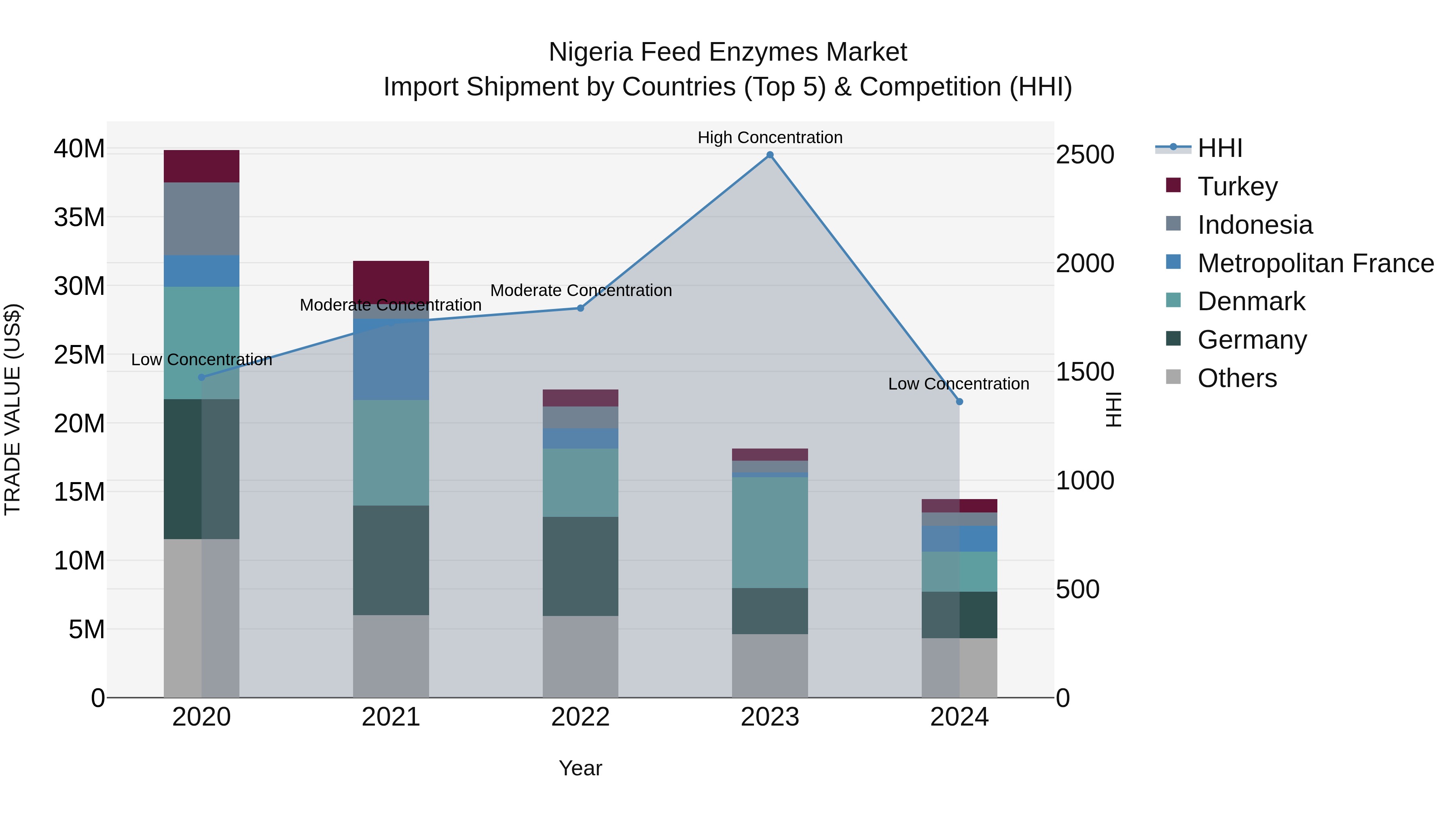
The Nigeria feed enzymes import market experienced a shift in concentration from high to low in 2024, with top exporters being Germany, Denmark, Metropolitan France, China, and Belgium. Despite a significant negative CAGR of -22.41% from 2020 to 2024, there was a slight improvement in the growth rate from 2023 to 2024 at -20.38%. This suggests a potential stabilization in the market and diversification of import sources, offering opportunities for market players to adapt to changing dynamics and enhance competitiveness in the Nigerian feed enzymes sector.
Nigeria Feed Enzymes Market Synopsis
The Nigeria Feed Enzymes Market is experiencing steady growth due to increasing demand for high-quality animal feed to enhance livestock productivity. Feed enzymes are essential additives used in animal nutrition to improve feed efficiency, digestion, and nutrient absorption. Factors driving market growth include rising meat consumption, expanding livestock farming operations, and a growing focus on animal health and nutrition. Key players in the Nigerian feed enzymes market are investing in research and development to introduce innovative enzyme products tailored to local livestock needs. Additionally, government initiatives promoting sustainable agriculture practices and the adoption of advanced feed technologies are further propelling market expansion. The market is expected to continue its upward trajectory as farmers increasingly prioritize animal nutrition and seek to optimize feed conversion rates for improved livestock performance.
Nigeria Feed Enzymes Market Trends
The Nigeria Feed Enzymes Market is witnessing a growing demand due to the increasing focus on improving animal nutrition and performance. Key trends include a shift towards natural feed additives to reduce the use of antibiotics and chemicals in animal feed, as well as the rising awareness about the benefits of feed enzymes in enhancing feed efficiency and overall animal health. Opportunities exist for market players to introduce innovative enzyme products tailored to the specific needs of the Nigerian livestock industry, such as heat-stable enzymes for the tropical climate and enzymes targeting common feed ingredients used in the region. Additionally, partnerships with local feed manufacturers and distributors can help expand market reach and capitalize on the growing demand for high-quality feed additives in Nigeria.
Nigeria Feed Enzymes Market Challenges
In the Nigeria Feed Enzymes Market, some key challenges include a lack of awareness and understanding among farmers about the benefits of using feed enzymes, limited availability of high-quality feed enzyme products, and the high cost associated with incorporating feed enzymes in animal feed formulations. Additionally, there are issues related to inconsistent feed quality and the need for more research and development efforts to tailor enzyme solutions to the specific needs of the Nigerian livestock sector. Infrastructure limitations, such as inadequate storage facilities and transportation networks, also pose challenges for the distribution of feed enzyme products in the country. Overall, overcoming these challenges will require increased education and support for farmers, improved product accessibility, and collaboration among stakeholders to drive innovation and address market needs effectively.
Nigeria Feed Enzymes Market Investment Opportunities
The Nigeria Feed Enzymes Market is primarily driven by the increasing demand for high-quality animal protein products, such as meat and dairy, due to a growing population and rising disposable incomes. Feed enzymes are essential in improving the efficiency of feed utilization, promoting better digestion in livestock, and enhancing overall animal health. Additionally, the focus on sustainable and eco-friendly farming practices is pushing farmers to adopt feed enzymes as a natural alternative to traditional feed additives. Furthermore, stringent regulations on the use of antibiotics in animal feed are also propelling the market growth, as feed enzymes offer a safe and effective solution to maintain animal health and productivity without the risks associated with antibiotic use.
Nigeria Feed Enzymes Market Government Polices
Government policies related to the Nigeria Feed Enzymes Market focus on promoting the production and usage of enzymes as feed additives to enhance animal nutrition and improve overall agricultural productivity. These policies aim to ensure quality control, safety standards, and regulatory compliance in the manufacturing, importation, and distribution of feed enzymes. The Nigerian government encourages research and innovation in developing new enzyme technologies for animal feed applications while also providing support for local production and industry growth through incentives and capacity-building programs. Additionally, there are regulations in place to monitor the effectiveness and environmental impact of feed enzymes, aligning with broader agricultural sustainability goals in Nigeria.
Nigeria Feed Enzymes Market Future Outlook
The Nigeria feed enzymes market is poised for significant growth in the coming years due to several key factors. Increasing demand for high-quality animal feed to enhance livestock productivity and the rising awareness about the benefits of feed enzymes in improving feed efficiency and animal health are driving market growth. Additionally, the focus on sustainable agricultural practices and the growing investments in animal husbandry are expected to further boost market expansion. Technological advancements in enzyme production and formulation are also likely to drive innovation and product development in the market. However, challenges such as fluctuating raw material prices and regulatory constraints may hinder the market growth to some extent. Overall, the Nigeria feed enzymes market is expected to show promising growth opportunities in the foreseeable future.
Key Highlights of the Report:
- Nigeria Feed Enzymes Market Outlook
- Market Size of Nigeria Feed Enzymes Market, 2024
- Forecast of Nigeria Feed Enzymes Market, 2031
- Historical Data and Forecast of Nigeria Feed Enzymes Revenues & Volume for the Period 2021 - 2031
- Nigeria Feed Enzymes Market Trend Evolution
- Nigeria Feed Enzymes Market Drivers and Challenges
- Nigeria Feed Enzymes Price Trends
- Nigeria Feed Enzymes Porter's Five Forces
- Nigeria Feed Enzymes Industry Life Cycle
- Historical Data and Forecast of Nigeria Feed Enzymes Market Revenues & Volume By Type for the Period 2021 - 2031
- Historical Data and Forecast of Nigeria Feed Enzymes Market Revenues & Volume By Phytase for the Period 2021 - 2031
- Historical Data and Forecast of Nigeria Feed Enzymes Market Revenues & Volume By Carbohydrase for the Period 2021 - 2031
- Historical Data and Forecast of Nigeria Feed Enzymes Market Revenues & Volume By Protease for the Period 2021 - 2031
- Historical Data and Forecast of Nigeria Feed Enzymes Market Revenues & Volume By Livestock for the Period 2021 - 2031
- Historical Data and Forecast of Nigeria Feed Enzymes Market Revenues & Volume By Poultry for the Period 2021 - 2031
- Historical Data and Forecast of Nigeria Feed Enzymes Market Revenues & Volume By Swine for the Period 2021 - 2031
- Historical Data and Forecast of Nigeria Feed Enzymes Market Revenues & Volume By Ruminants for the Period 2021 - 2031
- Historical Data and Forecast of Nigeria Feed Enzymes Market Revenues & Volume By Aquatic Animals for the Period 2021 - 2031
- Historical Data and Forecast of Nigeria Feed Enzymes Market Revenues & Volume By Source for the Period 2021 - 2031
- Historical Data and Forecast of Nigeria Feed Enzymes Market Revenues & Volume By Microorganism for the Period 2021 - 2031
- Historical Data and Forecast of Nigeria Feed Enzymes Market Revenues & Volume By Plant for the Period 2021 - 2031
- Historical Data and Forecast of Nigeria Feed Enzymes Market Revenues & Volume By Animal for the Period 2021 - 2031
- Nigeria Feed Enzymes Import Export Trade Statistics
- Market Opportunity Assessment By Type
- Market Opportunity Assessment By Livestock
- Market Opportunity Assessment By Source
- Nigeria Feed Enzymes Top Companies Market Share
- Nigeria Feed Enzymes Competitive Benchmarking By Technical and Operational Parameters
- Nigeria Feed Enzymes Company Profiles
- Nigeria Feed Enzymes Key Strategic Recommendations






































