Nigeria Filling Equipment Market (2026-2032) | Analysis, Industry, Share, Forecast, Revenue, Growth, Trends, Value, Companies, Outlook & Size
Market Forecast By Type (Rotary Fillers, Volumetric Fillers, Aseptic Fillers, Net Weight Fillers, Other), By Process (Manual, Semi-Automatic, Automatic), By Applications (Food & Beverage, Pharmaceutical, Cosmetic, Others) And Competitive Landscape
| Product Code: ETC047129 | Publication Date: Jan 2021 | Updated Date: Jun 2026 | Product Type: Report | |
| Publisher: 6Wresearch | Author: Ravi Bhandari | No. of Pages: 70 | No. of Figures: 35 | No. of Tables: 5 |
Nigeria Filling Equipment Market Size, Share & Growth Rate
The Nigeria Filling Equipment Market was estimated at USD 283 Million in 2025 and is projected to reach USD 372 Million by 2032, growing at a CAGR of 4.0% from 2026 to 2032. This trajectory is being propelled by several key factors, notably the escalating demand for packaged beverages, which correlates with the burgeoning food and beverage industry. Additionally, as urbanization accelerates and consumer preferences shift towards convenience, the need for efficient and advanced filling solutions becomes increasingly critical.
Nigeria Filling Equipment Market Year-wise Growth Rate and Key Drivers
This graph highlights how the Nigeria Filling Equipment Market has steadily grown over the years, supported by major growth factors.
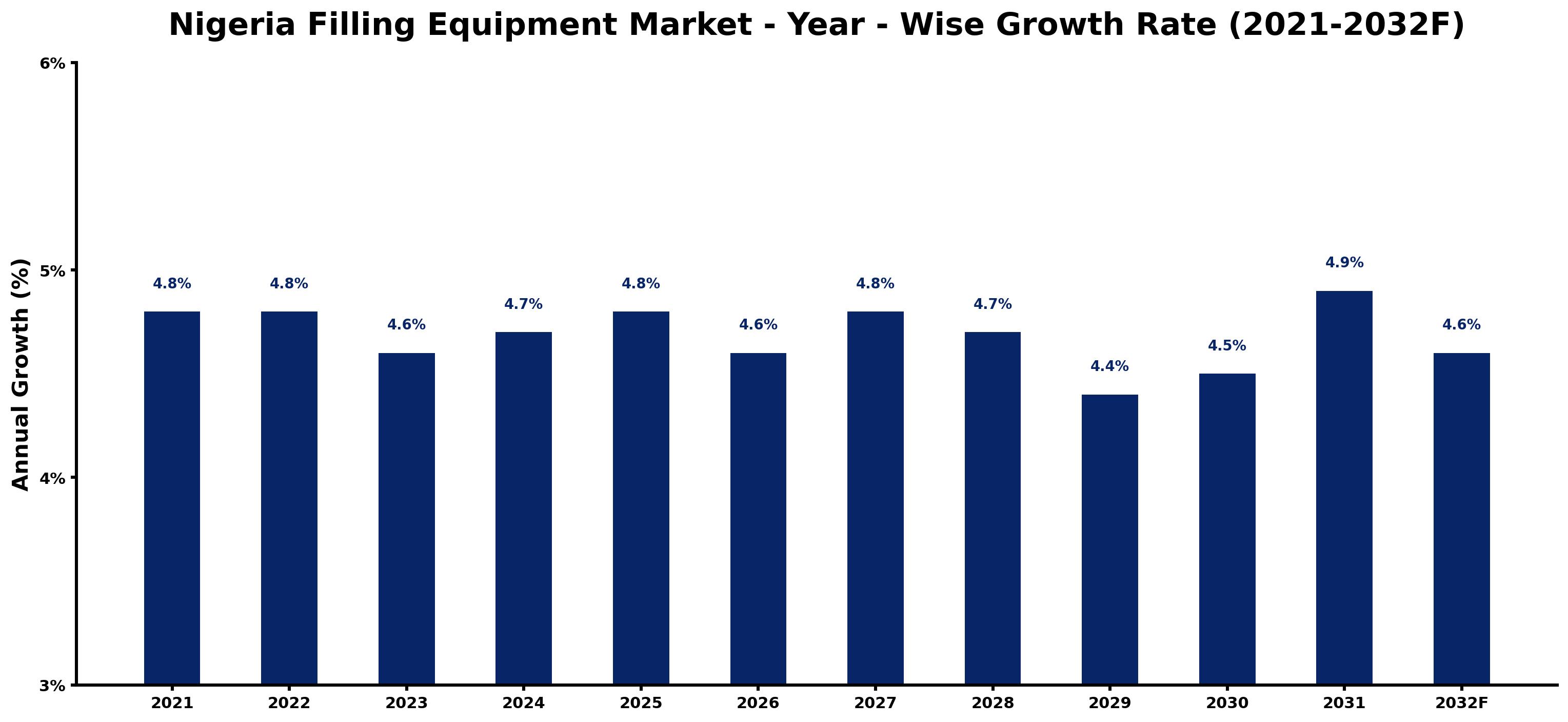
The table below presents the year‑wise growth rates along with the key drivers influencing the market
| Year | Growth Rate | Major Drivers |
| 2021 | 4.8% | Increasing adoption of advanced technologies |
| 2022 | 4.8% | Growing renewable energy integration projects |
| 2023 | 4.6% | Expansion of transportation and logistics networks |
| 2024 | 4.7% | Increasing industrial automation investments |
| 2025 | 4.8% | Increasing industrial infrastructure investments |
| 2026 | 4.6% | Expansion of manufacturing activities |
| 2027 | 4.8% | Expansion of commercial construction activities |
| 2028 | 4.7% | Government infrastructure modernization initiatives |
| 2029 | 4.4% | Increasing industrial infrastructure investments |
| 2030 | 4.5% | Expansion of commercial construction activities |
| 2031 | 4.9% | Increasing industrial infrastructure investments |
| 2032 | 4.6% | Increasing industrial automation investments |
Note - Market size estimations and growth projections presented in this report are based on 6Wresearch’s advanced forecasting approach, validated with industry datasets as of June 2026.
Nigeria Filling Equipment Market Synopsis
The Nigeria Filling Equipment Market is currently experiencing a robust momentum, fueled by the rising popularity of packaged goods across various sectors, including food and beverage, pharmaceuticals, and cosmetics. However, as market dynamics evolve, there is an impending need for innovative, automated solutions that cater to changing consumer preferences and operational demands.
Looking ahead, the market is expected to transition towards more sophisticated filling technologies, emphasizing automation and sustainability. As competition intensifies, businesses must adapt and invest in advanced filling equipment to enhance efficiency, precision, and compliance with health standards, paving the way for sustained growth in this sector.
Nigeria Filling Equipment Market Key Takeaways
- The market is characterized by increasing demand from the food and beverage, pharmaceutical, and cosmetic sectors.
- Government initiatives are fostering local manufacturing and reducing dependence on imports.
- There is a marked shift towards sustainable and eco-friendly filling solutions.
- Technological advancements are driving innovation in high-speed and automated filling equipment.
- Investment opportunities abound for manufacturers and distributors aiming to capitalize on a growing market.
Evaluation of Restraints in Nigeria Filling Equipment Market
Despite the promising growth of the Nigeria Filling Equipment Market, several restraints hinder its potential. One primary concern is the high cost of advanced filling equipment, which poses challenges for small and medium-sized enterprises striving for modernization. Furthermore, infrastructure limitations and erratic power supply complicate operational efficiency, often leading to increased downtime. Additionally, a lack of skilled personnel for maintenance and adherence to regulatory compliance further constrains businesses aiming to optimize their filling processes. Addressing these issues will be pivotal for the sustained growth and competitiveness of the filling equipment sector in Nigeria.
Nigeria Filling Equipment Market Trends
Current trends indicate a strong preference for automated filling equipment that enhances efficiency, accuracy, and hygiene standards. Manufacturers are prioritizing innovations such as high-speed filling systems and precise dosing mechanisms. Simultaneously, the demand for flexible and modular filling solutions is on the rise, allowing for adaptability to diverse products and packaging types. Furthermore, environmentally conscious filling equipment designed to align with emerging regulations is gaining traction, reflecting broader consumer preferences for sustainability and corporate responsibility.
Nigeria Filling Equipment Market Opportunities
The Nigeria Filling Equipment Market offers significant investment opportunities, primarily driven by the growing demand for packaged products in the food and beverage, pharmaceutical, and personal care sectors. As urbanization continues and disposable incomes rise, the need for efficient, automated filling solutions becomes more pronounced. Furthermore, the government's commitment to improving the business environment through favorable policies enhances the attractiveness of investments in local filling equipment manufacturing and distribution, positioning stakeholders for long-term success.
Government Initiatives in the Nigeria Filling Equipment Market
The Nigerian government has implemented various policies and initiatives aimed at enhancing the filling equipment sector. Regulatory bodies such as the Standards Organization of Nigeria (SON) oversee quality assurance, ensuring that filling equipment adheres to safety and quality standards. Additionally, the Nigerian Investment Promotion Commission (NIPC) actively promotes foreign direct investment through incentives and supportive measures, fostering a conducive environment for market growth and development.
Future Insights of the Nigeria Filling Equipment Market
The Nigeria Filling Equipment Market is projected to flourish from 2026 to 2032, driven by the increasing demand for packaged goods across multiple sectors. As urbanization expands and consumer purchasing power grows, there will be a stronger inclination toward convenience products, necessitating advanced filling solutions. Additionally, ongoing government efforts to support local manufacturing and innovations in automation and digitization will play a significant role in shaping the future landscape of the market, ensuring a sustainable growth trajectory.
Nigeria Filling Equipment Market Latest Developments (May 2025 - June 2026)
In recent months, the Nigeria Filling Equipment Market has observed a notable shift towards the adoption of eco-friendly technologies, with companies increasingly integrating sustainable practices into their operations. Many manufacturers are exploring partnerships and collaborations to leverage technological advancements and enhance their product offerings. Moreover, initiatives aimed at improving infrastructure and power reliability are underway, which are expected to bolster operational efficiencies in the coming years.
Nigeria Filling Equipment Market - Key Attractiveness of the Report
- 10 Years of Market Numbers
- Historical Data Starting from 2022 to 2025
- Base Year: 2025
- Forecast Data until 2032
- Key Performance Indicators Impacting the Market
- Major Upcoming Developments and Projects
Key Highlights of the Report:
- Nigeria Filling Equipment Market Outlook
- Market Size of Nigeria Filling Equipment Market, 2025
- Forecast of Nigeria Filling Equipment Market, 2032
- Historical Data and Forecast of Nigeria Filling Equipment Revenues & Volume for the Period 2022-2032F
- Nigeria Filling Equipment Market Trend Evolution
- Nigeria Filling Equipment Market Drivers and Challenges
- Nigeria Filling Equipment Price Trends
- Nigeria Filling Equipment Porter's Five Forces
- Nigeria Filling Equipment Industry Life Cycle
- Historical Data and Forecast of Nigeria Filling Equipment Market Revenues & Volume By Type for the Period 2022-2032F
- Historical Data and Forecast of Nigeria Filling Equipment Market Revenues & Volume By Rotary Fillers for the Period 2022-2032F
- Historical Data and Forecast of Nigeria Filling Equipment Market Revenues & Volume By Volumetric Fillers for the Period 2022-2032F
- Historical Data and Forecast of Nigeria Filling Equipment Market Revenues & Volume By Aseptic Fillers for the Period 2022-2032F
- Historical Data and Forecast of Nigeria Filling Equipment Market Revenues & Volume By Net Weight Fillers for the Period 2022-2032F
- Historical Data and Forecast of Nigeria Filling Equipment Market Revenues & Volume By Other for the Period 2022-2032F
- Historical Data and Forecast of Nigeria Filling Equipment Market Revenues & Volume By Process for the Period 2022-2032F
- Historical Data and Forecast of Nigeria Filling Equipment Market Revenues & Volume By Manual for the Period 2022-2032F
- Historical Data and Forecast of Nigeria Filling Equipment Market Revenues & Volume By Semi-Automatic for the Period 2022-2032F
- Historical Data and Forecast of Nigeria Filling Equipment Market Revenues & Volume By Automatic for the Period 2022-2032F
- Historical Data and Forecast of Nigeria Filling Equipment Market Revenues & Volume By Applications for the Period 2022-2032F
- Historical Data and Forecast of Nigeria Filling Equipment Market Revenues & Volume By Food & Beverage for the Period 2022-2032F
- Historical Data and Forecast of Nigeria Filling Equipment Market Revenues & Volume By Pharmaceutical for the Period 2022-2032F
- Historical Data and Forecast of Nigeria Filling Equipment Market Revenues & Volume By Cosmetic for the Period 2022-2032F
- Historical Data and Forecast of Nigeria Filling Equipment Market Revenues & Volume By Others for the Period 2022-2032F
- Nigeria Filling Equipment Import Export Trade Statistics
- Market Opportunity Assessment By Type
- Market Opportunity Assessment By Process
- Market Opportunity Assessment By Applications
- Nigeria Filling Equipment Top Companies Market Share
- Nigeria Filling Equipment Competitive Benchmarking By Technical and Operational Parameters
- Nigeria Filling Equipment Company Profiles
- Nigeria Filling Equipment Key Strategic Recommendations
Nigeria Filling Equipment Market - Frequently Asked Questions
The Nigeria Filling Equipment Market is projected to grow at a CAGR of 4.0% from 2026 to 2032, reaching USD 372 Million by 2032.
Increasing consumer preference for convenience and ready-to-consume products is driving demand for efficient filling solutions, pushing manufacturers to innovate and enhance their offerings.
There is a diverse demand for liquid, powder, and tablet fillers, primarily driven by sectors such as beverages, pharmaceuticals, and personal care products.
The government promotes local manufacturing through various initiatives, regulatory compliance, and incentives for foreign investments, creating a more attractive business environment.
Key challenges include the high cost of advanced filling equipment, infrastructure issues, and a shortage of skilled technicians, all of which can impede operational efficiency.
6Wresearch actively monitors the Nigeria Filling Equipment Market and publishes its comprehensive annual report, highlighting emerging trends, growth drivers, revenue analysis, and forecast outlook. Our insights help businesses to make data-backed strategic decisions with ongoing market dynamics. Our analysts track relevent industries related to the Nigeria Filling Equipment Market, allowing our clients with actionable intelligence and reliable forecasts tailored to emerging regional needs.
Yes, we provide customisation as per your requirements. To learn more, feel free to contact us on sales@6wresearch.com
1 Executive Summary |
2 Introduction |
2.1 Key Highlights of the Report |
2.2 Report Description |
2.3 Market Scope & Segmentation |
2.4 Research Methodology |
2.5 Assumptions |
3 Nigeria Filling Equipment Market Overview |
3.1 Nigeria Country Macro Economic Indicators |
3.2 Nigeria Filling Equipment Market Revenues & Volume, 2022 & 2032F |
3.3 Nigeria Filling Equipment Market - Industry Life Cycle |
3.4 Nigeria Filling Equipment Market - Porter's Five Forces |
3.5 Nigeria Filling Equipment Market Revenues & Volume Share, By Type, 2022 & 2032F |
3.6 Nigeria Filling Equipment Market Revenues & Volume Share, By Process, 2022 & 2032F |
3.7 Nigeria Filling Equipment Market Revenues & Volume Share, By Applications, 2022 & 2032F |
4 Nigeria Filling Equipment Market Dynamics |
4.1 Impact Analysis |
4.2 Market Drivers |
4.3 Market Restraints |
5 Nigeria Filling Equipment Market Trends |
6 Nigeria Filling Equipment Market, By Types |
6.1 Nigeria Filling Equipment Market, By Type |
6.1.1 Overview and Analysis |
6.1.2 Nigeria Filling Equipment Market Revenues & Volume, By Type, 2022-2032F |
6.1.3 Nigeria Filling Equipment Market Revenues & Volume, By Rotary Fillers, 2022-2032F |
6.1.4 Nigeria Filling Equipment Market Revenues & Volume, By Volumetric Fillers, 2022-2032F |
6.1.5 Nigeria Filling Equipment Market Revenues & Volume, By Aseptic Fillers, 2022-2032F |
6.1.6 Nigeria Filling Equipment Market Revenues & Volume, By Net Weight Fillers, 2022-2032F |
6.1.7 Nigeria Filling Equipment Market Revenues & Volume, By Other, 2022-2032F |
6.2 Nigeria Filling Equipment Market, By Process |
6.2.1 Overview and Analysis |
6.2.2 Nigeria Filling Equipment Market Revenues & Volume, By Manual, 2022-2032F |
6.2.3 Nigeria Filling Equipment Market Revenues & Volume, By Semi-Automatic, 2022-2032F |
6.2.4 Nigeria Filling Equipment Market Revenues & Volume, By Automatic, 2022-2032F |
6.3 Nigeria Filling Equipment Market, By Applications |
6.3.1 Overview and Analysis |
6.3.2 Nigeria Filling Equipment Market Revenues & Volume, By Food & Beverage, 2022-2032F |
6.3.3 Nigeria Filling Equipment Market Revenues & Volume, By Pharmaceutical, 2022-2032F |
6.3.4 Nigeria Filling Equipment Market Revenues & Volume, By Cosmetic, 2022-2032F |
6.3.5 Nigeria Filling Equipment Market Revenues & Volume, By Others, 2022-2032F |
7 Nigeria Filling Equipment Market Import-Export Trade Statistics |
7.1 Nigeria Filling Equipment Market Export to Major Countries |
7.2 Nigeria Filling Equipment Market Imports from Major Countries |
8 Nigeria Filling Equipment Market Key Performance Indicators |
9 Nigeria Filling Equipment Market - Opportunity Assessment |
9.1 Nigeria Filling Equipment Market Opportunity Assessment, By Type, 2022 & 2032F |
9.2 Nigeria Filling Equipment Market Opportunity Assessment, By Process, 2022 & 2032F |
9.3 Nigeria Filling Equipment Market Opportunity Assessment, By Applications, 2022 & 2032F |
10 Nigeria Filling Equipment Market - Competitive Landscape |
10.1 Nigeria Filling Equipment Market Revenue Share, By Companies, 2025 |
10.2 Nigeria Filling Equipment Market Competitive Benchmarking, By Operating and Technical Parameters |
11 Company Profiles |
12 Recommendations |
13 Disclaimer |
Global Go To Market Strategy - 2030
Export potential enables firms to identify high-growth global markets with greater confidence by combining advanced trade intelligence with a structured quantitative methodology. The framework analyzes emerging demand trends and country-level import patterns while integrating macroeconomic and trade datasets such as GDP and population forecasts, bilateral import–export flows, tariff structures, elasticity differentials between developed and developing economies, geographic distance, and import demand projections. Using weighted trade values from 2020–2024 as the base period to project country-to-country export potential for 2030, these inputs are operationalized through calculated drivers such as gravity model parameters, tariff impact factors, and projected GDP per-capita growth. Through an analysis of hidden potentials, demand hotspots, and market conditions that are most favorable to success, this method enables firms to focus on target countries, maximize returns, and global expansion with data, backed by accuracy.
By factoring in the projected importer demand gap that is currently unmet and could be potential opportunity, it identifies the potential for the Exporter (Country) among 190 countries, against the general trade analysis, which identifies the biggest importer or exporter.
To discover high-growth global markets and optimize your business strategy:
Click Here
Request Primary Research & Report
- Single User License$ 1,995
- Department License$ 2,400
- Site License$ 3,120
- Global License$ 3,795

Leadership Perspectives from Industry Events
Search
6Wresearch in the News
 Forbes
Citing 6Wresearch analytics to map global infrastructure and pharmaceutical industry trajectories.
 Bloomberg Law
Direct syndication of 6Wresearch's macro data points, capturing complex supply chain shifts.
 Reuters
Tracking industrial manufacturing adjustments and electronic security ecosystem scaling.
 Mint
Mint
Utilizing deep-tech sector market sizing to analyze global automation and robotics.
 The Economic Times
Anchoring features on industrial IoT growth metrics and connected smart-grid devices.
 Business Standard
Featuring strategic evaluations of Advanced Driver Assistance Systems (ADAS) and AI road safety.
 The Hindu
Spotlighting core commercial metrics ranging from unmanned aerial vehicles (UAVs) to consumer durables.
 Financial Express
Anchoring quarterly reviews on cross-border real estate tech and structural hardware manufacturing.
 Yahoo Finance
Syndicating the tracker's $30.1 billion untapped-market findings, spotlighting Japan, the US and China as India's top new-potential importers.
 India Today
Carrying the release on smartphones leading India's export potential to $94 billion by 2031, per 6WExportGTM data.
 Dailyhunt
Distributing the tracker findings to its regional readership, framing India's export diversification into Japan and Mexico.
 PR Newswire Original release
Publishing the full India Export Attractiveness Tracker 2026, detailing new trade corridors across iron ore, LCVs and pharmaceuticals.
 The Industrial
Highlighting the tracker's read on India's semiconductor ambitions and long-term chip-assembly export potential.
 PTI News
Reporting on the $66.81 billion pharmaceuticals export opportunity flagged in the tracker, amid looming US generic-drug tariffs.
 Tribune India
Covering the tracker's tariff-versus-regulation analysis across India's mature export markets in the US, China and UAE.
 ANI News
Amplifying the report's findings on polished diamonds, refined petroleum and medicines as India's core export engines.
 International Business Magazine
Covering the report's insight into how AEB, blind spot detection, and driver monitoring are reshaping India's ADAS market.
 Focus Gaming News
Highlighting the research forecast for Egypt's gambling market, projecting steady growth through 2032.
Thought Leadership and Analyst Meet





Our Clients








Latest Reports
- Global Whey Protein Market (2025-2031)
- Bahrain Vehicle-Supported Bicycle Drive Chains Market (2026-2032)
- Azerbaijan Vehicle-Supported Bicycle Drive Chains Market (2026-2032)
- Australia Vehicle-Supported Bicycle Drive Chains Market (2026-2032)
- Argentina Vehicle-Supported Bicycle Drive Chains Market (2026-2032)
- Algeria Vehicle-Supported Bicycle Drive Chains Market (2026-2032)
- Zimbabwe Vehicle-Grade Aluminum Materials Market (2026-2032)
- Zambia Vehicle-Grade Aluminum Materials Market (2026-2032)
- Yemen Vehicle-Grade Aluminum Materials Market (2026-2032)
- Vanuatu Vehicle-Grade Aluminum Materials Market (2026-2032)
Industry Events and Analyst Meet

EV India Expo 2026

HIMTEX 2026

India Refining Summit 2026

India EV Show 2026

EV tech India Expo 2026
Whitepaper
- Middle East & Africa Commercial Security Market Click here to view more.
- Middle East & Africa Fire Safety Systems & Equipment Market Click here to view more.
- GCC Drone Market Click here to view more.
- Middle East Lighting Fixture Market Click here to view more.
- GCC Physical & Perimeter Security Market Click here to view more.


