Nigeria Flavors And Fragrances Market Top 5 Importing Countries and Market Competition (HHI) Analysis
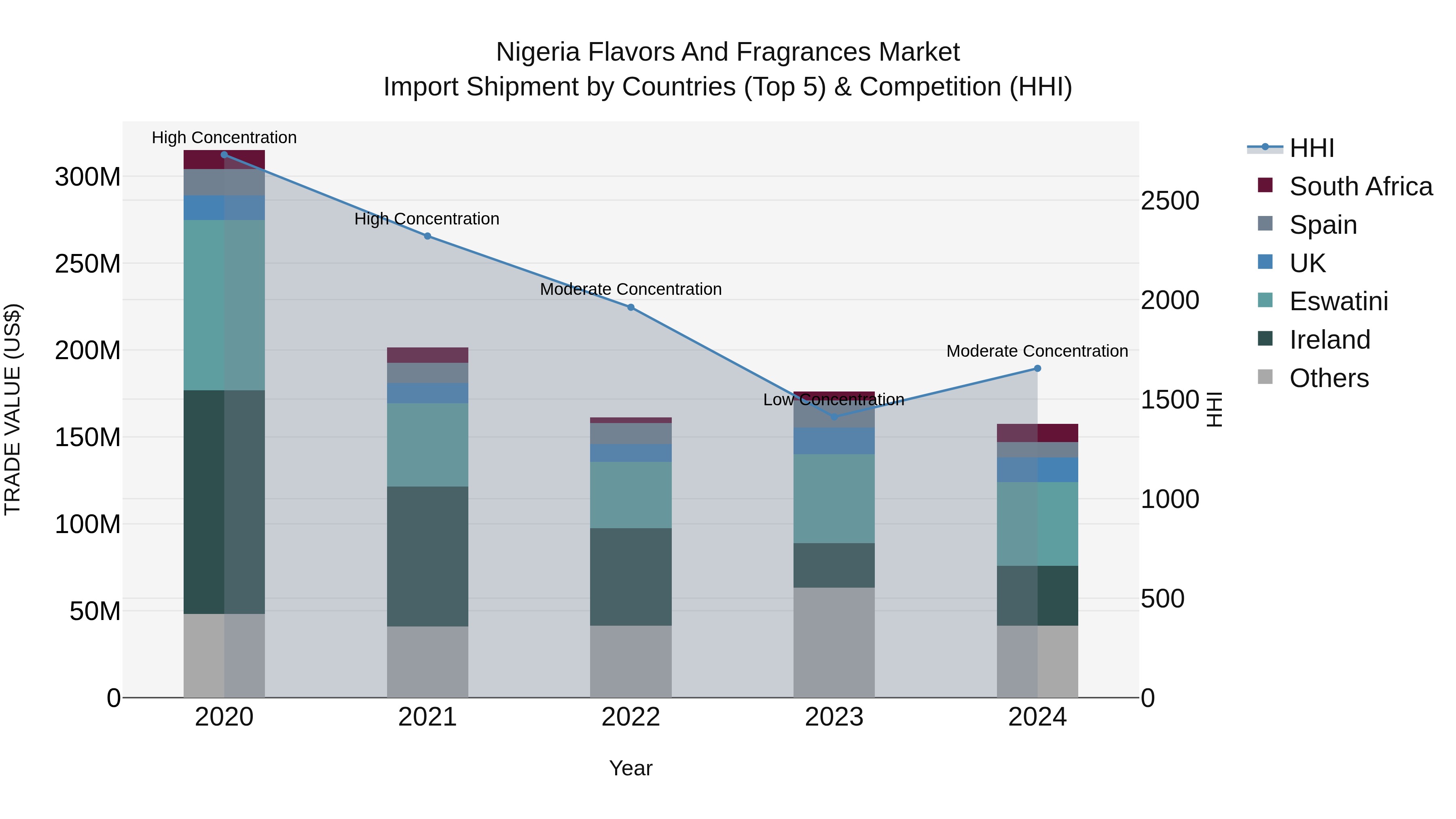
The flavors and fragrances import market in Nigeria experienced a shift in concentration levels from low to moderate in 2024, as reflected by the top exporting countries including Eswatini, Ireland, UK, South Africa, and Spain. Despite a challenging CAGR of -15.9% from 2020 to 2024, there was a slight improvement in the growth rate from 2023 to 2024 at -10.55%. This indicates a potential stabilization in the market, with opportunities for further growth and diversification in the coming years.
Nigeria Flavors and Fragrances Market Overview
The Nigeria Flavors and Fragrances Market is witnessing significant growth driven by increasing consumer demand for enhanced sensory experiences in various products such as food, beverages, cosmetics, and personal care items. The market is characterized by a diverse range of flavors and fragrances catering to the preferences of the country`s multicultural population. Key trends include the rising popularity of natural and organic ingredients, the influence of international flavor profiles, and the growing awareness of health and wellness benefits associated with certain flavors and fragrances. Manufacturers are investing in research and development to innovate and offer unique and customized solutions to meet consumer expectations. The market is also influenced by regulatory frameworks governing the use of flavors and fragrances in different industries, ensuring quality and safety standards are met.
Nigeria Flavors and Fragrances Market Trends
The Nigeria Flavors and Fragrances market is experiencing a shift towards natural and organic products driven by increasing consumer awareness and demand for clean-label ingredients. Manufacturers are focusing on developing innovative formulations using locally sourced raw materials to cater to the growing trend of sustainability and authenticity. There is also a rising interest in unique and indigenous flavors inspired by traditional Nigerian cuisine, such as hibiscus, ginger, and citrus. Furthermore, the market is witnessing a growing preference for long-lasting fragrances in personal care products and home care applications. Companies are investing in research and development to create sophisticated scent profiles that resonate with the local consumer preferences while also meeting international quality standards. Overall, the Nigeria Flavors and Fragrances market is evolving towards a more diverse and dynamic landscape driven by consumer preferences and industry innovations.
Nigeria Flavors and Fragrances Market Challenges
In the Nigeria flavors and fragrances market, challenges are primarily related to sourcing raw materials, maintaining consistent quality standards, and dealing with regulatory complexities. Limited availability and high costs of quality raw materials can impact production costs and product pricing. Ensuring a consistent supply chain for raw materials can be difficult due to issues such as weather conditions and transportation constraints. Additionally, complying with complex regulatory requirements in the fragrance and flavor industry poses challenges for manufacturers in Nigeria. Adhering to safety, labeling, and quality standards set by regulatory bodies requires significant investments in testing and compliance measures. Overall, navigating these challenges while meeting consumer demands for innovative and high-quality products remains a key concern for companies operating in the Nigeria flavors and fragrances market.
Nigeria Flavors and Fragrances Market Investment Opportunities
The Nigeria flavors and fragrances market presents attractive investment opportunities due to the country`s large and growing population, increasing disposable income, and changing consumer preferences towards premium products. With the rising demand for natural and exotic flavors and fragrances in various industries such as food and beverages, personal care, and household products, there is a significant market potential for investors to capitalize on. Investing in research and development to create innovative and unique products tailored to local preferences, as well as establishing strong distribution networks and partnerships with local manufacturers, can help investors gain a competitive edge in this market. Additionally, focusing on sustainability and eco-friendly practices can further enhance the market position and appeal to the environmentally conscious consumer base in Nigeria.
Nigeria Flavors and Fragrances Market Government Policy
The Nigerian government has implemented various policies to support the flavors and fragrances market in the country. These include initiatives to promote local production, such as the National Industrial Revolution Plan and the Presidential Enabling Business Environment Council. Additionally, the government has introduced regulations to ensure product quality and safety, such as the National Agency for Food and Drug Administration and Control (NAFDAC) Act. Furthermore, efforts to attract foreign investment and promote exports are evident through organizations like the Nigerian Investment Promotion Commission and the Nigerian Export Promotion Council. Overall, the government policies aim to stimulate growth and competitiveness in the Nigeria flavors and fragrances market by fostering a conducive business environment and ensuring compliance with industry standards.
Nigeria Flavors and Fragrances Market Future Outlook
The Nigeria Flavors and Fragrances Market is poised for significant growth in the coming years. Factors such as the expanding population, increasing disposable income, and changing consumer preferences towards premium products are expected to drive the demand for flavors and fragrances in various industries including food and beverages, cosmetics, and personal care. Additionally, the growing trend towards natural and organic ingredients is likely to create opportunities for manufacturers to innovate and introduce new products in the market. With a focus on product diversification, quality improvement, and sustainability, key players in the industry are expected to invest in research and development to stay competitive and cater to the evolving consumer needs. Overall, the Nigeria Flavors and Fragrances Market is projected to experience steady growth and expansion in the foreseeable future.
Key Highlights of the Report:
- Nigeria Flavors and Fragrances Market Outlook
- Market Size of Nigeria Flavors and Fragrances Market, 2024
- Forecast of Nigeria Flavors and Fragrances Market, 2031
- Historical Data and Forecast of Nigeria Flavors and Fragrances Revenues & Volume for the Period 2021 - 2031
- Nigeria Flavors and Fragrances Market Trend Evolution
- Nigeria Flavors and Fragrances Market Drivers and Challenges
- Nigeria Flavors and Fragrances Price Trends
- Nigeria Flavors and Fragrances Porter's Five Forces
- Nigeria Flavors and Fragrances Industry Life Cycle
- Historical Data and Forecast of Nigeria Flavors and Fragrances Market Revenues & Volume By Product for the Period 2021 - 2031
- Historical Data and Forecast of Nigeria Flavors and Fragrances Market Revenues & Volume By Natural for the Period 2021 - 2031
- Historical Data and Forecast of Nigeria Flavors and Fragrances Market Revenues & Volume By Aroma Chemical for the Period 2021 - 2031
- Historical Data and Forecast of Nigeria Flavors and Fragrances Market Revenues & Volume By Application for the Period 2021 - 2031
- Historical Data and Forecast of Nigeria Flavors and Fragrances Market Revenues & Volume By Flavors for the Period 2021 - 2031
- Historical Data and Forecast of Nigeria Flavors and Fragrances Market Revenues & Volume By Fragrances for the Period 2021 - 2031
- Nigeria Flavors and Fragrances Import Export Trade Statistics
- Market Opportunity Assessment By Product
- Market Opportunity Assessment By Application
- Nigeria Flavors and Fragrances Top Companies Market Share
- Nigeria Flavors and Fragrances Competitive Benchmarking By Technical and Operational Parameters
- Nigeria Flavors and Fragrances Company Profiles
- Nigeria Flavors and Fragrances Key Strategic Recommendations






































