Nigeria Food Colors Market Top 5 Importing Countries and Market Competition (HHI) Analysis
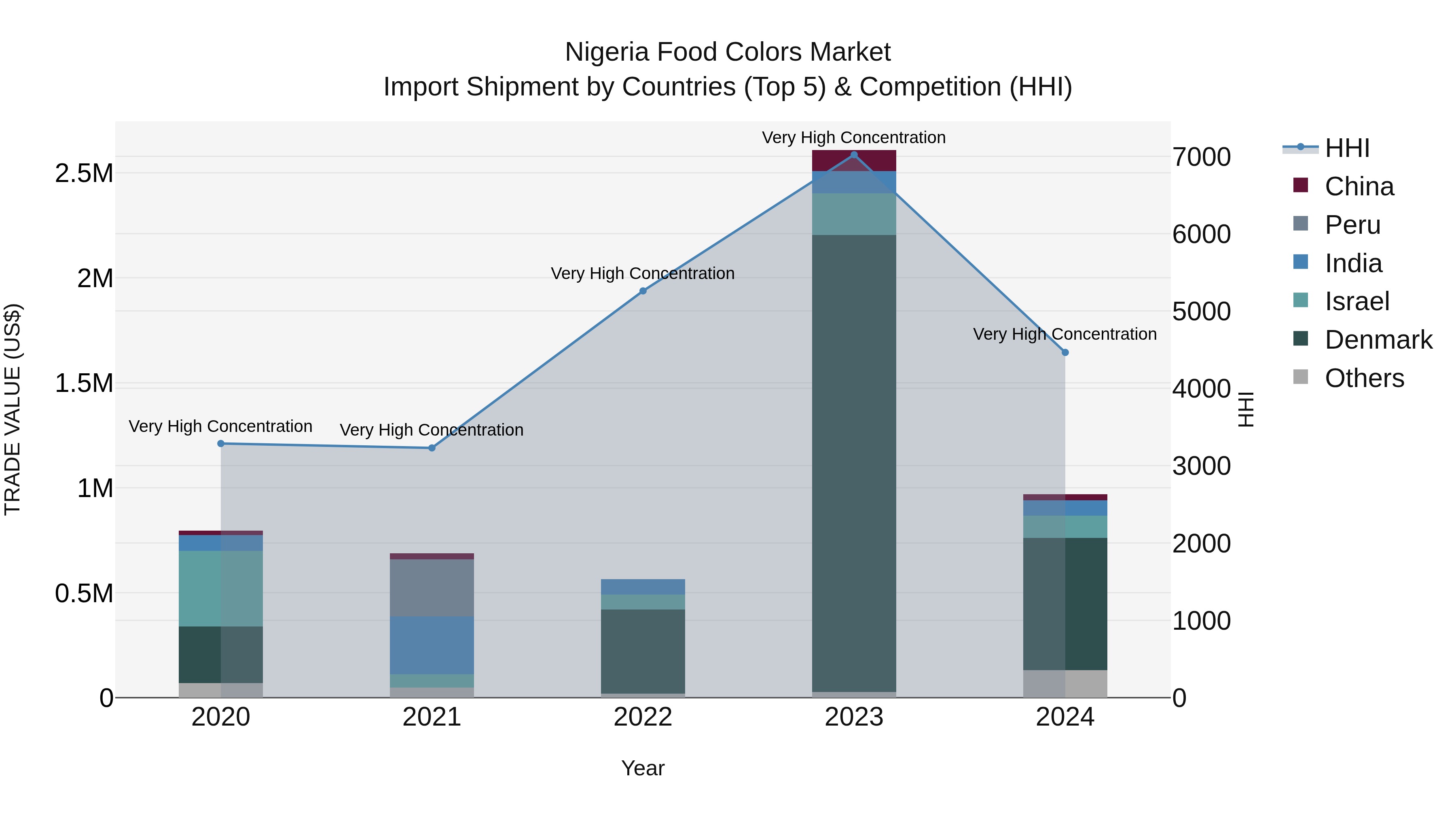
In 2024, Nigeria`s food colors import market saw a notable presence of top exporting countries including Denmark, Israel, Ireland, India, and China. Despite the high Herfindahl-Hirschman Index indicating market concentration, the industry demonstrated a steady growth with a CAGR of 5.07% from 2020 to 2024. However, a sharp decline in growth rate of -62.85% from 2023 to 2024 raises concerns for the future trajectory of the market. Stakeholders should closely monitor factors influencing this sudden downturn to make informed decisions and strategies for the coming years.
Nigeria Food Colors Market Overview
The Nigeria Food Colors Market is expanding with the growing demand for visually appealing food products. Natural food colors are gaining popularity due to increasing health consciousness among consumers. Regulatory approval and the availability of a wide range of natural colorants are contributing to the market growth, with applications ranging from beverages to confectionery.
Drivers of the market
The demand for food colors in Nigeria is experiencing steady growth due to various factors. With changing consumer preferences and increasing disposable incomes, there`s a rising inclination towards visually appealing food products. Food colors play a crucial role in enhancing the appearance of food items, thereby influencing consumer purchasing decisions. Additionally, the food processing industry`s expansion, coupled with the introduction of innovative food products, is driving the demand for a diverse range of food colors in the market.
Challenges of the market
The Nigeria Food Colors Market encounters challenges related to stringent regulatory standards and limitations on the use of certain synthetic colors. These restrictions compel manufacturers to seek natural alternatives, which are often more expensive and less stable. Additionally, limited consumer awareness and the preference for traditional foods that do not require artificial coloring restrict market expansion.
Government Policy of the market
In Nigeria, the government has established regulations to control the use of food colors to ensure they are safe for consumption. The National Agency for Food and Drug Administration and Control (NAFDAC) monitors and evaluates food color additives used in the industry. The agency sets permissible limits for food colors and ensures compliance with international safety standards. Furthermore, the Federal Ministry of Health collaborates with NAFDAC to enforce labeling requirements for food products containing colors, providing consumers with accurate information.
Key Highlights of the Report:
- Nigeria Food Colors Market Outlook
- Market Size of Nigeria Food Colors Market, 2024
- Forecast of Nigeria Food Colors Market, 2031
- Historical Data and Forecast of Nigeria Food Colors Revenues & Volume for the Period 2021-2031
- Nigeria Food Colors Market Trend Evolution
- Nigeria Food Colors Market Drivers and Challenges
- Nigeria Food Colors Price Trends
- Nigeria Food Colors Porter's Five Forces
- Nigeria Food Colors Industry Life Cycle
- Historical Data and Forecast of Nigeria Food Colors Market Revenues & Volume By Type for the Period 2021-2031
- Historical Data and Forecast of Nigeria Food Colors Market Revenues & Volume By Natural for the Period 2021-2031
- Historical Data and Forecast of Nigeria Food Colors Market Revenues & Volume By Synthetic for the Period 2021-2031
- Historical Data and Forecast of Nigeria Food Colors Market Revenues & Volume By Nature Identical for the Period 2021-2031
- Historical Data and Forecast of Nigeria Food Colors Market Revenues & Volume By Application for the Period 2021-2031
- Historical Data and Forecast of Nigeria Food Colors Market Revenues & Volume By Food Products for the Period 2021-2031
- Historical Data and Forecast of Nigeria Food Colors Market Revenues & Volume By Beverages for the Period 2021-2031
- Historical Data and Forecast of Nigeria Food Colors Market Revenues & Volume By Form for the Period 2021-2031
- Historical Data and Forecast of Nigeria Food Colors Market Revenues & Volume By Liquid for the Period 2021-2031
- Historical Data and Forecast of Nigeria Food Colors Market Revenues & Volume By Powder for the Period 2021-2031
- Historical Data and Forecast of Nigeria Food Colors Market Revenues & Volume By Gel for the Period 2021-2031
- Historical Data and Forecast of Nigeria Food Colors Market Revenues & Volume By Solubility for the Period 2021-2031
- Historical Data and Forecast of Nigeria Food Colors Market Revenues & Volume By Dyes for the Period 2021-2031
- Historical Data and Forecast of Nigeria Food Colors Market Revenues & Volume By Lakes for the Period 2021-2031
- Nigeria Food Colors Import Export Trade Statistics
- Market Opportunity Assessment By Type
- Market Opportunity Assessment By Application
- Market Opportunity Assessment By Form
- Market Opportunity Assessment By Solubility
- Nigeria Food Colors Top Companies Market Share
- Nigeria Food Colors Competitive Benchmarking By Technical and Operational Parameters
- Nigeria Food Colors Company Profiles
- Nigeria Food Colors Key Strategic Recommendations






































