Nigeria Food Packaging Market Summary
The nigeria food packaging market was estimated at USD 458 Million in 2025 and is projected to reach USD 599 Million by 2032, growing at a CAGR of 4.4% from 2026 to 2032.
Nigeria Food Packaging Market Year-wise Growth Rate and Key Drivers
This graph highlights how the Nigeria Food Packaging Market has steadily grown over the past five years, supported by major growth factors.
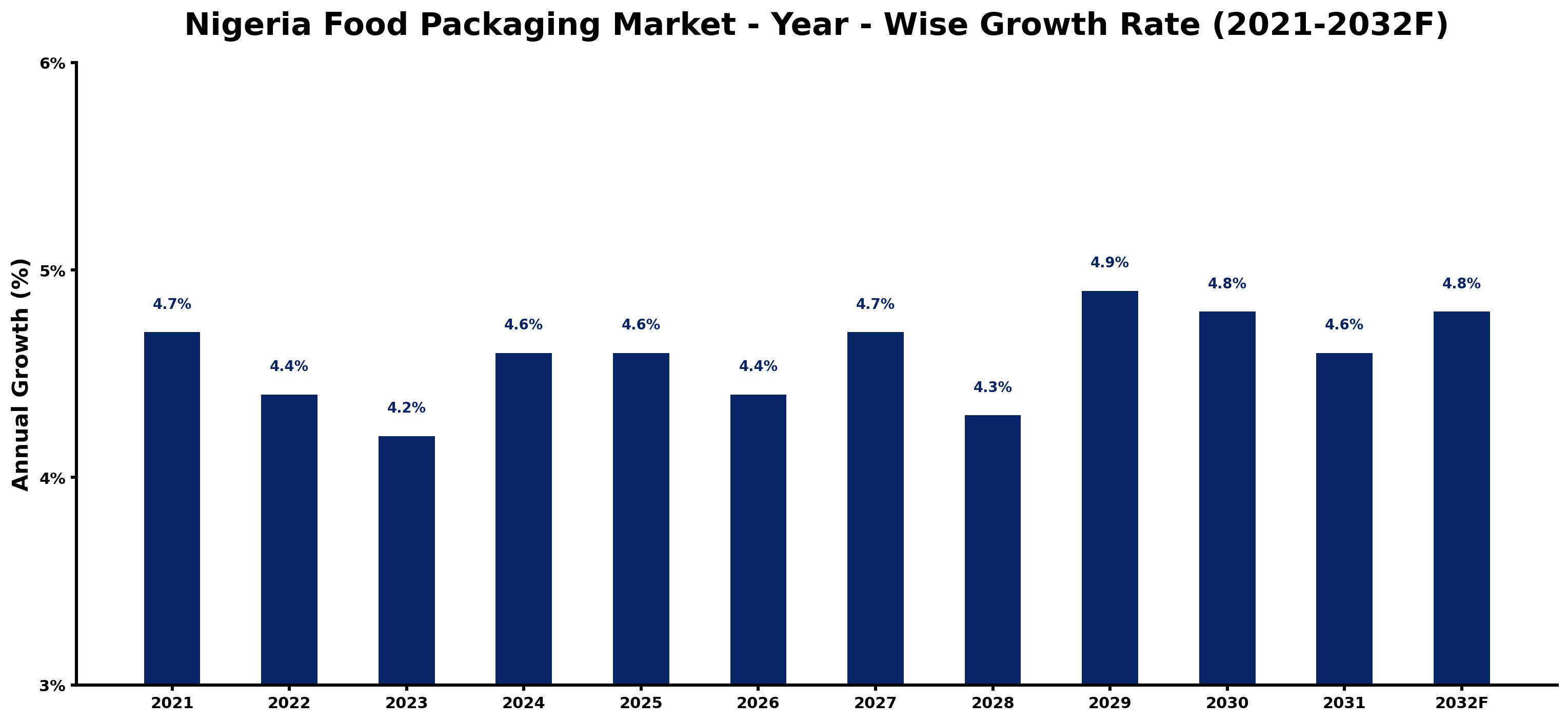
The table below presents the year wise growth rates along with the key drivers influencing the market
| Year | Growth Rate | Major Drivers |
| 2021 | 4.7% | Consumers increasingly prefer sustainable packaging, shifting the market landscape significantly. |
| 2022 | 4.4% | Local manufacturers begin adopting innovative technologies to enhance production efficiency. |
| 2023 | 4.2% | Supply chain disruptions prompt food producers to rethink packaging solutions strategically. |
| 2024 | 4.6% | Urbanization trends create demand for convenient, ready-to-eat food packaging options. |
| 2025 | 4.6% | Investment in infrastructure development fuels growth in the food packaging sector. |
| 2026 | 4.4% | E-commerce expansion encourages brands to refine packaging for online delivery efficiency. |
| 2027 | 4.7% | Health-conscious consumers demand transparent labeling, impacting packaging design choices. |
| 2028 | 4.3% | Emerging startups introduce eco-friendly materials, reshaping traditional packaging practices. |
| 2029 | 4.9% | Cultural shifts highlight the importance of local sourcing in packaging materials. |
| 2030 | 4.8% | Technological integration in food processing optimizes packaging workflows and reduces waste. |
| 2031 | 4.6% | Collaborations between manufacturers and retailers enhance packaging sustainability initiatives. |
| 2032 | 4.8% | Global brands entering the market bring diverse packaging solutions explicitly tailored for Nigeria. |
Note - Market size estimations and growth projections presented in this report are based on 6Wresearch's advanced forecasting approach, validated with industry datasets as of June 2026.
Nigeria Food Packaging Market Synopsis
The Nigeria Food Packaging Market is projected to reach 4.4% and witness significant growth during the forecast period (2026-2032). This growth can be attributed to various factors, including increasing urbanization, shifting consumer lifestyles, and a heightened demand for convenience foods. The market is characterized by a diverse array of packaging materials such as flexible, rigid, and paper-based options. As environmental concerns gain prominence, sustainable packaging solutions are emerging as a key focus for stakeholders seeking to meet both consumer expectations and regulatory standards.
Nigeria Food Packaging Market Growth Drivers
Several factors are contributing to the expansion of the Nigeria food packaging market. Urbanization is a significant driver, as more individuals move to cities where convenience foods are in increasing demand. Additionally, changing consumer lifestyles are pushing for innovative packaging solutions that cater to on-the-go consumption. The trend towards sustainable practices is also gaining momentum, prompting manufacturers to explore eco-friendly packaging options. Furthermore, improvements in logistics and distribution networks are facilitating access to a wider range of packaging products.
Nigeria Food Packaging Market Trends and Opportunities
The Nigeria food packaging market is witnessing various trends that indicate both challenges and opportunities. One prevailing trend is the shift towards eco-friendly packaging materials, including biodegradable plastics and recyclable options. This is in response to growing consumer awareness regarding environmental sustainability. Another trend is the increasing preference for visually appealing and functional packaging designs that enhance product visibility, particularly among younger consumers. Additionally, advancements in technology are enabling smart packaging solutions that provide consumers with detailed product information, thereby enhancing their overall shopping experience.
Nigeria Food Packaging Market Challenges and Restraints
Despite the promising growth, the Nigeria food packaging market faces several challenges. Inadequate infrastructure remains a critical hurdle, leading to logistical issues in transportation and distribution. Inconsistent government policies can hamper the industry's growth and create uncertainties for investors. Furthermore, limited access to advanced packaging technologies restricts competitiveness among market players. Fluctuating raw material prices pose financial constraints, especially for new entrants. Lastly, the prevalence of counterfeit products undermines consumer trust, highlighting the need for stringent quality control measures.
Nigeria Food Packaging Market Investment Opportunities
The Nigeria food packaging market presents numerous investment opportunities driven by demographic trends and economic growth. The increasing population and rising disposable incomes create a fertile ground for innovative packaging solutions tailored to consumer preferences. Investments in sustainable packaging technologies—such as biodegradable and recyclable materials—are likely to yield significant returns. Additionally, there is a growing demand for premium and value-added packaging options. Collaborations with food manufacturers to develop customized packaging solutions can further enhance market entry and growth strategies.
Nigeria Food Packaging Market Government Investment and Initiatives
Government policies in Nigeria are concentrated on promoting food safety, environmental sustainability, and consumer protection within the packaging sector. Regulatory bodies, such as the National Agency for Food and Drug Administration and Control (NAFDAC), play a critical role in ensuring that packaging materials adhere to safety standards. The Standards Organization of Nigeria (SON) sets comprehensive standards for packaging materials to guarantee product quality. Incentives for the adoption of eco-friendly packaging materials are also part of the government's strategy to mitigate environmental impacts, while regulations on imports aim to protect the market from substandard products.
Nigeria Food Packaging Market Latest Developments (May 2025 - June 2026)
In the recent period from May 2025 to June 2026, the Nigeria food packaging market has seen notable developments aligning with global trends. There has been a marked increase in the adoption of sustainable packaging solutions, reflecting a growing consciousness among consumers and manufacturers alike towards environmental issues. Technological advancements have also gained momentum, with innovations in smart packaging and interactive labeling becoming more prominent. Furthermore, regulatory measures have been strengthened to ensure compliance with safety and quality standards, thereby enhancing consumer trust in packaged food products.
Nigeria Food Packaging Market - Key Attractiveness of the Report
- 10 Years of Market Numbers
- Historical Data Starting from 2022 to 2025
- Base Year: 2025
- Forecast Data until 2032
- Key Performance Indicators Impacting the Market
- Major Upcoming Developments and Projects
Key Highlights of the Report:
- Nigeria Food Packaging Market Outlook
- Market Size of Nigeria Food Packaging Market, 2025
- Forecast of Nigeria Food Packaging Market, 2032F
- Historical Data and Forecast of Nigeria Food Packaging Revenues & Volume for the Period 2022-2032F
- Nigeria Food Packaging Market Trend Evolution
- Nigeria Food Packaging Market Drivers and Challenges
- Nigeria Food Packaging Price Trends
- Nigeria Food Packaging Porter's Five Forces
- Nigeria Food Packaging Industry Life Cycle
- Historical Data and Forecast of Nigeria Food Packaging Market Revenues & Volume By Material Types for the Period 2022-2032F
- Historical Data and Forecast of Nigeria Food Packaging Market Revenues & Volume By Paper & board for the Period 2022-2032F
- Historical Data and Forecast of Nigeria Food Packaging Market Revenues & Volume By Plastic for the Period 2022-2032F
- Historical Data and Forecast of Nigeria Food Packaging Market Revenues & Volume By Metal for the Period 2022-2032F
- Historical Data and Forecast of Nigeria Food Packaging Market Revenues & Volume By Glass for the Period 2022-2032F
- Historical Data and Forecast of Nigeria Food Packaging Market Revenues & Volume By Others for the Period 2022-2032F
- Historical Data and Forecast of Nigeria Food Packaging Market Revenues & Volume By Product Types for the Period 2022-2032F
- Historical Data and Forecast of Nigeria Food Packaging Market Revenues & Volume By Rigid for the Period 2022-2032F
- Historical Data and Forecast of Nigeria Food Packaging Market Revenues & Volume By Semi-Rigid for the Period 2022-2032F
- Historical Data and Forecast of Nigeria Food Packaging Market Revenues & Volume By Flexible for the Period 2022-2032F
- Historical Data and Forecast of Nigeria Food Packaging Market Revenues & Volume By Applications for the Period 2022-2032F
- Historical Data and Forecast of Nigeria Food Packaging Market Revenues & Volume By Bakery & Confectionary for the Period 2022-2032F
- Historical Data and Forecast of Nigeria Food Packaging Market Revenues & Volume By Dairy Products for the Period 2022-2032F
- Historical Data and Forecast of Nigeria Food Packaging Market Revenues & Volume By Fruits & Vegetables for the Period 2022-2032F
- Historical Data and Forecast of Nigeria Food Packaging Market Revenues & Volume By Meat, Poultry, & Seafood for the Period 2022-2032F
- Historical Data and Forecast of Nigeria Food Packaging Market Revenues & Volume By Sauces & Dressings for the Period 2022-2032F
- Historical Data and Forecast of Nigeria Food Packaging Market Revenues & Volume By Others for the Period 2022-2032F
- Nigeria Food Packaging Import Export Trade Statistics
- Market Opportunity Assessment By Material Types
- Market Opportunity Assessment By Product Types
- Market Opportunity Assessment By Applications
- Nigeria Food Packaging Top Companies Market Share
- Nigeria Food Packaging Competitive Benchmarking By Technical and Operational Parameters
- Nigeria Food Packaging Company Profiles
- Nigeria Food Packaging Key Strategic Recommendations






































