Nigeria Frozen Processed Meat Market Size, Share & Growth Rate
The Nigeria Frozen Processed Meat Market was estimated at USD 219 Million in 2025 and is projected to reach USD 308 Million by 2032, growing at a CAGR of 5.0% from 2026 to 2032. This growth trajectory is primarily propelled by the increasing urbanization trends in Nigeria, coupled with evolving consumer lifestyles that favor convenience and ready-to-eat food options. Rising disposable incomes also play a critical role, as consumers seek higher-quality meat products that align with their busy schedules.
Nigeria Frozen Processed Meat Market Year-wise Growth Rate and Key Drivers
This graph highlights how the Nigeria Frozen Processed Meat Market has steadily grown over the years, supported by major growth factors.
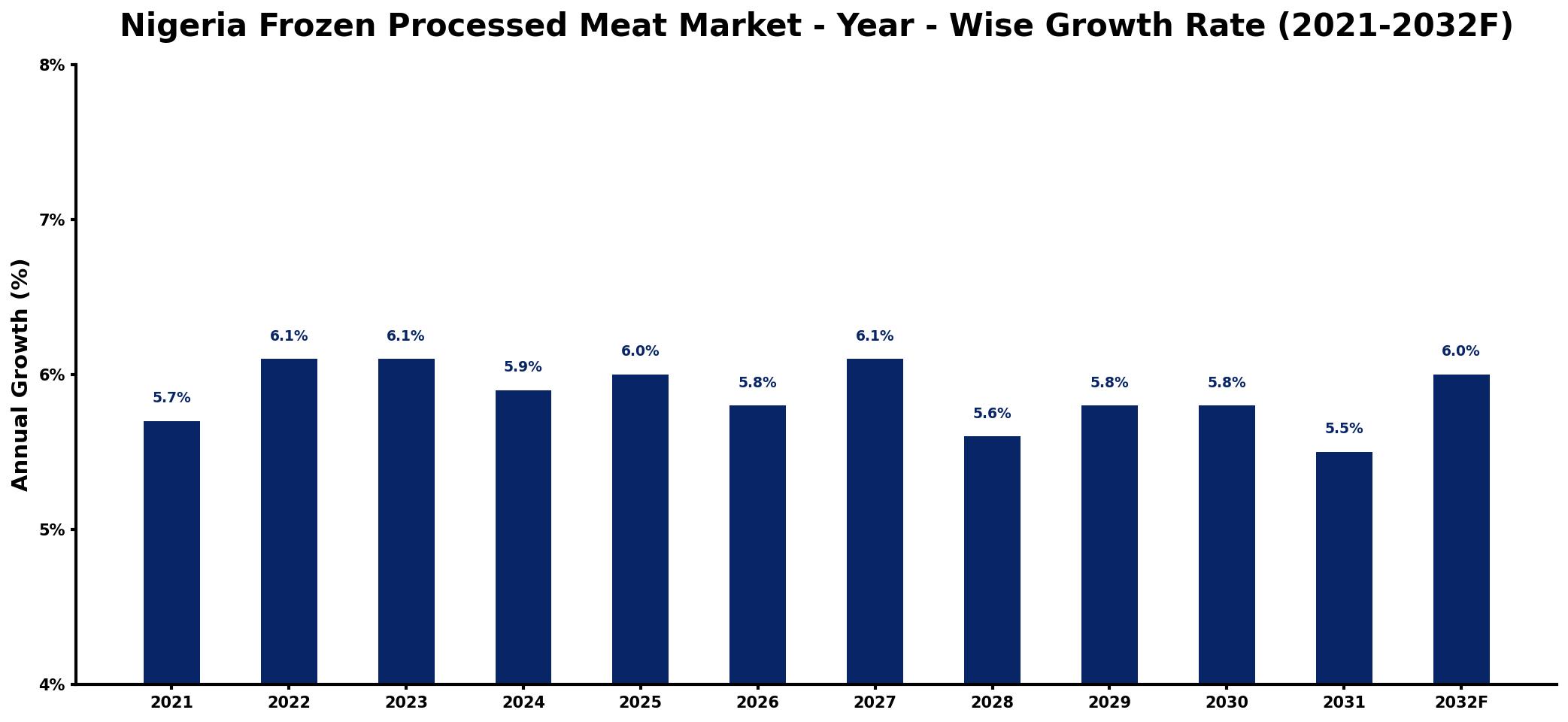
The table below presents the year‑wise growth rates along with the key drivers influencing the market
| Year | Growth Rate | Major Drivers |
| 2021 | 5.7% | Rising consumer health awareness |
| 2022 | 6.1% | Growing urban population demand |
| 2023 | 6.1% | Increased retail distribution channels |
| 2024 | 5.9% | Expansion of e-commerce platforms |
| 2025 | 6.0% | Surge in convenience food demand |
| 2026 | 5.8% | Growth in export opportunities |
| 2027 | 6.1% | Investment in cold chain logistics |
| 2028 | 5.6% | Emergence of alternative proteins |
| 2029 | 5.8% | Technological advancements in preservation |
| 2030 | 5.8% | Rising disposable income levels |
| 2031 | 5.5% | Increased focus on sustainability |
| 2032 | 6.0% | Demand for premium product offerings |
Note: Market size estimations and growth projections presented in this report are based on 6Wresearch's proprietary forecasting methodology, utilizing the latest available industry data, government publications, and primary research inputs.
Nigeria Frozen Processed Meat Market Synopsis
The Nigeria Frozen Processed Meat Market has witnessed notable momentum in recent years, yet it stands on the cusp of a transformative phase. As consumers become more health-conscious and demand convenience, the sector is expected to adapt swiftly to these changing preferences.
While traditional fresh meat remains popular, the growing acceptance of frozen processed options marks a significant shift. Market players are actively innovating to enhance product quality and expand offerings, thus paving the way for broader consumer adoption of frozen meats in Nigeria.
Nigeria Frozen Processed Meat Market Key Takeaways
- The market is driven by rising urbanization and increasing disposable incomes.
- Poultry and beef are the leading categories in frozen processed meat consumption.
- Health-conscious trends are leading consumers to favor products without artificial additives.
- Investment opportunities are significant in production and distribution channels.
- Government regulations are increasingly focused on food safety and quality assurance.
Evaluation of Restraints in Nigeria Frozen Processed Meat Market
Despite the promising outlook, the Nigeria Frozen Processed Meat Market contends with various restraints that threaten its potential. A significant issue is the inconsistent power supply, which complicates the preservation of frozen goods and increases the risk of spoilage. Furthermore, the inadequate cold chain infrastructure restricts the efficiency of both storage and transportation, thus hampering market growth. Limited consumer awareness of the benefits of frozen processed meats compared to fresh alternatives also poses a challenge, as does the prevalence of counterfeit products that undermine trust in the market. Addressing these issues will be vital for sustainable market advancement.
Nigeria Frozen Processed Meat Market Trends
Several key trends are shaping the Nigeria Frozen Processed Meat Market. The demand for convenience foods continues to rise due to fast-paced urban lifestyles, leading to increased consumption of frozen products like sausages, burgers, and nuggets. As health consciousness grows, consumers are actively seeking frozen processed meat that is free from artificial additives and preservatives. Innovations in flavors and packaging are also becoming commonplace as manufacturers strive to meet diverse consumer preferences and enhance product appeal. Additionally, e-commerce's rising popularity is facilitating broader access to frozen meat products, thereby further influencing consumer choices.
Nigeria Frozen Processed Meat Market Opportunities
The Nigeria Frozen Processed Meat Market is ripe for investment, particularly with the continuous growth in demand for convenient food options. Opportunities exist for the establishment of production facilities focusing on a variety of frozen meat products, including marinated meats and ready-to-cook options. Strengthening distribution channels to penetrate deeper into the consumer base across Nigeria can significantly enhance market share. Moreover, increased marketing efforts aimed at educating consumers about the advantages of frozen processed meats could drive acceptance and sales, thus capitalizing on this growing segment.
Government Initiatives in the Nigeria Frozen Processed Meat Market
Government policies play a crucial role in shaping the landscape of the Nigeria Frozen Processed Meat Market. Regulations established by bodies such as the National Agency for Food and Drug Administration and Control (NAFDAC) ensure food safety and quality through stringent labeling and packaging standards. The government also encourages local production through initiatives aimed at enhancing self-sufficiency in food supply, which indirectly boosts the frozen processed meat industry. Such policies not only promote consumer safety but also regulate foreign imports, thus encouraging domestic industry growth.
Future Insights of the Nigeria Frozen Processed Meat Market
Looking ahead to 2026-2032, the Nigeria Frozen Processed Meat Market is anticipated to undergo significant expansion, underpinned by persistent urbanization and changing consumer lifestyles. The demand for convenient and quality frozen meat products is expected to rise, fueled by online grocery shopping trends and the expanding reach of retail chains. However, challenges like food safety concerns and competition from fresh meat will require strategic approaches. With continued product innovation and marketing strategies that resonate with consumer values, the market is well-positioned to achieve promising growth in the years to come.
Nigeria Frozen Processed Meat Market Latest Developments (2025 - 2026)
In recent months, the Nigeria Frozen Processed Meat Market has seen a shift towards enhancing food safety standards, spurred by increasing consumer awareness. Industry players are investing in improving cold chain logistics to minimize spoilage and ensure product quality. Additionally, there is a rising trend in developing unique flavor profiles in frozen processed meats to cater to diverse Nigerian palates. Efforts to combat counterfeit products are intensifying, supported by government regulations aimed at safeguarding consumer interests. Overall, these developments indicate a proactive approach to fostering growth and maintaining consumer trust in the market.
Nigeria Frozen Processed Meat Market - Key Attractiveness of the Report
- 10 Years of Market Numbers
- Historical Data Starting from 2022 to 2025
- Base Year: 2025
- Forecast Data until 2032
- Key Performance Indicators Impacting the Market
- Major Upcoming Developments and Projects
Key Highlights of the Report:
- Nigeria Frozen Processed Meat Market Outlook
- Market Size of Nigeria Frozen Processed Meat Market, 2025
- Forecast of Nigeria Frozen Processed Meat Market, 2032
- Historical Data and Forecast of Nigeria Frozen Processed Meat Revenues & Volume for the Period 2022-2032F
- Nigeria Frozen Processed Meat Market Trend Evolution
- Nigeria Frozen Processed Meat Market Drivers and Challenges
- Nigeria Frozen Processed Meat Price Trends
- Nigeria Frozen Processed Meat Porter's Five Forces
- Nigeria Frozen Processed Meat Industry Life Cycle
- Historical Data and Forecast of Nigeria Frozen Processed Meat Market Revenues & Volume By Product Type for the Period 2022-2032F
- Historical Data and Forecast of Nigeria Frozen Processed Meat Market Revenues & Volume By Beef for the Period 2022-2032F
- Historical Data and Forecast of Nigeria Frozen Processed Meat Market Revenues & Volume By Pork for the Period 2022-2032F
- Historical Data and Forecast of Nigeria Frozen Processed Meat Market Revenues & Volume By Chicken for the Period 2022-2032F
- Historical Data and Forecast of Nigeria Frozen Processed Meat Market Revenues & Volume By Mutton for the Period 2022-2032F
- Historical Data and Forecast of Nigeria Frozen Processed Meat Market Revenues & Volume By Others for the Period 2022-2032F
- Historical Data and Forecast of Nigeria Frozen Processed Meat Market Revenues & Volume By Application for the Period 2022-2032F
- Historical Data and Forecast of Nigeria Frozen Processed Meat Market Revenues & Volume By Retail Store for the Period 2022-2032F
- Historical Data and Forecast of Nigeria Frozen Processed Meat Market Revenues & Volume By Online Sale for the Period 2022-2032F
- Nigeria Frozen Processed Meat Import Export Trade Statistics
- Market Opportunity Assessment By Product Type
- Market Opportunity Assessment By Application
- Nigeria Frozen Processed Meat Top Companies Market Share
- Nigeria Frozen Processed Meat Competitive Benchmarking By Technical and Operational Parameters
- Nigeria Frozen Processed Meat Company Profiles
- Nigeria Frozen Processed Meat Key Strategic Recommendations






































