Nigeria Helicopter Market Size, Share & Growth Rate
The Nigeria Helicopter Market was estimated at USD 510 Million in 2025 and is projected to reach USD 724 Million by 2032, growing at a CAGR of 5.1% from 2026 to 2032. This growth trajectory is primarily driven by increasing demand from the oil and gas sector, which continues to be the dominant force behind helicopter usage, especially for offshore operations. Furthermore, rising investments in tourism and emergency services are further bolstering the need for diverse helicopter applications across Nigeria's unique geographic landscape.
Nigeria Helicopter Market Year-wise Growth Rate and Key Drivers
This graph highlights how the Nigeria Helicopter Market has steadily grown over the years, supported by major growth factors.
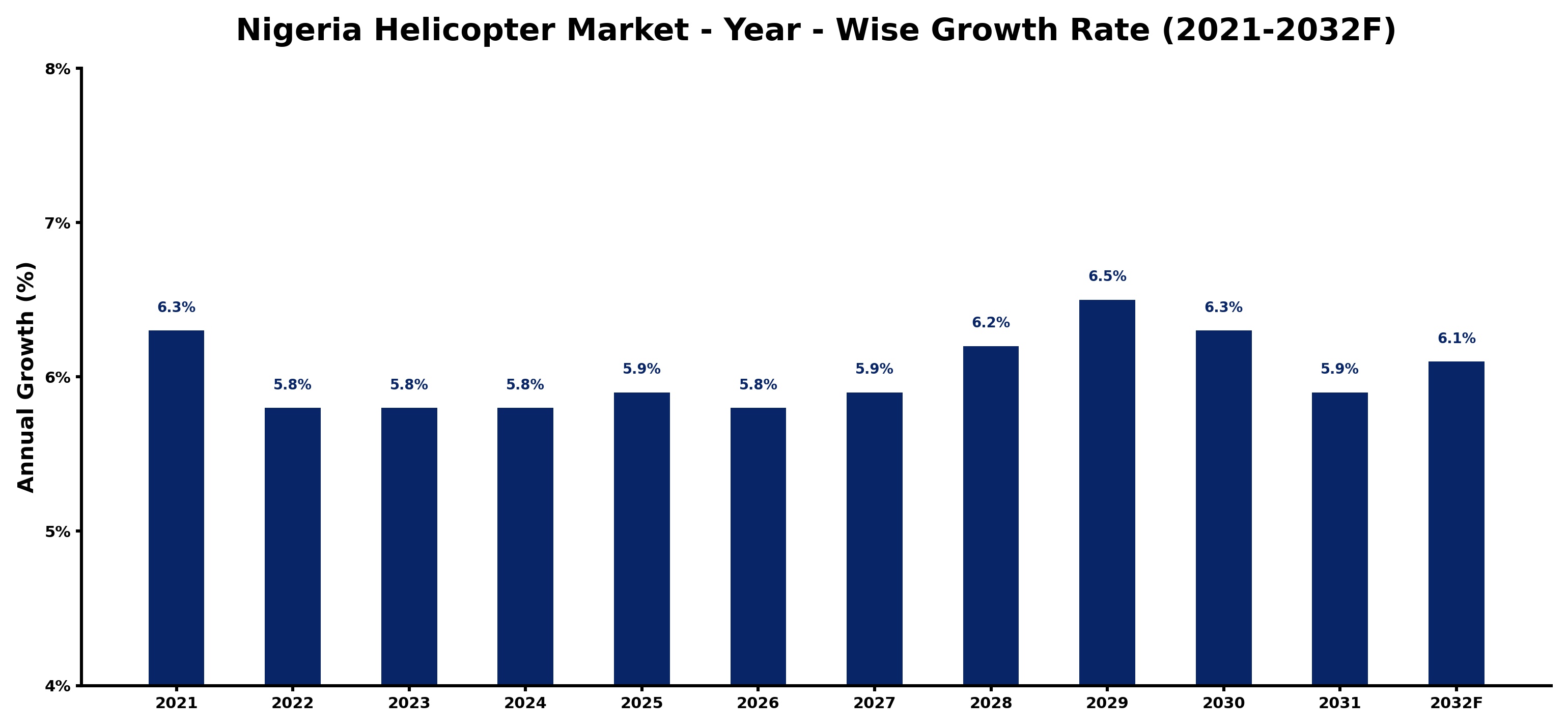
The table below presents the year‑wise growth rates along with the key drivers influencing the market
| Year | Growth Rate | Major Drivers |
| 2021 | 6.3% | Helicopter service providers upgraded fleets for enhanced operational capacity |
| 2022 | 5.8% | Increased offshore drilling operations drive helicopter maintenance service demand |
| 2023 | 5.8% | Local assembly of helicopters boosts regional supply chain resilience |
| 2024 | 5.8% | Helicopter fleet upgrades fueled demand for localized manufacturing parts |
| 2025 | 5.9% | Local assembly plants boost helicopter component manufacturing capabilities |
| 2026 | 5.8% | Local oil and gas projects drive helicopter demand and support operations |
| 2027 | 5.9% | Infrastructure projects demand increased helicopter fleet service capabilities |
| 2028 | 6.2% | Infrastructure development projects boost helicopter maintenance service demand |
| 2029 | 6.5% | Local assembly plants boost helicopter component manufacturing capabilities in Nigeria |
| 2030 | 6.3% | Local assembly of helicopters boosts manufacturing investments in Nigeria |
| 2031 | 5.9% | Improved maintenance capabilities boosted helicopter component manufacturing efficiencies |
| 2032 | 6.1% | Improved technology integration enhanced helicopter maintenance service efficiency |
Note - Market size estimations and growth projections presented in this report are based on 6Wresearch's advanced forecasting approach, validated with industry datasets as of June 2026.
Nigeria Helicopter Market Synopsis
Recently, the Nigeria helicopter market has witnessed significant momentum, underpinned by an increasing reliance on aerial transport solutions. However, the market is on the cusp of a transformative phase, as emerging sectors like tourism and medical evacuation begin to shape its future landscape.
While the current growth is promising, the outlook is mixed due to ongoing challenges related to infrastructure and regulatory frameworks. Nevertheless, as local operators and international players adapt to these dynamics, the market is set to unlock new growth avenues in the coming years.
Nigeria Helicopter Market Key Takeaways
- Steady growth driven by the oil & gas, tourism, and emergency medical services sectors.
- Infrastructural development and government support are critical for market expansion.
- A rise in demand for environmentally friendly helicopter models is notable.
- Investment opportunities abound in VIP transportation and helicopter tourism services.
- Regulatory complexities and security concerns remain significant hurdles.
Evaluation of Restraints in Nigeria Helicopter Market
The Nigeria helicopter market faces substantial restraints that are limiting its growth potential. One major constraint is the lack of adequate heliport infrastructure, which hinders operational efficiency and increases costs for operators. Additionally, security concerns in regions like the Niger Delta continue to pose risks to helicopter operations, adversely impacting passenger safety and deterring investment. Regulatory complexities add to the challenges, making it difficult for new entrants to navigate the market landscape effectively. Addressing these barriers will be essential for realizing the full potential of the market.
Nigeria Helicopter Market Trends
Several current and emerging trends are influencing the Nigeria helicopter market. A notable trend is the rising demand for helicopter services in the tourism sector, driven by the increasing popularity of aerial tours and scenic flights. Additionally, there is a growing emphasis on utilizing helicopters for medical evacuations, particularly in remote areas where ground transportation is impractical. Furthermore, as environmental concerns become paramount, there is a noticeable shift towards investing in more fuel-efficient and sustainable helicopter technologies, reflecting a broader commitment to reducing emissions across the industry.
Nigeria Helicopter Market Opportunities
The Nigeria helicopter market presents lucrative investment opportunities, particularly within the oil and gas exploration sector. The vast untapped reserves of natural resources necessitate efficient transportation solutions, creating a sustained demand for helicopter support. Additionally, the burgeoning need for emergency medical services in underserved regions signals a significant niche market for helicopter operators. Furthermore, with the country's diverse attractions, helicopter tourism stands out as a growth area, catering to both local and international tourists seeking unique aerial experiences. Investors looking to capitalize on these sectors are well-positioned to achieve substantial returns.
Government Initiatives in the Nigeria Helicopter Market
The Nigerian government has taken proactive steps to bolster the helicopter market through various initiatives aimed at enhancing safety and compliance. The Nigerian Civil Aviation Authority (NCAA) plays a crucial role in regulating helicopter operations, focusing on maintaining high standards for pilot licensing, maintenance, and airworthiness. Additionally, there is a concerted effort to promote local content in the helicopter industry, encouraging domestic manufacturing and maintenance practices. These government initiatives are pivotal for fostering a sustainable and secure operating environment for helicopter services in Nigeria.
Future Insights of the Nigeria Helicopter Market
Looking ahead to 2026-2032, the Nigeria helicopter market is projected to maintain its growth momentum, largely driven by ongoing investments in infrastructure and a persistent demand for efficient transport solutions. As the economy expands, sectors such as oil and gas, mining, and tourism are expected to increasingly rely on helicopter services. Moreover, technological advancements aimed at improving performance and safety will continue to play a crucial role in shaping the market landscape. However, stakeholders must remain vigilant regarding regulatory changes and security challenges that may impact market dynamics. Overall, a positive outlook prevails for the Nigeria helicopter market, underscoring the potential for further growth and diversification.
Nigeria Helicopter Market Latest Developments (May 2025 - June 2026)
Recent developments in the Nigeria helicopter market indicate a shift towards greater collaboration among stakeholders to address infrastructural and operational challenges. Initiatives to enhance training programs for pilots and technicians are being prioritized to improve overall service quality. Additionally, there is an observable increase in partnerships between local operators and international firms aimed at leveraging expertise and technology. These trends underscore a collective commitment to enhancing safety and efficiency in helicopter operations across the country, positioning the market for robust growth in the near future.
Nigeria Helicopter Market - Key Attractiveness of the Report
- 10 Years of Market Numbers
- Historical Data Starting from 2022 to 2025
- Base Year: 2025
- Forecast Data until 2032
- Key Performance Indicators Impacting the Market
- Major Upcoming Developments and Projects
Key Highlights of the Report:
- Nigeria Helicopter Market Outlook
- Market Size of Nigeria Helicopter Market, 2025
- Forecast of Nigeria Helicopter Market, 2032
- Historical Data and Forecast of Nigeria Helicopter Revenues & Volume for the Period 2022-2032F
- Nigeria Helicopter Market Trend Evolution
- Nigeria Helicopter Market Drivers and Challenges
- Nigeria Helicopter Price Trends
- Nigeria Helicopter Porter's Five Forces
- Nigeria Helicopter Industry Life Cycle
- Historical Data and Forecast of Nigeria Helicopter Market Revenues & Volume By End-users for the Period 2022-2032F
- Historical Data and Forecast of Nigeria Helicopter Market Revenues & Volume By Commercial for the Period 2022-2032F
- Historical Data and Forecast of Nigeria Helicopter Market Revenues & Volume By Military for the Period 2022-2032F
- Historical Data and Forecast of Nigeria Helicopter Market Revenues & Volume By Component for the Period 2022-2032F
- Historical Data and Forecast of Nigeria Helicopter Market Revenues & Volume By Aerostructures/Airframes for the Period 2022-2032F
- Historical Data and Forecast of Nigeria Helicopter Market Revenues & Volume By Rotary System for the Period 2022-2032F
- Historical Data and Forecast of Nigeria Helicopter Market Revenues & Volume By Engine for the Period 2022-2032F
- Historical Data and Forecast of Nigeria Helicopter Market Revenues & Volume By Undercarriage for the Period 2022-2032F
- Historical Data and Forecast of Nigeria Helicopter Market Revenues & Volume By Avionics for the Period 2022-2032F
- Historical Data and Forecast of Nigeria Helicopter Market Revenues & Volume By Cabin Interiors for the Period 2022-2032F
- Historical Data and Forecast of Nigeria Helicopter Market Revenues & Volume By Environmental Control System for the Period 2022-2032F
- Historical Data and Forecast of Nigeria Helicopter Market Revenues & Volume By Sales Channels for the Period 2022-2032F
- Historical Data and Forecast of Nigeria Helicopter Market Revenues & Volume By OEM for the Period 2022-2032F
- Historical Data and Forecast of Nigeria Helicopter Market Revenues & Volume By Maintenance for the Period 2022-2032F
- Historical Data and Forecast of Nigeria Helicopter Market Revenues & Volume By Repair for the Period 2022-2032F
- Historical Data and Forecast of Nigeria Helicopter Market Revenues & Volume By Overhaul for the Period 2022-2032F
- Nigeria Helicopter Import Export Trade Statistics
- Market Opportunity Assessment By End-users
- Market Opportunity Assessment By Component
- Market Opportunity Assessment By Sales Channels
- Nigeria Helicopter Top Companies Market Share
- Nigeria Helicopter Competitive Benchmarking By Technical and Operational Parameters
- Nigeria Helicopter Company Profiles
- Nigeria Helicopter Key Strategic Recommendations






































