Nigeria Hepatitis Vaccine Market Size, Share & Growth Rate
The Nigeria Hepatitis Vaccine Market was estimated at USD 258 Million in 2025 and is projected to reach USD 365 Million by 2032, growing at a CAGR of 5.1% from 2026 to 2032. This growth trajectory is primarily driven by increasing public awareness regarding hepatitis prevention and the government's commitment to enhancing vaccination programs. Additionally, the rising incidence of hepatitis infections within the country underscores the urgent need for effective immunization solutions.
Nigeria Hepatitis Vaccine Market Year-wise Growth Rate and Key Drivers
This graph highlights how the Nigeria Hepatitis Vaccine Market has steadily grown over the years, supported by major growth factors.
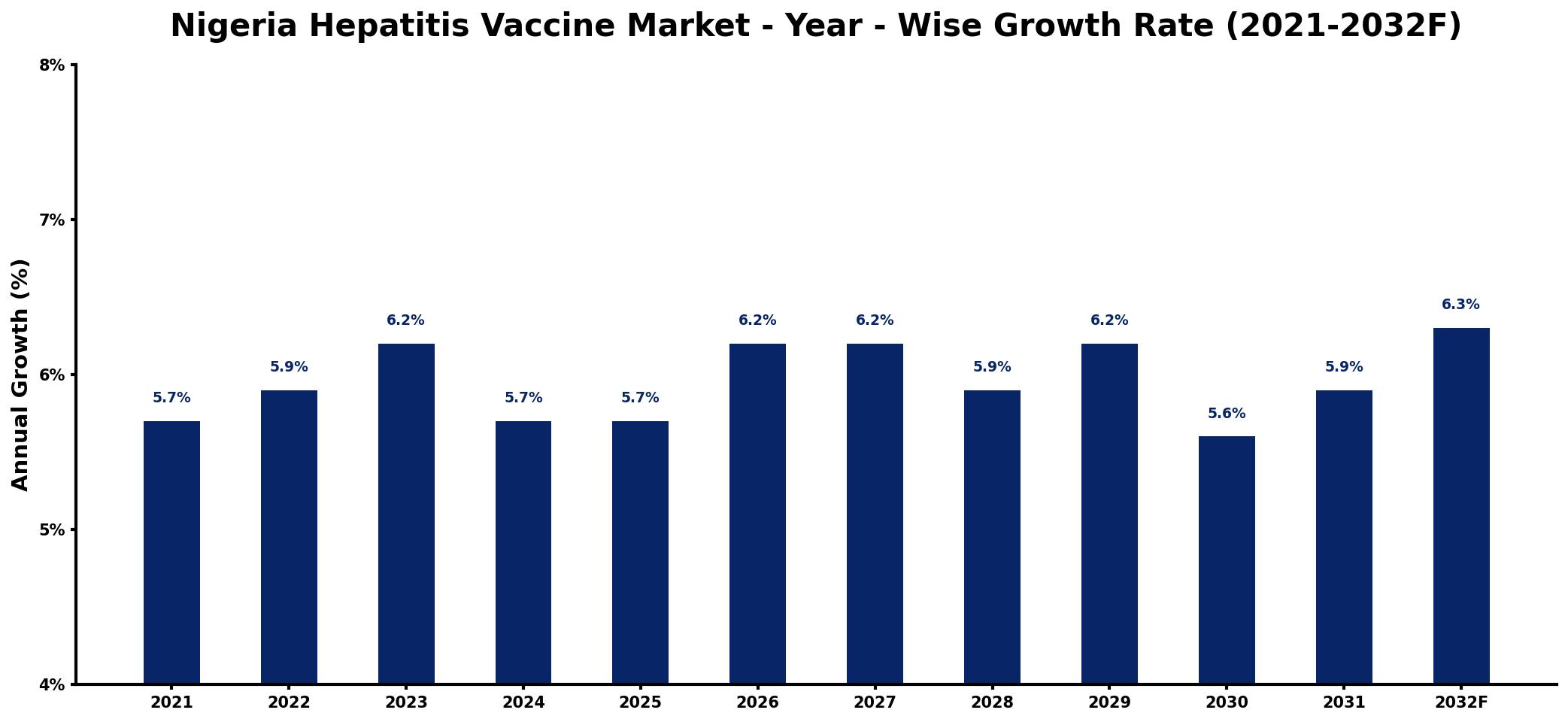
The table below presents the year‑wise growth rates along with the key drivers influencing the market
| Year | Growth Rate | Major Drivers |
| 2021 | 5.7% | increased healthcare spending initiatives |
| 2022 | 5.9% | growing public health awareness |
| 2023 | 6.2% | expansion of immunization programs |
| 2024 | 5.7% | rising demand for preventive measures |
| 2025 | 5.7% | supportive regulatory frameworks established |
| 2026 | 6.2% | advancements in medical technology adoption |
| 2027 | 6.2% | increased partnerships with NGOs |
| 2028 | 5.9% | enhanced community outreach efforts |
| 2029 | 6.2% | growing investments in health infrastructure |
| 2030 | 5.6% | increased overall sector activity |
| 2031 | 5.9% | strengthened disease surveillance systems |
| 2032 | 6.3% | increased funding for health initiatives |
Note: Market size estimations and growth projections presented in this report are based on 6Wresearch's proprietary forecasting methodology, utilizing the latest available industry data, government publications, and primary research inputs.
Nigeria Hepatitis Vaccine Market Synopsis
The landscape of the Nigeria Hepatitis Vaccine Market is shifting, propelled by a surge in public health initiatives aimed at combating hepatitis. The government, alongside healthcare organizations, is undertaking significant efforts to increase vaccination rates, particularly among vulnerable demographics such as children and healthcare workers.
In this environment, key players are adapting to the growing demand for both hepatitis A and B vaccines. With initiatives aimed at improving healthcare infrastructure and access to vaccines, the market is poised for dynamic growth. However, public health campaigns must continue to expand awareness and education to overcome existing barriers.
Nigeria Hepatitis Vaccine Market Key Takeaways
- The Nigeria Hepatitis Vaccine Market is on a growth path, estimated to reach USD 365 Million by 2032.
- Increasing awareness of hepatitis and the importance of vaccination is driving demand.
- Government initiatives are crucial in expanding immunization coverage, particularly in underserved areas.
- Challenges such as affordability and healthcare access must be addressed to enhance market penetration.
- Innovative vaccine technologies and combination vaccines are gaining traction in response to evolving public health needs.
Evaluation of Restraints in Nigeria Hepatitis Vaccine Market
While the Nigeria Hepatitis Vaccine Market exhibits robust growth potential, several significant restraints impede its expansion. A major barrier is the limited awareness surrounding the importance of vaccination against hepatitis, particularly in rural regions where healthcare access is inadequate. The high cost of vaccines can also lead to affordability issues for many individuals, particularly in economically disadvantaged communities. Moreover, the healthcare infrastructure in remote areas lacks the necessary support for effective vaccine distribution, exacerbating public health challenges. Overcoming these restraints necessitates a collaborative approach involving government entities, healthcare providers, and community organizations to improve awareness and enhance healthcare access.
Nigeria Hepatitis Vaccine Market Trends
Current trends in the Nigeria Hepatitis Vaccine Market show a growing emphasis on vaccination programs tailored for high-risk populations, such as healthcare professionals and individuals living with HIV/AIDS. There is also a notable shift towards the adoption of combination vaccines, which not only provide protection against multiple strains of hepatitis but are also more efficient in resource allocation. Furthermore, increasing public health campaigns are fostering greater awareness of hepatitis prevention, which is vital for driving vaccination rates and supporting overall health initiatives.
Nigeria Hepatitis Vaccine Market Opportunities
The market offers numerous investment opportunities, fueled by an increasing demand for hepatitis vaccines and related healthcare services. Investors are encouraged to explore production and distribution avenues, particularly through partnerships with healthcare providers to facilitate vaccination campaigns. Moreover, advancing research and development of innovative vaccine technologies that cater specifically to the Nigerian populace can yield competitive advantages. Collaborating with local health authorities and non-profit organizations can also enhance vaccination outreach, leading to better public health outcomes and positioning investors favorably in the expanding market.
Government Initiatives in the Nigeria Hepatitis Vaccine Market
The Nigerian government has undertaken various initiatives to combat hepatitis, including integrating the hepatitis B vaccine into the routine immunization schedule for infants. Additionally, programs have been developed to enhance public awareness about hepatitis, encouraging testing and treatment. The government has also partnered with international organizations to improve access to vaccines and fortify healthcare infrastructure across the nation, aiming for sustainable immunization coverage and overall enhancement of public health outcomes.
Future Insights of the Nigeria Hepatitis Vaccine Market
Looking ahead to the period from 2026 to 2032, the Nigeria Hepatitis Vaccine Market is expected to flourish as health initiatives intensify. Increasing focus on preventive healthcare and the introduction of new, more effective vaccines will likely contribute to market growth. Public and private sector collaborations, along with investments in innovative vaccine research, will play a critical role in meeting the healthcare needs of the Nigerian population and ensuring widespread immunization against hepatitis.
Nigeria Hepatitis Vaccine Market Latest Developments (2025 - 2026)
Recent developments in the Nigeria Hepatitis Vaccine Market indicate a strengthened focus on enhancing vaccine access and awareness. Health authorities are ramping up vaccination drives, particularly in rural areas where healthcare access has traditionally lagged. Simultaneously, initiatives to combat counterfeit vaccines are being prioritized, ensuring public safety and trust in the vaccination process. Ongoing collaborations with international health organizations continue to provide essential support in boosting vaccination coverage nationwide.
Nigeria Hepatitis Vaccine Market - Key Attractiveness of the Report
- 10 Years of Market Numbers
- Historical Data Starting from 2022 to 2025
- Base Year: 2025
- Forecast Data until 2032
- Key Performance Indicators Impacting the Market
- Major Upcoming Developments and Projects
Key Highlights of the Report:
- Nigeria Hepatitis Vaccine Market Outlook
- Market Size of Nigeria Hepatitis Vaccine Market, 2025
- Forecast of Nigeria Hepatitis Vaccine Market, 2032
- Historical Data and Forecast of Nigeria Hepatitis Vaccine Revenues & Volume for the Period 2022-2032F
- Nigeria Hepatitis Vaccine Market Trend Evolution
- Nigeria Hepatitis Vaccine Market Drivers and Challenges
- Nigeria Hepatitis Vaccine Price Trends
- Nigeria Hepatitis Vaccine Porter's Five Forces
- Nigeria Hepatitis Vaccine Industry Life Cycle
- Historical Data and Forecast of Nigeria Hepatitis Vaccine Market Revenues & Volume By Indication for the Period 2022-2032F
- Historical Data and Forecast of Nigeria Hepatitis Vaccine Market Revenues & Volume By Hepatitis A for the Period 2022-2032F
- Historical Data and Forecast of Nigeria Hepatitis Vaccine Market Revenues & Volume By Hepatitis B for the Period 2022-2032F
- Historical Data and Forecast of Nigeria Hepatitis Vaccine Market Revenues & Volume By Vaccine Type for the Period 2022-2032F
- Historical Data and Forecast of Nigeria Hepatitis Vaccine Market Revenues & Volume By Recombinant Vaccine for the Period 2022-2032F
- Historical Data and Forecast of Nigeria Hepatitis Vaccine Market Revenues & Volume By Inactivated Vaccine for the Period 2022-2032F
- Historical Data and Forecast of Nigeria Hepatitis Vaccine Market Revenues & Volume By Distribution Channel for the Period 2022-2032F
- Historical Data and Forecast of Nigeria Hepatitis Vaccine Market Revenues & Volume By Hospitals for the Period 2022-2032F
- Historical Data and Forecast of Nigeria Hepatitis Vaccine Market Revenues & Volume By Retail Pharmacy for the Period 2022-2032F
- Historical Data and Forecast of Nigeria Hepatitis Vaccine Market Revenues & Volume By Online Pharmacy for the Period 2022-2032F
- Nigeria Hepatitis Vaccine Import Export Trade Statistics
- Market Opportunity Assessment By Indication
- Market Opportunity Assessment By Vaccine Type
- Market Opportunity Assessment By Distribution Channel
- Nigeria Hepatitis Vaccine Top Companies Market Share
- Nigeria Hepatitis Vaccine Competitive Benchmarking By Technical and Operational Parameters
- Nigeria Hepatitis Vaccine Company Profiles
- Nigeria Hepatitis Vaccine Key Strategic Recommendations






































