Nigeria Herbal Cosmetics Market Top 5 Importing Countries and Market Competition (HHI) Analysis
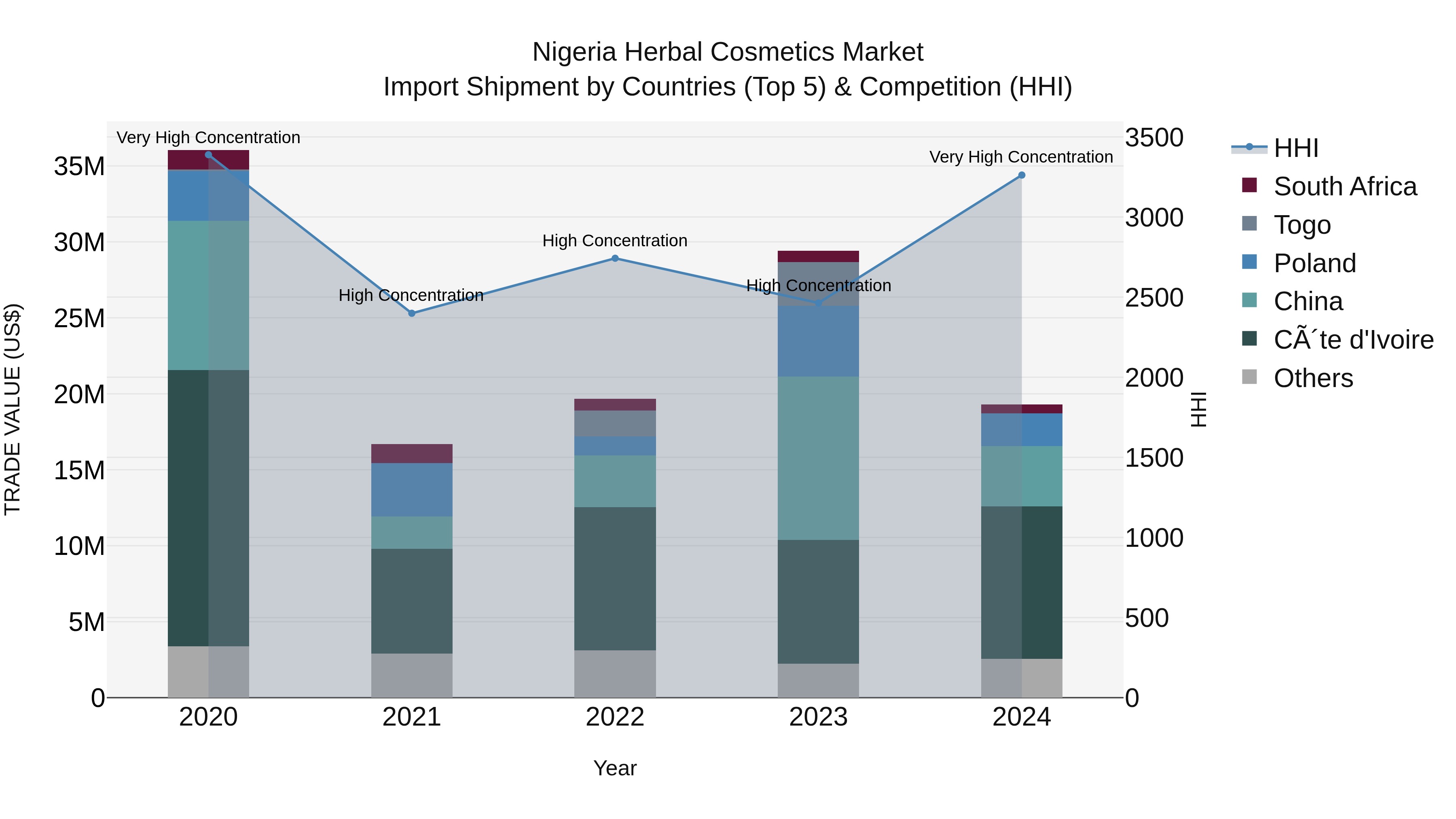
The import shipments of herbal cosmetics to Nigeria in 2024 saw a significant increase in concentration, with Côte d`Ivoire, China, Poland, South Africa, and Indonesia being the top exporting countries. The high Herfindahl-Hirschman Index (HHI) in 2023 intensified to very high concentration in 2024. However, the compound annual growth rate (CAGR) from 2020 to 2024 was notably negative at -14.44%, with a steep decline in the growth rate from 2023 to 2024 at -34.37%. This indicates a challenging market environment for herbal cosmetics imports in Nigeria.
Nigeria Herbal Cosmetics Market Synopsis
The Nigeria herbal cosmetics market is experiencing significant growth due to increasing consumer preference for natural and organic products. The demand for herbal cosmetics is driven by the growing awareness of the harmful effects of synthetic chemicals in conventional beauty products. Local Nigerian brands are incorporating traditional herbal ingredients such as shea butter, aloe vera, and coconut oil into their cosmetics to cater to the rising demand for natural products. Moreover, the market is witnessing a surge in online sales channels, making herbal cosmetics more accessible to a wider audience. Key players in the Nigeria herbal cosmetics market are focusing on product innovation, packaging, and marketing strategies to differentiate themselves in this competitive landscape, offering a diverse range of skincare, haircare, and personal care products to meet the diverse needs of consumers.
Nigeria Herbal Cosmetics Market Trends
Currently, the Nigeria Herbal Cosmetics Market is experiencing a significant growth trend driven by increasing consumer awareness and preference for natural and organic beauty products. Consumers are becoming more conscious about the ingredients in their skincare and haircare products, leading to a rising demand for herbal cosmetics. This trend is further fueled by the growing concern for sustainable and eco-friendly products. Key players in the market are expanding their product offerings to include a wide range of herbal cosmetics, including skincare, haircare, and personal care products. Additionally, the market is witnessing a surge in the popularity of traditional herbal remedies and ingredients, such as shea butter, aloe vera, and moringa oil, being incorporated into beauty products. Overall, the Nigeria Herbal Cosmetics Market is poised for continued growth as consumers seek natural alternatives in their beauty routines.
Nigeria Herbal Cosmetics Market Challenges
In the Nigeria Herbal Cosmetics Market, some challenges include lack of standardized regulations and quality control measures, limited consumer awareness and trust in herbal products, competition from international brands with established reputations, and difficulties in sourcing high-quality herbal ingredients locally. Additionally, distribution and retail infrastructure issues, such as poor transport networks and limited access to rural areas, hinder market penetration. The lack of research and development investment in herbal cosmetics also limits product innovation and efficacy, leading to a perception of inferiority compared to mainstream beauty products. Overcoming these challenges will require collaboration between industry stakeholders, government bodies, and consumer education initiatives to build trust, improve quality standards, and promote the benefits of herbal cosmetics in the Nigerian market.
Nigeria Herbal Cosmetics Market Investment Opportunities
The Nigeria Herbal Cosmetics Market presents a promising investment opportunity due to the increasing consumer preference for natural and organic beauty products. With a growing awareness of the potential harmful effects of chemicals in traditional cosmetics, there is a rising demand for herbal cosmetics in Nigeria. Investing in this market could involve launching new herbal cosmetic brands, expanding existing product lines to include herbal options, or partnering with local herbal beauty artisans to create unique offerings. Additionally, investing in research and development to innovate new herbal cosmetic formulations tailored to the Nigerian market can help capture the attention of eco-conscious consumers. Overall, the Nigeria Herbal Cosmetics Market offers a lucrative space for investors looking to capitalize on the shift towards natural beauty products in the region.
Jordan Agar Market Government Policies
The Nigerian government has implemented policies to regulate the herbal cosmetics market, aiming to ensure the safety, quality, and efficacy of products. The National Agency for Food and Drug Administration and Control (NAFDAC) oversees the registration, labeling, and marketing of herbal cosmetics, requiring manufacturers to meet specific standards and guidelines. Additionally, the government encourages the use of locally sourced ingredients and supports research and development in the herbal cosmetics sector through funding and incentives. These policies aim to promote consumer confidence, protect public health, and stimulate growth in the Nigerian herbal cosmetics industry by creating a conducive regulatory environment for businesses to thrive.
Nigeria Herbal Cosmetics Market Future Outlook
The Nigeria Herbal Cosmetics Market is poised for significant growth in the coming years as consumers are increasingly seeking natural and organic beauty products. With a rising awareness of the benefits of herbal ingredients and a growing demand for sustainable and chemical-free alternatives, the market is expected to expand rapidly. Factors such as the influence of social media, a shift towards clean beauty trends, and a preference for products that cater to specific skin and hair concerns will drive the market forward. Additionally, the government`s initiatives to promote local manufacturing and the rise of indigenous beauty brands are likely to further boost the growth of the herbal cosmetics sector in Nigeria. Overall, the future outlook for the Nigeria Herbal Cosmetics Market is promising, with ample opportunities for innovation and market expansion.
Key Highlights of the Report:
- Nigeria Herbal Cosmetics Market Outlook
- Market Size of Nigeria Herbal Cosmetics Market, 2024
- Forecast of Nigeria Herbal Cosmetics Market, 2031
- Historical Data and Forecast of Nigeria Herbal Cosmetics Revenues & Volume for the Period 2021 - 2031
- Nigeria Herbal Cosmetics Market Trend Evolution
- Nigeria Herbal Cosmetics Market Drivers and Challenges
- Nigeria Herbal Cosmetics Price Trends
- Nigeria Herbal Cosmetics Porter's Five Forces
- Nigeria Herbal Cosmetics Industry Life Cycle
- Historical Data and Forecast of Nigeria Herbal Cosmetics Market Revenues & Volume By Physical State for the Period 2021 - 2031
- Historical Data and Forecast of Nigeria Herbal Cosmetics Market Revenues & Volume By Solid for the Period 2021 - 2031
- Historical Data and Forecast of Nigeria Herbal Cosmetics Market Revenues & Volume By Semi-solid for the Period 2021 - 2031
- Historical Data and Forecast of Nigeria Herbal Cosmetics Market Revenues & Volume By Liquid for the Period 2021 - 2031
- Historical Data and Forecast of Nigeria Herbal Cosmetics Market Revenues & Volume By Product for the Period 2021 - 2031
- Historical Data and Forecast of Nigeria Herbal Cosmetics Market Revenues & Volume By Skin Care Product for the Period 2021 - 2031
- Historical Data and Forecast of Nigeria Herbal Cosmetics Market Revenues & Volume By Hair Care Product for the Period 2021 - 2031
- Historical Data and Forecast of Nigeria Herbal Cosmetics Market Revenues & Volume By Baby Care Product for the Period 2021 - 2031
- Historical Data and Forecast of Nigeria Herbal Cosmetics Market Revenues & Volume By Oral Care Product for the Period 2021 - 2031
- Historical Data and Forecast of Nigeria Herbal Cosmetics Market Revenues & Volume By Make-up Product for the Period 2021 - 2031
- Historical Data and Forecast of Nigeria Herbal Cosmetics Market Revenues & Volume By Distribution Channel for the Period 2021 - 2031
- Historical Data and Forecast of Nigeria Herbal Cosmetics Market Revenues & Volume By Supermarket for the Period 2021 - 2031
- Historical Data and Forecast of Nigeria Herbal Cosmetics Market Revenues & Volume By Pharmacy for the Period 2021 - 2031
- Historical Data and Forecast of Nigeria Herbal Cosmetics Market Revenues & Volume By Departmental Store for the Period 2021 - 2031
- Historical Data and Forecast of Nigeria Herbal Cosmetics Market Revenues & Volume By Beauty Spa/Salon for the Period 2021 - 2031
- Historical Data and Forecast of Nigeria Herbal Cosmetics Market Revenues & Volume By Internet Retailing for the Period 2021 - 2031
- Historical Data and Forecast of Nigeria Herbal Cosmetics Market Revenues & Volume By Specialty Store for the Period 2021 - 2031
- Nigeria Herbal Cosmetics Import Export Trade Statistics
- Market Opportunity Assessment By Physical State
- Market Opportunity Assessment By Product
- Market Opportunity Assessment By Distribution Channel
- Nigeria Herbal Cosmetics Top Companies Market Share
- Nigeria Herbal Cosmetics Competitive Benchmarking By Technical and Operational Parameters
- Nigeria Herbal Cosmetics Company Profiles
- Nigeria Herbal Cosmetics Key Strategic Recommendations






































