Nigeria Microscopy Market Top 5 Importing Countries and Market Competition (HHI) Analysis
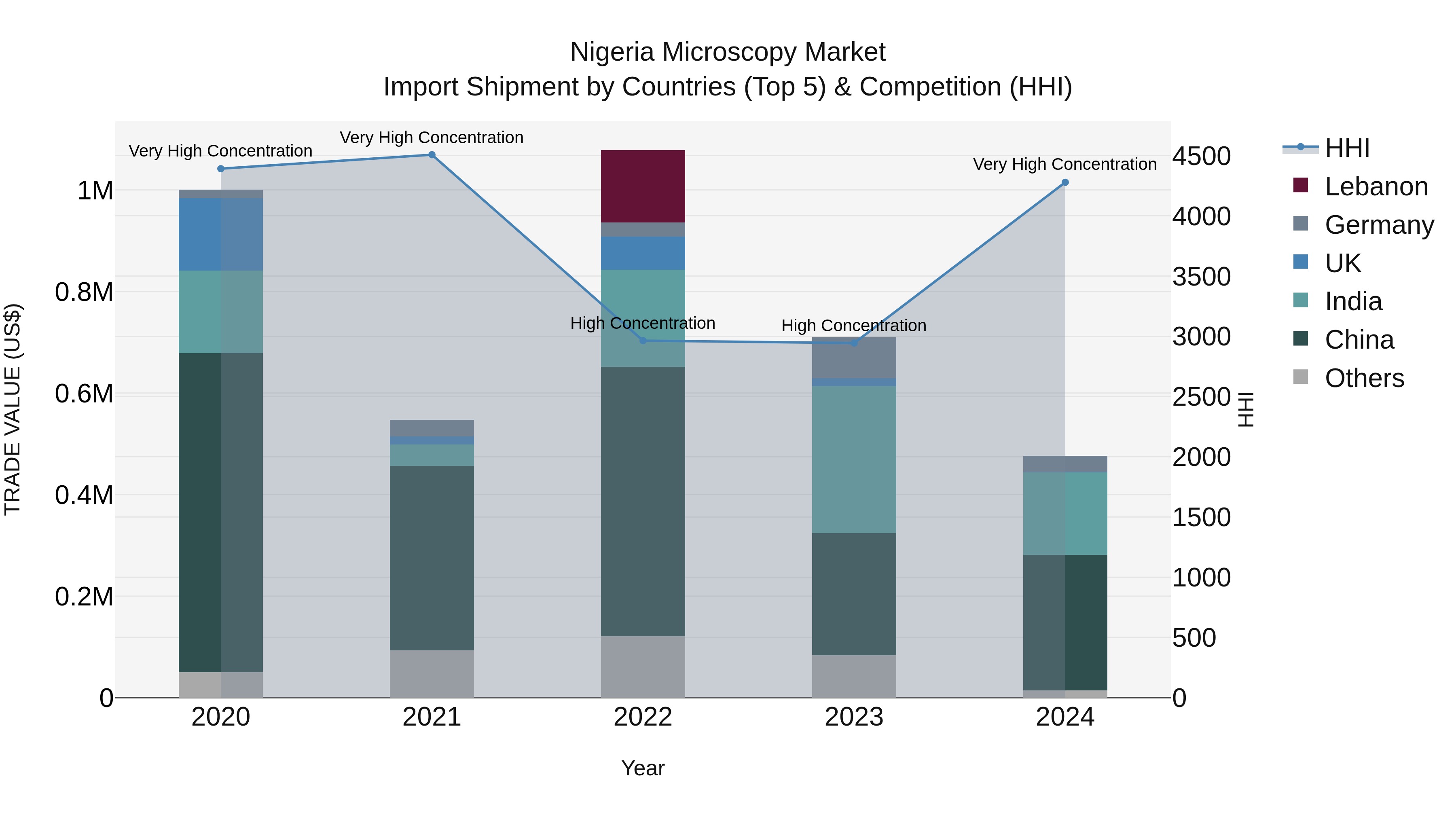
The microscopy import market in Nigeria saw a significant increase in concentration in 2024, with top exporters including China, India, Germany, USA, and South Africa. The high Herfindahl-Hirschman Index (HHI) indicates a competitive landscape dominated by a few major players. Despite a declining Compound Annual Growth Rate (CAGR) of -16.91% from 2020 to 2024, the growth rate plummeted to -32.85% in 2024. This suggests a challenging market environment with intensified competition and potential shifts in trade dynamics impacting the importation of microscopy equipment into Nigeria.
Nigeria Microscopy Market Overview
The Nigeria Microscopy Market involves the use of microscopes for magnifying small objects and structures. This market serves research, education, healthcare, and industrial applications, providing essential tools for detailed analysis and observation.
Drivers of the market
The microscopy market in Nigeria is witnessing growth driven by the increasing demand for advanced diagnostic tools, growing research activities in life sciences and material sciences, and rising investments in healthcare and educational infrastructure. Microscopy techniques, including optical, electron, and scanning probe microscopy, are essential for detailed visualization and analysis of biological and material samples. With Nigeria expanding healthcare sector, focus on scientific research, and growth in academic institutions, there is a rising need for state-of-the-art microscopy equipment to enhance research capabilities, diagnostic accuracy, and educational outcomes. Moreover, advancements in imaging technologies, digital integration, and analytical software are driving innovation and expanding the applications of microscopy in various fields, further stimulating market growth.
Challenges of the market
In Nigeria, the microscopy market faces challenges such as limited access to advanced imaging equipment, shortage of skilled technicians, and budget constraints. These challenges hinder scientific research, medical diagnostics, and industrial quality control efforts in Nigeria. Addressing these challenges requires investments in research infrastructure, skills development, and technology transfer to enhance microscopy capabilities and support various applications in the country.
Government Policy of the market
Government policies in Nigeria prioritize investments in scientific research and technological innovation, driving initiatives to support the microscopy market. Funding for research institutions and academic laboratories enables the acquisition of advanced microscopy equipment and facilities. Additionally, regulatory frameworks establish standards and guidelines for microscopy techniques and applications, ensuring quality assurance and reliability in research and diagnostic services.
Key Highlights of the Report:
- Nigeria Microscopy Market Outlook
- Market Size of Nigeria Microscopy Market, 2024
- Forecast of Nigeria Microscopy Market, 2031
- Historical Data and Forecast of Nigeria Microscopy Revenues & Volume for the Period 2021-2031
- Nigeria Microscopy Market Trend Evolution
- Nigeria Microscopy Market Drivers and Challenges
- Nigeria Microscopy Price Trends
- Nigeria Microscopy Porter's Five Forces
- Nigeria Microscopy Industry Life Cycle
- Historical Data and Forecast of Nigeria Microscopy Market Revenues & Volume By Product for the Period 2021-2031
- Historical Data and Forecast of Nigeria Microscopy Market Revenues & Volume By Microscopes for the Period 2021-2031
- Historical Data and Forecast of Nigeria Microscopy Market Revenues & Volume By Software for the Period 2021-2031
- Historical Data and Forecast of Nigeria Microscopy Market Revenues & Volume By Accessories for the Period 2021-2031
- Historical Data and Forecast of Nigeria Microscopy Market Revenues & Volume By Type for the Period 2021-2031
- Historical Data and Forecast of Nigeria Microscopy Market Revenues & Volume By Optical Microscopes for the Period 2021-2031
- Historical Data and Forecast of Nigeria Microscopy Market Revenues & Volume By Electron Microscopes for the Period 2021-2031
- Historical Data and Forecast of Nigeria Microscopy Market Revenues & Volume By Scanning Probe Microscopes for the Period 2021-2031
- Historical Data and Forecast of Nigeria Microscopy Market Revenues & Volume By Other Microscopes for the Period 2021-2031
- Historical Data and Forecast of Nigeria Microscopy Market Revenues & Volume By Applications for the Period 2021-2031
- Historical Data and Forecast of Nigeria Microscopy Market Revenues & Volume By Semiconductors for the Period 2021-2031
- Historical Data and Forecast of Nigeria Microscopy Market Revenues & Volume By Life Sciences for the Period 2021-2031
- Historical Data and Forecast of Nigeria Microscopy Market Revenues & Volume By Material Sciences for the Period 2021-2031
- Historical Data and Forecast of Nigeria Microscopy Market Revenues & Volume By Nanotechnology for the Period 2021-2031
- Historical Data and Forecast of Nigeria Microscopy Market Revenues & Volume By Other Applications for the Period 2021-2031
- Historical Data and Forecast of Nigeria Microscopy Market Revenues & Volume By End-users for the Period 2021-2031
- Historical Data and Forecast of Nigeria Microscopy Market Revenues & Volume By Industries for the Period 2021-2031
- Historical Data and Forecast of Nigeria Microscopy Market Revenues & Volume By Research Institutes for the Period 2021-2031
- Historical Data and Forecast of Nigeria Microscopy Market Revenues & Volume By Other end-users for the Period 2021-2031
- Nigeria Microscopy Import Export Trade Statistics
- Market Opportunity Assessment By Product
- Market Opportunity Assessment By Type
- Market Opportunity Assessment By Applications
- Market Opportunity Assessment By End-users
- Nigeria Microscopy Top Companies Market Share
- Nigeria Microscopy Competitive Benchmarking By Technical and Operational Parameters
- Nigeria Microscopy Company Profiles
- Nigeria Microscopy Key Strategic Recommendations






































