Nigeria Mobile Application Development Platform Market Size & Growth Rate (2026-2032)
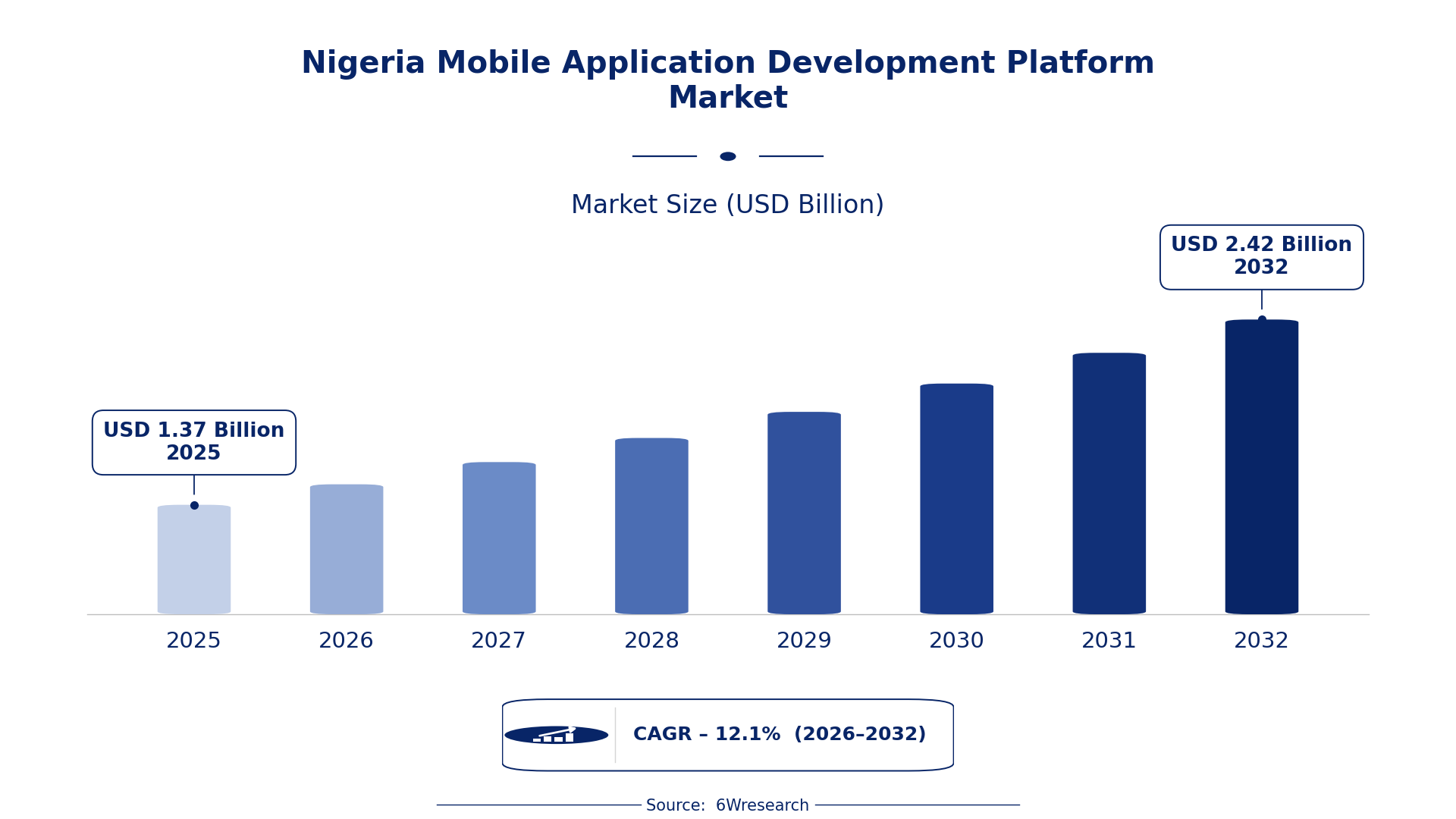
The Nigeria Mobile Application Development Platform Market was estimated at USD 1372 Million in 2025 and is projected to reach USD 2417 Million by 2032, growing at a CAGR of 12.1% from 2026 to 2032.
Nigeria Mobile Application Development Platform Market Synopsis
The Nigeria Mobile Application Development Platform Market has witnessed a surge in interest and investment as businesses across various sectors increasingly embrace mobile solutions. This momentum, however, is just the beginning, as the market is on the verge of substantial expansion driven by technological advancements and changing consumer preferences.
With the rapid proliferation of mobile applications in sectors such as e-commerce, banking, and healthcare, the demand for effective development platforms is set to escalate. As Nigerian businesses prioritize mobile-first strategies, the focus will likely shift toward platforms that offer not only efficiency but also innovative features that enhance user engagement.
Nigeria Mobile Application Development Platform Market Year-wise Growth Rate and Key Drivers
This graph illustrates the annual growth rates of the Nigeria Mobile Application Development Platform Market from 2021 to 2032, highlighting a steady upward trajectory and projected expansion over the forecast period.
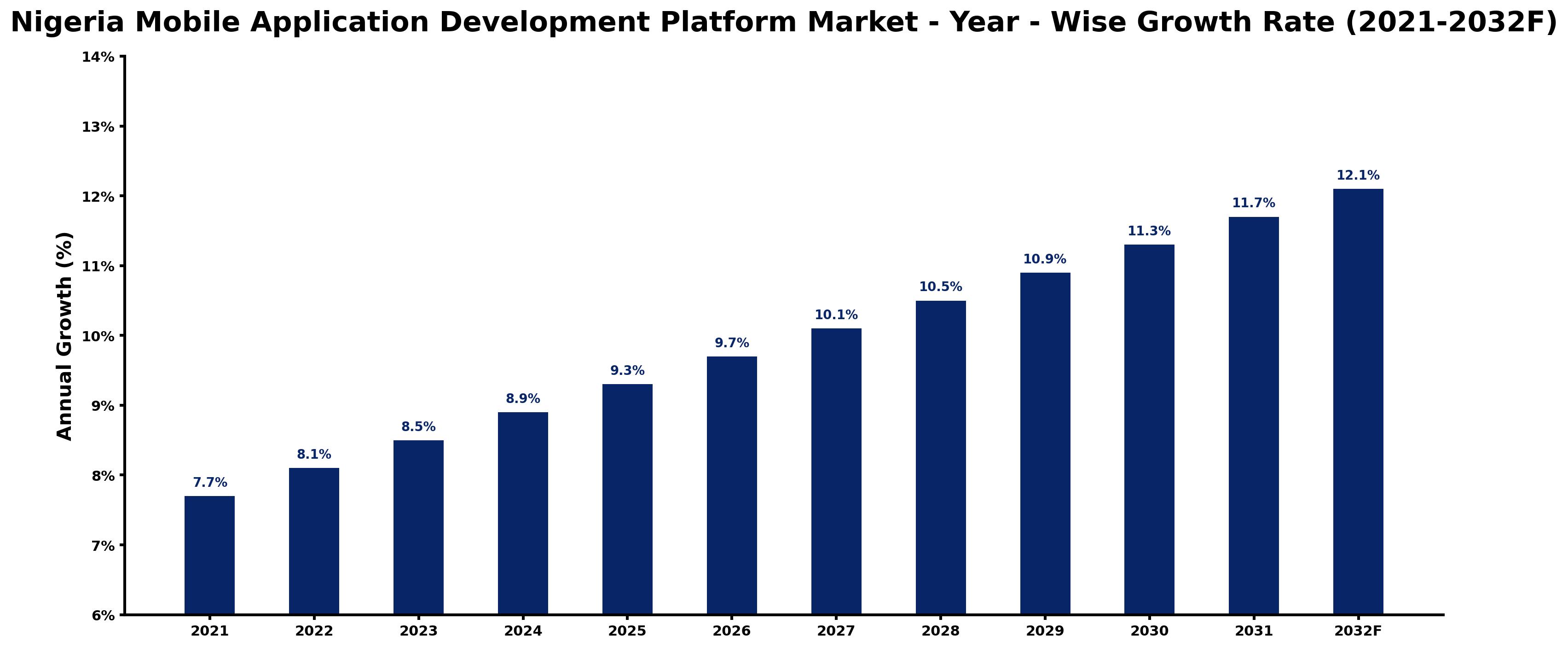
The table below presents the year‑wise growth rates along with the key drivers influencing the market
| Year | Growth Rate | Major Drivers |
| 2021 | 7.7% | NITDA's digital economy initiative boosts app development. |
| 2022 | 8.1% | Surge in fintech startups driving mobile app needs. |
| 2023 | 8.5% | Government policies favoring tech entrepreneurship encourage investment. |
| 2024 | 8.9% | Increased foreign investment in Nigeria’s tech sector. |
| 2025 | 9.3% | Growing adoption of mobile payments enhances application utility. |
| 2026 | 9.7% | Youth population growth fuels demand for mobile solutions. |
| 2027 | 10.1% | Rising e-learning platforms drive educational app development. |
| 2028 | 10.5% | Local incubators launching more mobile tech startups. |
| 2029 | 10.9% | Public-private partnerships enhancing technological infrastructure. |
| 2030 | 11.3% | Integration of artificial intelligence in local app development. |
| 2031 | 11.7% | Increased mobile data affordability with new service plans. |
| 2032 | 12.1% | Boost in remote work driving business app demand. |
Note: Market size estimations and growth projections presented in this report are based on 6Wresearch's proprietary forecasting methodology, utilizing the latest available industry data, government publications, and primary research inputs.
Nigeria Mobile Application Development Platform Market Key Takeaways
Below are some of the specific key takeaways from the market, including:
- Rapid growth driven by increasing mobile app adoption across multiple industries.
- The rise of cloud computing and mobile-first strategies is shaping development needs.
- Low-code and no-code platforms are democratizing app development opportunities.
- Integration with analytics and third-party services is becoming essential for user engagement.
- Investment in technical training and standardization is critical for sustainable growth.
Evaluation of Restraints in Nigeria Mobile Application Development Platform Market
Despite its growth potential, the Nigeria Mobile Application Development Platform Market faces notable challenges. Limited technical expertise among developers constrains innovation and slows down project timelines. High development costs further deter many businesses from fully capitalizing on mobile solutions. Additionally, platform fragmentation complicates the development process, leading to inconsistent user experiences and increased maintenance efforts. Addressing these issues will require strategic investments in education and the establishment of standardized practices within the industry.
Nigeria Mobile Application Development Platform Market Trends
Several trends are currently shaping the Nigeria Mobile Application Development Platform Market. The shift toward low-code and no-code development environments is empowering non-technical users to create applications, which is particularly appealing for small businesses and startups. Alongside this, the integration of artificial intelligence and machine learning into development platforms is streamlining processes and enhancing app functionality. on top of that, the emphasis on user experience is leading to increased investments in UX design capabilities, ensuring that applications meet consumer expectations.
Nigeria Mobile Application Development Platform Market Opportunities
The growth trajectory of the Nigeria Mobile Application Development Platform Market presents numerous opportunities for both local and international players. One key area is the financial services sector, where mobile applications can enhance customer engagement and streamline transactions. Additionally, the healthcare industry is ripe for innovation through mobile solutions that improve patient care and access to medical services. Companies that focus on providing tailored solutions, especially in underserved markets, stand to gain a competitive advantage.
Government Initiatives in the Nigeria Mobile Application Development Platform Market
Government policies in Nigeria are increasingly focused on fostering innovation within the mobile application development sector. By supporting digital literacy and entrepreneurship, the government is laying the groundwork for a more vibrant mobile app ecosystem. These initiatives are crucial for ensuring that the market can meet the growing demand for mobile solutions.
- A national digital literacy program launched in early 2025 aims to equip developers with necessary skills and knowledge.
- Current initiatives include technology parks that provide resources and support for startups in the mobile app space.
- A regulatory framework introduced in 2025 focuses on protecting intellectual property rights for app developers.
- Upcoming public-private partnerships are expected to enhance access to mobile technology by 2028.
- Startup incubation programs are currently underway to accelerate innovation and commercialization in the mobile app market.
Future Insights of the Nigeria Mobile Application Development Platform Market
Looking ahead to 2026-2032, the Nigeria Mobile Application Development Platform Market is set for substantial growth driven by technological advancements and increased demand for mobile solutions. As businesses continue to prioritize digital transformation, platforms that offer scalability, integration capabilities, and user-centric features will thrive. The focus will shift towards enhancing customer engagement and leveraging analytics for informed decision-making, creating a dynamic environment for developers and businesses alike.
Nigeria Mobile Application Development Platform Market Latest Developments
Recent developments in the Nigeria Mobile Application Development Platform Market reflect a growing commitment to innovation and efficiency. Over the past year, various initiatives have emerged that highlight the sector's potential and the increasing interest from businesses seeking to enhance their mobile offerings.
- A major technology vendor launched a new low-code development platform in Q2 2025, allowing businesses to accelerate their app development timelines.
- Ongoing collaboration between telecom operators and software developers aims to improve mobile network infrastructure, enhancing app performance.
- New partnerships were formed in early 2025 between local startups and international firms, fostering knowledge transfer and innovation.
- Upcoming initiatives include a rollout planned for late 2026 focusing on integrating AI capabilities into existing mobile application platforms.
- Several regional hackathons hosted throughout 2025 have encouraged innovation and showcased local talent in app development.
Nigeria Mobile Application Development Platform Market - Key Attractiveness of the Report
- 10 Years of Market Numbers
- Historical Data Starting from 2022 to 2025
- Base Year: 2025
- Forecast Data until 2032
- Key Performance Indicators Impacting the Market
- Major Upcoming Developments and Projects
Key Highlights of the Report:
- Nigeria Mobile Application Development Platform Market Outlook
- Market Size of Nigeria Mobile Application Development Platform Market, 2025
- Forecast of Nigeria Mobile Application Development Platform Market, 2032
- Historical Data and Forecast of Nigeria Mobile Application Development Platform Revenues & Volume for the Period 2022-2032F
- Nigeria Mobile Application Development Platform Market Trend Evolution
- Nigeria Mobile Application Development Platform Market Drivers and Challenges
- Nigeria Mobile Application Development Platform Price Trends
- Nigeria Mobile Application Development Platform Porter's Five Forces
- Nigeria Mobile Application Development Platform Industry Life Cycle
- Historical Data and Forecast of Nigeria Mobile Application Development Platform Market Revenues & Volume By Deployment for the Period 2022-2032F
- Historical Data and Forecast of Nigeria Mobile Application Development Platform Market Revenues & Volume By Cloud for the Period 2022-2032F
- Historical Data and Forecast of Nigeria Mobile Application Development Platform Market Revenues & Volume By On-Premise for the Period 2022-2032F
- Historical Data and Forecast of Nigeria Mobile Application Development Platform Market Revenues & Volume By End User Type for the Period 2022-2032F
- Historical Data and Forecast of Nigeria Mobile Application Development Platform Market Revenues & Volume By SMBs for the Period 2022-2032F
- Historical Data and Forecast of Nigeria Mobile Application Development Platform Market Revenues & Volume By Large Enterprise for the Period 2022-2032F
- Historical Data and Forecast of Nigeria Mobile Application Development Platform Market Revenues & Volume By Verticals for the Period 2022-2032F
- Historical Data and Forecast of Nigeria Mobile Application Development Platform Market Revenues & Volume By Banking, Financial Services and Insurance (BFSI) for the Period 2022-2032F
- Historical Data and Forecast of Nigeria Mobile Application Development Platform Market Revenues & Volume By Retail for the Period 2022-2032F
- Historical Data and Forecast of Nigeria Mobile Application Development Platform Market Revenues & Volume By Government for the Period 2022-2032F
- Historical Data and Forecast of Nigeria Mobile Application Development Platform Market Revenues & Volume By Healthcare for the Period 2022-2032F
- Historical Data and Forecast of Nigeria Mobile Application Development Platform Market Revenues & Volume By Manufacturing for the Period 2022-2032F
- Historical Data and Forecast of Nigeria Mobile Application Development Platform Market Revenues & Volume By Telecom and IT for the Period 2022-2032F
- Historical Data and Forecast of Nigeria Mobile Application Development Platform Market Revenues & Volume By Utilities for the Period 2022-2032F
- Historical Data and Forecast of Nigeria Mobile Application Development Platform Market Revenues & Volume By Travel and Hospitality for the Period 2022-2032F
- Nigeria Mobile Application Development Platform Import Export Trade Statistics
- Market Opportunity Assessment By Deployment
- Market Opportunity Assessment By End User Type
- Market Opportunity Assessment By Verticals
- Nigeria Mobile Application Development Platform Top Companies Market Share
- Nigeria Mobile Application Development Platform Competitive Benchmarking By Technical and Operational Parameters
- Nigeria Mobile Application Development Platform Company Profiles
- Nigeria Mobile Application Development Platform Key Strategic Recommendations






































