Nigeria Network as a Service Market Size & Growth Rate (2026-2032)
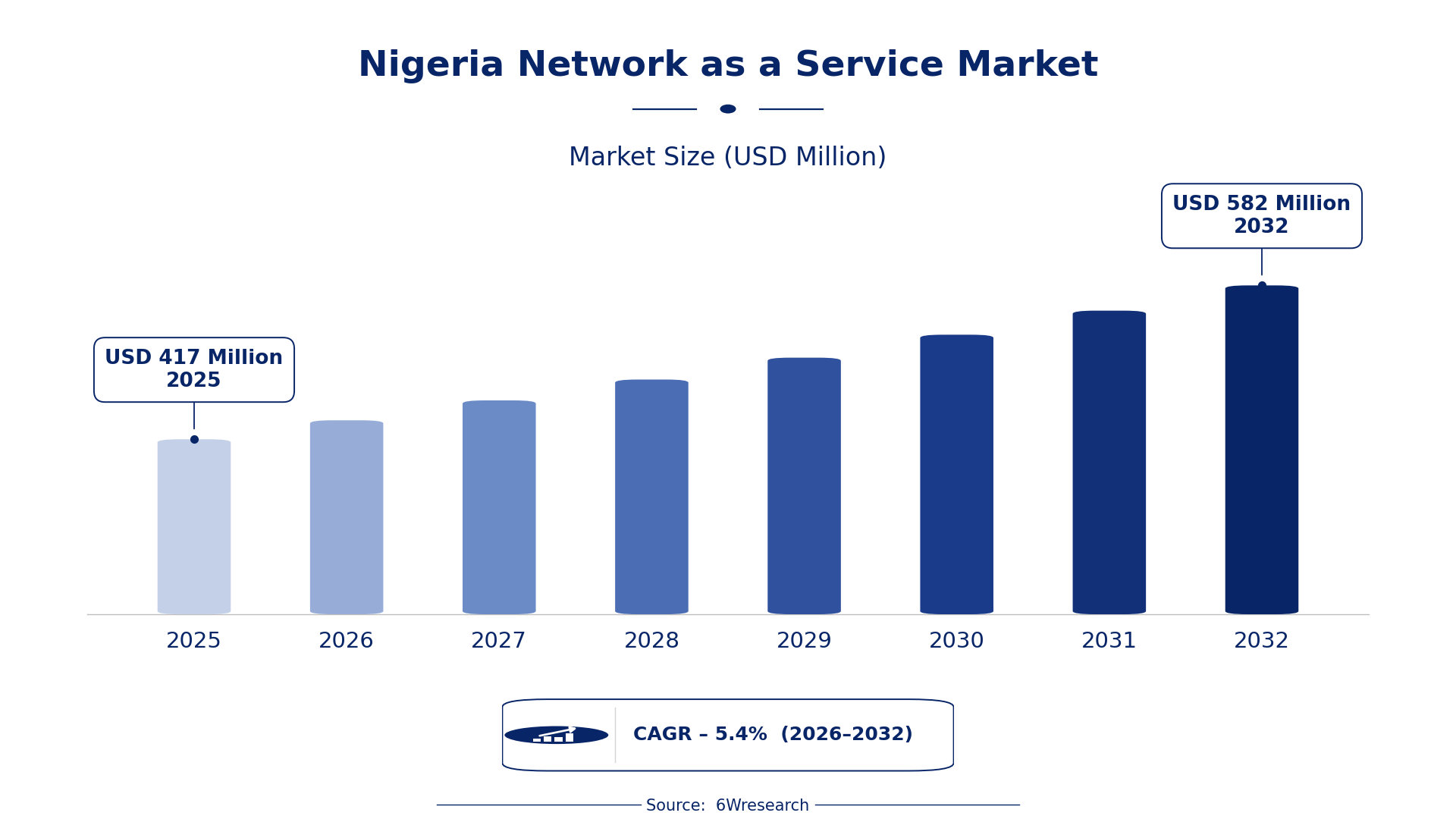
The Nigeria Network as a Service Market was estimated at USD 417 Million in 2025 and is projected to reach USD 582 Million by 2032, growing at a CAGR of 5.4% from 2026 to 2032.
Nigeria Network as a Service Market Synopsis
The demand for network as a service (NaaS) in Nigeria is surging as organizations seek agile and cost-effective solutions to meet their connectivity needs. With the rise of remote working and digital transformation efforts, businesses are increasingly turning to NaaS for its flexibility and scalability.
This market is influenced by a growing digital economy, where high-speed internet and reliable network services are critical. Companies are eager to embrace cloud-based networking solutions to streamline operations and drive innovation, marking a pivotal shift in how they manage their network infrastructure.
Nigeria Network as a Service Market Year-wise Growth Rate and Key Drivers
This graph illustrates the annual growth rates of the Nigeria Network as a Service Market from 2021 to 2032, highlighting a steady upward trajectory and projected expansion over the forecast period.
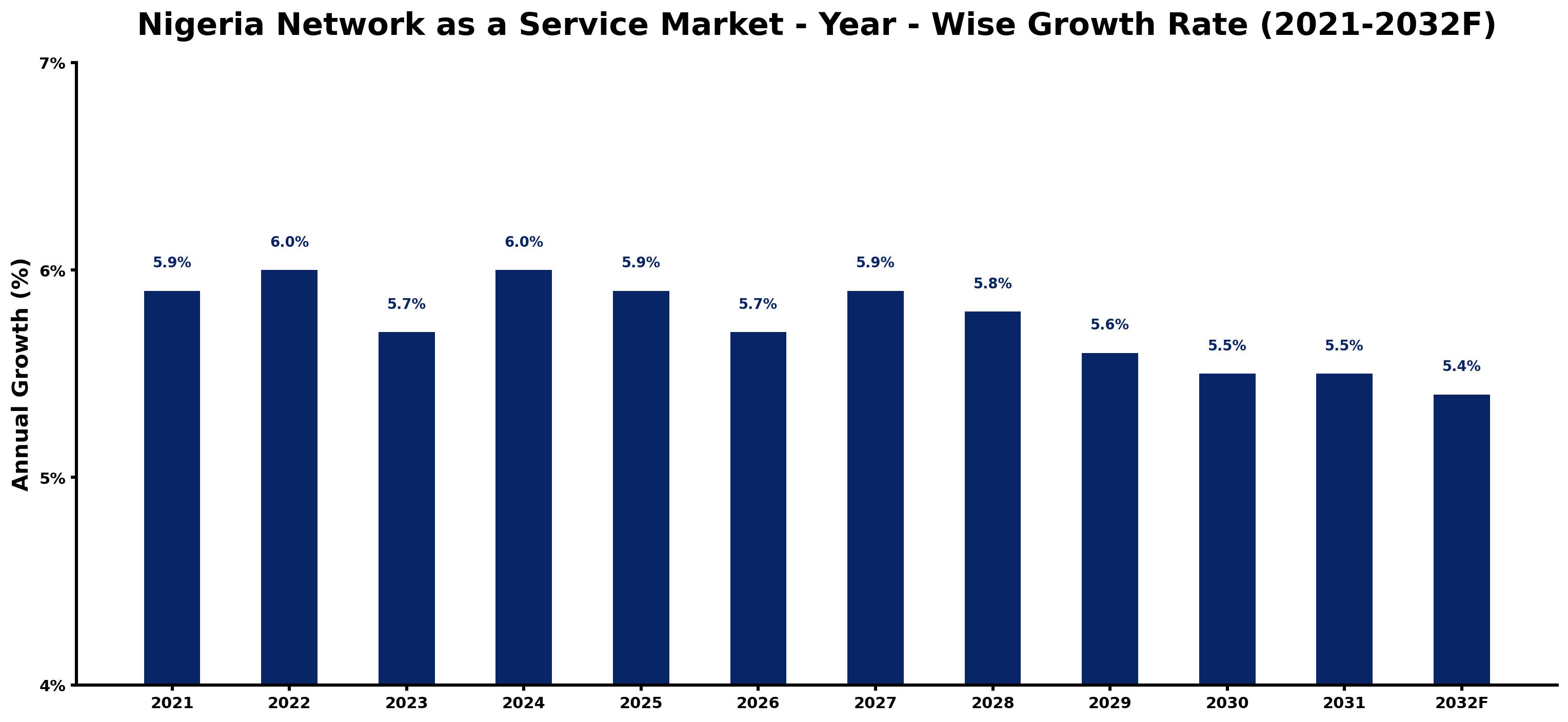
The table below presents the year‑wise growth rates along with the key drivers influencing the market
| Year | Growth Rate | Major Drivers |
| 2021 | 5.9% | Increased investment in broadband infrastructure by government agencies |
| 2022 | 6.0% | Growth in IoT applications driving network demand in Nigeria |
| 2023 | 5.7% | Evolving cybersecurity regulations boosting secure network services |
| 2024 | 6.0% | Rural connectivity initiatives enhancing market access nationwide |
| 2025 | 5.9% | Digital transformation programs encouraging enterprise network upgrades |
| 2026 | 5.7% | Government partnerships with tech firms fostering innovation in services |
| 2027 | 5.9% | Surge in remote work driving demand for network flexibility |
| 2028 | 5.8% | Adoption of smart agriculture technologies increasing networking needs |
| 2029 | 5.6% | Local startup ecosystem thriving, requiring enhanced network solutions |
| 2030 | 5.5% | Enhanced online education platforms demanding robust network infrastructure |
| 2031 | 5.5% | Rising fintech innovations necessitating reliable network access |
| 2032 | 5.4% | Government's push for increased digital economy participation |
Note: Market size estimations and growth projections presented in this report are based on 6Wresearch's proprietary forecasting methodology, utilizing the latest available industry data, government publications, and primary research inputs.
Nigeria Network as a Service Market Key Takeaways
Below are some of the specific key takeaways from the market, including:
- The increasing adoption of cloud-based services is a primary driver for the NaaS market in Nigeria.
- Organizations are motivated to reduce capital expenditures and improve network agility through NaaS offerings.
- Concerns around service quality and vendor lock-in remain critical barriers to widespread adoption.
- Government policies are actively promoting digital transformation and enhancing connectivity across sectors.
- The rise of remote work is amplifying the demand for reliable and secure network services.
Evaluation of Restraints in Nigeria Network as a Service Market
While the NaaS market is gaining momentum, several restraints hinder its full potential. Concerns over service quality are top of mind for many organizations considering NaaS solutions. Questions regarding uptime, data privacy, and performance can create hesitation in decision-making processes. Additionally, the fear of vendor lock-in poses a challenge, as organizations worry about being tied to specific providers without the flexibility to switch or adapt as their needs change.
The lack of standardized interoperability among different NaaS providers can also create barriers. Companies often need to assess compatibility issues, which complicates the decision to transition to a NaaS model. These factors contribute to a cautious approach toward adopting NaaS, despite its clear advantages.
Nigeria Network as a Service Market Trends
Key trends shaping the Nigeria NaaS market include an accelerated shift to cloud solutions, driven by the need for rapid scalability and cost efficiency. Businesses are leveraging NaaS to enhance their digital capabilities, with an emphasis on improving user experiences.
on top of that, the integration of artificial intelligence and machine learning technologies into NaaS offerings is emerging. These technologies promise improved network management, real-time analytics, and enhanced security, making NaaS even more appealing for organizations navigating complex IT environments.
Nigeria Network as a Service Market Opportunities
The NaaS market in Nigeria presents numerous opportunities for growth. As businesses increasingly adopt digital transformation strategies, providers can capitalize on the demand for tailored NaaS solutions that meet specific industry needs. Industries such as healthcare, education, and finance are particularly ripe for NaaS adoption, as they seek enhanced connectivity and security.
on top of that, partnerships between public and private sectors to enhance digital infrastructure can spur innovation in NaaS offerings. These collaborations can facilitate the development of new services that not only cater to existing market needs but also anticipate future demands.
Government Initiatives in the Nigeria Network as a Service Market
The Nigerian government recognizes the essential role of cloud computing and subscription-based services in fostering economic growth. By implementing policies that encourage the adoption of NaaS, the government aims to boost digital transformation across various sectors. Regulatory frameworks are being established to ensure compliance with data sovereignty, enhancing trust in NaaS providers.
- A recently completed national digital infrastructure upgrade program aims to enhance internet connectivity across urban and rural areas.
- Currently ongoing initiatives focus on developing public-private partnerships to accelerate the rollout of cloud services.
- A planned regulatory framework introduced in 2025 will mandate improved transparency in service level agreements for NaaS providers.
- The government is working on a digital skills training initiative to equip the workforce with the necessary skills to utilize NaaS effectively.
- Future policies are expected to further promote competition among NaaS providers, enhancing service offerings for consumers.
Future Insights of the Nigeria Network as a Service Market
Looking ahead to 2026-2032, the Nigeria Network as a Service Market is set for steady growth driven by increasing digitalization across industries. As businesses seek to enhance their operational efficiencies and embrace innovative technologies, the reliance on NaaS will likely deepen.
The emphasis on security and data privacy will shape the development of NaaS offerings, as organizations become more discerning about their network solutions. As regulatory frameworks evolve, they will provide a more structured environment for NaaS providers, ultimately benefiting end-users through improved services and reliability.
Nigeria Network as a Service Market Latest Developments
In the past year, the Nigeria Network as a Service Market has seen notable activity reflecting its growing importance. Companies are increasingly investing in NaaS solutions to enhance their competitive edge and operational capabilities. This shift is driven by both necessity and opportunity as businesses adapt to changing market conditions.
- A major technology vendor launched a new NaaS platform in Q1 2025, aimed at small and medium enterprises seeking affordable connectivity solutions.
- An initiative that began in mid-2025 focuses on integrating AI capabilities into existing NaaS offerings, enhancing performance and user experience.
- Plans for a rollout of expanded fiber optic infrastructure are expected to begin in the second half of 2026, aiming to improve connectivity for NaaS users.
- A partnership between leading telecom operators was announced in early 2025 to enhance service availability and reliability for NaaS customers.
- The introduction of a new regulatory guideline is underway, expected to be finalized by late 2025, focusing on data privacy standards for NaaS services.
Nigeria Network as a Service Market - Key Attractiveness of the Report
- 10 Years of Market Numbers
- Historical Data Starting from 2022 to 2025
- Base Year: 2025
- Forecast Data until 2032
- Key Performance Indicators Impacting the Market
- Major Upcoming Developments and Projects
Key Highlights of the Report:
- Nigeria Network as a Service Market Outlook
- Market Size of Nigeria Network as a Service Market, 2025
- Forecast of Nigeria Network as a Service Market, 2032
- Historical Data and Forecast of Nigeria Network as a Service Revenues & Volume for the Period 2022-2032F
- Nigeria Network as a Service Market Trend Evolution
- Nigeria Network as a Service Market Drivers and Challenges
- Nigeria Network as a Service Price Trends
- Nigeria Network as a Service Porter's Five Forces
- Nigeria Network as a Service Industry Life Cycle
- Historical Data and Forecast of Nigeria Network as a Service Market Revenues & Volume By Type for the Period 2022-2032F
- Historical Data and Forecast of Nigeria Network as a Service Market Revenues & Volume By Local Area Network and Wireless Local Area Network for the Period 2022-2032F
- Historical Data and Forecast of Nigeria Network as a Service Market Revenues & Volume By Wire Area Network for the Period 2022-2032F
- Historical Data and Forecast of Nigeria Network as a Service Market Revenues & Volume By Communication and Collaboration for the Period 2022-2032F
- Historical Data and Forecast of Nigeria Network as a Service Market Revenues & Volume By Network Security for the Period 2022-2032F
- Historical Data and Forecast of Nigeria Network as a Service Market Revenues & Volume By End User for the Period 2022-2032F
- Historical Data and Forecast of Nigeria Network as a Service Market Revenues & Volume By Banking, Financial, Services, and Insurance for the Period 2022-2032F
- Historical Data and Forecast of Nigeria Network as a Service Market Revenues & Volume By Manufacturing for the Period 2022-2032F
- Historical Data and Forecast of Nigeria Network as a Service Market Revenues & Volume By Retail and eCommerce for the Period 2022-2032F
- Historical Data and Forecast of Nigeria Network as a Service Market Revenues & Volume By Software and Technology for the Period 2022-2032F
- Historical Data and Forecast of Nigeria Network as a Service Market Revenues & Volume By Media and Entertainment for the Period 2022-2032F
- Historical Data and Forecast of Nigeria Network as a Service Market Revenues & Volume By Healthcare for the Period 2022-2032F
- Historical Data and Forecast of Nigeria Network as a Service Market Revenues & Volume By Education for the Period 2022-2032F
- Historical Data and Forecast of Nigeria Network as a Service Market Revenues & Volume By Government for the Period 2022-2032F
- Historical Data and Forecast of Nigeria Network as a Service Market Revenues & Volume By Organization Size for the Period 2022-2032F
- Historical Data and Forecast of Nigeria Network as a Service Market Revenues & Volume By Large Enterprises for the Period 2022-2032F
- Historical Data and Forecast of Nigeria Network as a Service Market Revenues & Volume By SMEs for the Period 2022-2032F
- Historical Data and Forecast of Nigeria Network as a Service Market Revenues & Volume By Application for the Period 2022-2032F
- Historical Data and Forecast of Nigeria Network as a Service Market Revenues & Volume By UCaaS/Video Conferencing for the Period 2022-2032F
- Historical Data and Forecast of Nigeria Network as a Service Market Revenues & Volume By Virtual Private Network for the Period 2022-2032F
- Historical Data and Forecast of Nigeria Network as a Service Market Revenues & Volume By Cloud and SaaS Connectivity for the Period 2022-2032F
- Historical Data and Forecast of Nigeria Network as a Service Market Revenues & Volume By Bandwidth on Demand for the Period 2022-2032F
- Historical Data and Forecast of Nigeria Network as a Service Market Revenues & Volume By Multi-Branch Connectivity for the Period 2022-2032F
- Historical Data and Forecast of Nigeria Network as a Service Market Revenues & Volume By WAN Optimization for the Period 2022-2032F
- Historical Data and Forecast of Nigeria Network as a Service Market Revenues & Volume By Secure Web Gateway for the Period 2022-2032F
- Nigeria Network as a Service Import Export Trade Statistics
- Market Opportunity Assessment By Type
- Market Opportunity Assessment By End User
- Market Opportunity Assessment By Organization Size
- Market Opportunity Assessment By Application
- Nigeria Network as a Service Top Companies Market Share
- Nigeria Network as a Service Competitive Benchmarking By Technical and Operational Parameters
- Nigeria Network as a Service Company Profiles
- Nigeria Network as a Service Key Strategic Recommendations






































